Who Got What? Full List of Ministerial Portfolios in Bengal BJP Government
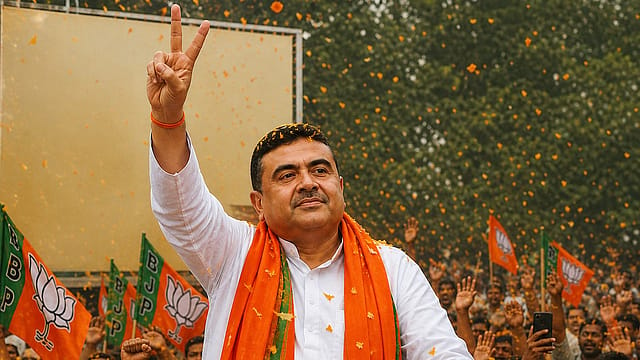
Following a decisive victory in the 2026 Assembly elections, Chief Minister Suvendu Adhikari moved quickly to stabilise governance by assigning responsibilities to key ministers. The allocation was finalised during a meeting with MLAs, signalling an effort to establish administrative clarity early in the BJP-led government’s tenure.
Who are the key ministers and what portfolios have they received?
Senior BJP leader Dilip Ghosh has been given charge of Rural Development, Panchayats and Animal Resources, placing him at the centre of grassroots governance and rural policy execution. Ashok Kirtania will head the Food Department, a critical portfolio in a state where public distribution systems are politically significant.
Khudiram Tudu has been assigned the Backward Class Welfare Department, reflecting the party’s outreach to marginalised communities. Meanwhile, Agnimitra Paul will oversee the Women and Child Welfare Department, making her the only woman minister in the Cabinet. Nisith Pramanik has been entrusted with North Bengal Development along with Sports and Youth Welfare.
What is the political significance of these new ministers?
The ministers represent a mix of organisational strength, social outreach, and electoral influence. Dilip Ghosh, a former state BJP president and ex-MP, played a key role in building the party’s base in West Bengal. Agnimitra Paul’s elevation highlights the party’s attempt to strengthen its appeal among women voters, while leaders like Khudiram Tudu and Ashok Kirtania reflect outreach to tribal and Matua communities respectively.

Open Minds 2026
26 Jun 2026 - Vol 05 | Issue 26
The power of ideas and arguments in 50 portraits
Nisith Pramanik’s inclusion is also notable given his political journey from the Trinamool Congress to the BJP and his earlier stint as a Union Minister of State.
How decisive was the BJP’s electoral victory?
The 2026 Assembly elections marked a major political shift in West Bengal. The BJP secured 206 seats in the 294-member House, while the Trinamool Congress was reduced to 80 seats. This mandate gave the new government significant room to implement its agenda without coalition pressures.
At its first Cabinet meeting, the government announced the rollout of major central schemes, including Ayushman Bharat and PM Jan Arogya Yojana, along with initiatives such as PM SHRI, Vishwakarma Scheme, Beti Bachao Beti Padhao and Ujjwala Yojana.
The administration also signalled governance reforms, including alignment with the Bharatiya Nyaya Sanhita, increasing the government job age limit by five years, and greater participation of IAS officers in central training programmes.
What has the Chief Minister said about governance priorities?
Chief Minister Suvendu Adhikari emphasised a focus on "good governance and transparency," while assuring that welfare schemes would continue with stricter verification to prevent misuse. He also underlined priorities such as border security and faster land allocation to the BSF.
What does this mean for West Bengal going forward?
The swift portfolio allocation and early policy announcements indicate an attempt to project administrative efficiency and alignment with central policies. With a strong mandate and a clearly defined Cabinet structure, the government is positioning itself to deliver on development, welfare, and governance reforms in the state.
(With inputs from ANI)