Weathering the Trump Storm Together
THE RECENT two-day visit of German Chancellor Friedrich Merz to India coincided with the 75th anniversary of India-German diplomatic relations. It also came at a time of great instability in trade relations between countries the world over thanks to aggressive protectionist measures announced by US President Donald Trump as a cure-all solution to economic problems back home. These American trade wars with allies and rivals alike, used also as bargaining chips to negotiate deals, have led to heightened uncertainty worldwide.
As Chancellor Merz and Prime Minister Modi flew kites at the famous Kite Festival of Ahmedabad, which draws crowds and visitors from around the world, both were also occupied with calibrating ways to meet new challenges. For the German, this was a part of a concerted effort along with other European Union (EU) member states to ride out the bad times due to growing trade tensions with the US and security concerns and related difficulties following the Russian invasion of Ukraine. Merz’s visit, ahead of a summit between India and EU, was intended to boost exports and attract a skilled force.
For Modi, the occasion was crucial, again, because of the tariff wars the US is waging on the country. Which was why New Delhi saw the meeting as momentous as it committed to expanding bilateral trade between India and Germany, which has now crossed $51 billion, and also signalled that India—driven by national security interests—was keen on purchasing defence equipment from Germany.
India has repeatedly maintained, even in the face of attacks by the US as regards oil purchase from Russia, that its trade and security ties are not governed by any ideology. For his part, the prime minister said at a press meet during the German chancellor’s visit that the growing cooperation in defence and security is a symbol of mutual trust and shared vision. “I express my heartfelt gratitude to Chancellor Merz for simplifying the processes related to defence trade,” he said, adding that the two countries will also work on a roadmap to enhance cooperation between defence industries, which will open up new opportunities for co-development and co-production.
Modi was also gung-ho about the technology cooperation between India and Germany which he said has grown stronger year after year. “In the field of renewable energy, India and Germany share similar priorities. To strengthen cooperation in this area, we have decided to establish the India-Germany Centre of Excellence. It will serve as a shared platform for knowledge, technology, and innovation,” he said, emphasising, “We’re jointly advancing new projects in areas such as climate, energy, urban development, and urban mobility. The new mega project in green hydrogen involving companies from both countries will prove to be a game-changer for the energy of the future.”
During his visit, Merz, who visited Ahmedabad and Bengaluru, announced visa-free transit for Indian citizens. Which means Indian passport holders will no longer need a Schengen airport transit visa, also known as a Type A Schengen visa, when transiting through its international hubs such as Frankfurt and Munich on their way to a non-Schengen destination.
While the two sides focused on areas such as defence, trade, semiconductors and mobility, the easing of visa curbs, Modi acknowledged in his speech, was intended to enhance people-to-people ties. Existing collaborations galore: the German Maritime Museum is helping with the National Maritime Heritage Complex being built at Lothal in Gujarat, and the Gujarat Ayurveda University has tied up with Germany in the field of traditional medicine. More importantly, there are plans for German conglomerate Thyssenkrupp to build six submarines for the Indian Navy. While no announcement was made during this visit, Thyssenkrupp is known to be working with Mazagon Dock Shipbuilders in a $9.3 billion deal.
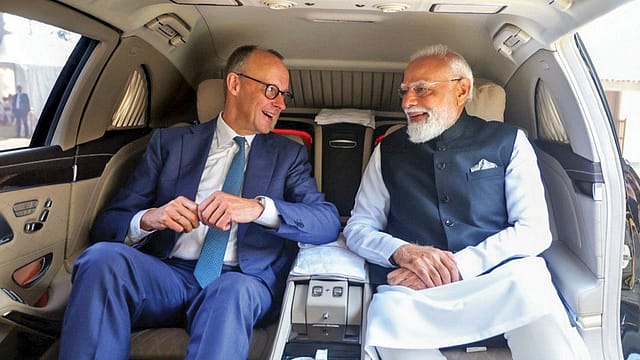
The meeting between Modi and Merz was warm. Breaking protocol, the two leaders took a car ride together in Ahmedabad as we had seen Modi do earlier with Russian President Vladimir Putin on the sidelines of the SCO Summit in China apart from a few other countries.
Notably, in both the countries, the stress has been on deepening ties with new markets and new regions to overcome the troubles caused by a great power that is seemingly more inward-looking than it used to be in the past.
Meanwhile, analysts who have watched German trade and defence ties for long say that opportunities for India and Germany across trade segments are huge, and both can benefit from transfer of technology and skilled manpower. But they also see cultural problems coming in the way, since India is traditionally committed to maintaining a non-aligned foreign policy posture, cooperating with a wide range of partners, including Russia, while Germany is anchored firmly in NATO and EU strategic frameworks. These differing orientations can produce friction or limit deeper security cooperation. Germany has historically been cautious in calibrating its security engagement with India due to ties with Russia, especially in defence procurement and energy. On the other hand, India’s reliance on Russian military equipment complicates deeper defence industrial cooperation with NATO partners.
But then, nothing is permanent and things do change. To tide over such hurdles, the two countries can fast-track trade agreements; promote innovation partnerships in clean tech, digital infrastructure and supply chains; enhance defence dialogues with clearer mechanisms for technology transfer; and ease mobility barriers.
It’s a well-known fact that Germany needs diversification away from China and India wants to move up global value chains. German firms, to start with, increasingly see India as a China-plus-one manufacturing and sourcing hub, especially in automobiles, machinery, chemicals and electronics. In this context, German Mittelstand firms partnering with Indian MSMEs for long-term production rather than short-term outsourcing is one way forward.
Not surprisingly, Prime Minister Modi is upbeat about the prospects of India and Germany forging ahead in bilateral trade. He pointed out in his speech that more than 2,000 German companies have been present in India for a long time. Both leaders talked about strengthening cooperation in the field of renewable energy. “We’re jointly advancing new projects in areas such as climate, energy, urban development, and urban mobility. The new mega project in green hydrogen involving companies from both countries will prove to be a game-changer for the energy of the future,” Modi said, adding that, “India and Germany are working together to build secure, trusted and resilient supply chains,” referring to MoUs signed in these areas. The two countries also announced plans in higher education.
Now, apart from institutional links in the sphere of culture and the arts, German scholars like Max Müller and others have historically studied ancient Indian texts, the Vedas, Upanishads and also Buddhism. Modi highlighted this fact during his speech at the start of Merz’s India tour. “India and Germany share deep and historic people-to-people ties. The works of Rabindranath Tagore gave a new perspective to Germany’s intellectual world. Swami Vivekananda’s philosophy inspired not only Germany but all of Europe. And Madame Cama, by unfurling India’s flag of freedom in Germany for the first time, gave global recognition to our aspirations for independence. Today, we are giving this historic connection the form of a modern partnership.”
There are obstacles to overcome even as new opportunities emerge.