Water for Peace
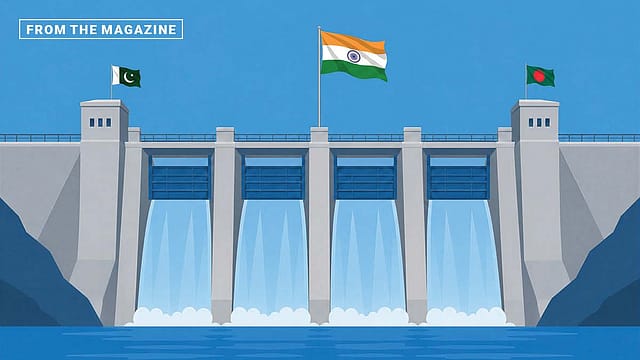
India has long maintained that its water largesse to Pakistan cannot be repaid with blood, with Prime Minister Narendra Modi declaring that “blood and water cannot flow together. ”Pakistan has effectively waged a proxy war against India through terrorism, with the 2008 Mumbai massacre, in particular, still etched in India’s national memory.
But after Pakistan-backed Islamist gunmen, two of whom were identified as Pakistani nationals, slaughtered 25 Hindu tourists in a brutal attack at a resort in Jammu & Kashmir, New Delhi placed the Indus Waters Treaty (IWT) “in abeyance”. Concluded in 1960, the IWT has remained the world’s most generous water-sharing treaty, giving downstream Pakistan access to over 80 per cent of the Indus Basin waters.
Unlike the IWT, which has an indefinite duration, India’s Ganges Water-Sharing Treaty with Bangladesh contains a 30-year term and is set to expire soon on December 12, unless it is renewed or extended with potential amendments. The Ganges treaty was signed when Sheikh Hasina was Bangladesh’s prime minister. But Bangladesh has now emerged as a South Asian flashpoint amid rising Islamist extremism and intensifying repression of minorities and political opponents, with the current regime in Dhaka anything but India-friendly.
The Ganges treaty guarantees Bangladesh specific cross-border flows in the critical five-month dry season, setting a new principle in international water relations.
Asia’s water resources are largely transnational, making inter-country cooperation essential. Yet the vast majority of the 57 transnational river basins in continental Asia have no water-sharing treaty or other cooperative mechanism. Indeed, the only treaties in Asia that establish specific formulas for sharing cross-border river flows are those between India and its two downstream neighbours, Pakistan and Bangladesh.
India, meanwhile, confronts its own deepening water crisis, driven by a growing mismatch between demand and supply. With surface-water resources under increasing pressure, the crisis has fuelled massive groundwater extraction, further aggravated by climate-induced hydrological unpredictability.
India’s dilemma today over the Indus and Ganges treaties is rooted partly in how these pacts were structured. The two treaties conferred rights without establishing corresponding responsibilities for downstream Pakistan and Bangladesh. Yet rights should come with duties. The treaty obligations fall mainly on India, explaining why Pakistan and Bangladesh have focused overwhelmingly on their treaty-accorded rights.
Pakistan has repeatedly invoked the IWT’s dispute-settlement provisions to constrain India’s ability to address chronic electricity shortages in J&K through modest run-of-the-river hydropower projects. Yet Pakistan itself has generated grassroots opposition in its restive northern regions by pursuing huge storage dams, including the 4,500-megawatt Diamer-Bhasha Dam and the planned 7,000 MW Bunji Dam. Many of Pakistan’s major dam projects are concentrated in Gilgit-Baltistan, where Islamabad has faced persistent local opposition to its rule.
Both the Indus and Ganges treaties were negotiated on the premise that water was essentially a technical resource whose sharing could be agreed upon independently of broader inter-country relations. India’s water munificence, in other words, was not linked to downstream states’ obligations to uphold basic norms of good-neighbourly conduct.
It is past time for India to move towards a new water-sharing framework with its neighbours—one that links the sharing of this vital resource to peace and verifiable good behaviour. Any bilateral treaty must respect the sovereignty, security and well-being of both parties.
This would be a necessary recalibration, recognising that the old framework is no longer tenable. Peace cannot flow from terrorism, hatred or overtly hostile policies.
Instead, upstream India should regard water as an instrument of peace and security. The Israel-Jordan treaty provides a useful template for linking water sharing to a broader peace and security framework.
India’s very different strategic circumstances require adaptation, not replication. Israel’s control over critical water resources in its sub-region was shaped by its capture of the Golan Heights and the West Bank during the 1967 Six-Day War. China’s seizure of the then-autonomous Tibet in 1950-51, by contrast, transformed the communist giant into Asia’s pre-eminent hydro-hegemon.
India has multiple riparian identities. It is the uppermost riparian on rivers originating on its territory, such as the Chenab and Jhelum, which flow into Pakistan, and the Teesta, which drains into northern Bangladesh. India is a mid-riparian on the Brahmaputra and the main Indus stream. While the Ganges originates on the Indian side of the Himalayas, India is the lowermost riparian on tributaries that begin in Tibet and flow southward through Nepal before entering the Ganges basin in northern India, including the Karnali, Gandak and Kosi (Arun). Few other Asian states occupy all three positions—as upper, middle and lower riparians.
While Pakistan is heavily dependent on the Indus, Bangladesh’s largest source of freshwater is not the Ganges but the Brahmaputra. Yet Dhaka has remained silent on China’s ongoing construction of an unprecedented super-dam near the Indian border that would likely have major implications for the quality and quantity of downstream flows.
China’s upstream dominance and its growing dam-building footprint on the Brahmaputra and other transboundary rivers make it imperative for India to adapt the Israel-Jordan model to South Asian realities. A water-for-peace framework could transform water from an unconditional entitlement into a strategic instrument of cooperation—one in which water sharing is accompanied by reciprocal obligations on security, good-neighbourly conduct and protection of mutual interests.
Such a framework would offer India something the existing treaties do not: A way to make water sharing part of a broader peace architecture, potentially addressing concerns over cross-border terrorism from Pakistan and unconventional security threats emanating from Bangladesh.
By insisting that water sharing is accompanied by reciprocal obligations, India would be updating and strengthening international water norms for an era in which water security, climate stress and national security are increasingly intertwined.
The Israel-Jordan Model
By making water sharing an integral part of a broader peace and security architecture, the Israel-Jordan water arrangement is one of the most distinctive examples of water diplomacy in the world. The arrangement is embedded directly in the 1994 Treaty of Peace between Israel and Jordan, principally through Article 6 and Annex II.
The architecture transforms water from a potential source of conflict into an instrument of mutual security and interdependence. The treaty establishes legally binding allocations from the Jordan River and its Yarmouk tributary, as well as from groundwater resources. It specifies seasonal quantities and operational rules and creates a Joint Water Committee (JWC) to oversee implementation, water transfers, data exchange and compliance.
In this way, water sharing between the two countries has been institutionalised within the peace process itself.
The arrangement also creates a direct connection between water security and broader security commitments. Article 4 of the peace treaty obligates both countries to prevent hostile acts, terrorism and military activity against the other from their territory.
It was the absence of any such mutual obligation in the Indus treaty that emboldened Pakistan, just five years after the IWT came into force, to launch the 1965 war in an abortive attempt to grab India’s J&K.
In the Israel-Jordan treaty, water provisions are implanted inside a comprehensive peace agreement. Article 30 integrates the water-centred Annex II into the whole treaty, and compliance with water allocations is directly tied to Article 4 (Security and Non-Hostility).

Incorporating reciprocal rights and responsibilities, the treaty offers mutual benefits. One of the world’s most water-stressed countries, Jordan relies heavily on water supplied from or through Israel. Israel significantly benefits from a stable and cooperative eastern border and sustained security coordination in the Jordan Valley.
Because Israel controls important upstream diversion and transfer infrastructure, reliable water deliveries require continuing technical cooperation, communication and security coordination between the two governments. Annex II requires each side to protect water systems in its territory that supply the other from pollution, damage, contamination or unauthorised withdrawals. Protecting water infrastructure and maintaining the conditions for reliable water transfers are, therefore, part of the broader obligations of peace.
While Annex II established a baseline obligation for Israel to supply Jordan with about 50 million cubic metres in total water transfers, bilateral protocols and commercial agreements brokered through the JWC subsequently expanded transfers to address severe droughts in Jordan.
In a 2021 deal, Israel agreed to sell Jordan an additional 50 million cubic metres of desalinated water annually on top of the original 50 million cubic metres guaranteed under the 1994 treaty. But those supplementary allotments were scrapped in late 2025 after Jordan declined to make diplomatic concessions sought by Israel. This shows that the treaty, while establishing a durable legal foundation, has left room for the parties to adapt water cooperation to changing climatic and political circumstances.
The water allocations in the Israel-Jordan treaty are indeed very small compared with what India agreed to reserve for Pakistan under the Indus pact. Yet what makes the Israel-Jordan arrangement particularly significant is not the volume of water exchanged but its uniqueness in integrating water into a larger bargain for peace. In this framework, water is simultaneously a humanitarian necessity, an economic resource, a security interest and a mechanism for continued political engagement.
The arrangement establishes reciprocal dependence: Jordan has a vital interest in maintaining peace and reliable water cooperation, while Israel has a major stake in preserving the stable security environment and bilateral mechanisms that make that cooperation possible.
This model should hold special appeal in other water-stressed regions such as South Asia, where rivers cross political borders and water scarcity exacerbates existing inter-country tensions. By embedding water-sharing obligations within broader peace and security arrangements, co-riparian states could make predictable water access, infrastructure protection, data sharing, drought management and emergency water release components of a larger political bargain.
By adapting this model to local hydrology, power asymmetries and upstream realities, other states sharing transnational rivers could create a parallel architecture of reciprocal dependence. That would create legally defined water entitlements, joint institutions, continuous hydrological-data exchange, water-infrastructure protection, mechanisms for adjusting allocations during droughts and, above all, a political understanding that water security and regional security are inseparable.
A Peace Dividend
India needs a new way to think about water, especially because it has major water-sharing treaties with both its downstream neighbours. This is in stark contrast to China, which has not concluded a single water-sharing treaty with any of the multiple countries that depend on cross-border flows of rivers originating on the Tibetan Plateau.
The region’s great rivers cross some of the world’s most contentious and militarised borders. Climate change, for its part, is making water supplies increasingly unpredictable. Yet India’s treaties governing the rivers flowing to Pakistan and Bangladesh have treated water as a purely technical resource, insulated from the political, security and economic issues that bedevil bilateral relations.
Learning from the experience of Israel and Jordan, India should seek to make water sharing an instrument of peace to help advance regional security and its own well-being. The Israel-Jordan Peace Treaty offers a unique model because it explicitly links water-cooperation commitments to the maintenance of peace and security. Water sharing is thus not a standalone technical agreement but part of a larger political bargain.
The traditional approach in South Asia has been to insulate water from politics. The Indus treaty, for example, was focused on the separation and allocation of river systems, while the Ganges treaty centred on dry-season flows. But the experience over the years has underscored the limits of trying to separate hydrology from geopolitics. When one side flouts even international norms of good-neighbourly conduct, even technically constructed water arrangements come under increasing strain.
Treaties are built on mutual trust and good faith—or, as the IWT’s preamble puts it: “a spirit of goodwill and friendship.” India steadfastly adhered to the IWT for 65 years, even when it meant compromising development in its water-stressed regions, even though Pakistan persistently acted in bad faith, including employing the treaty’s dispute-resolution mechanisms to drag India repeatedly into international arbitration over minor engineering differences so as to obstruct India’s ability to use its rightful share of water.
Rather than pretending that security and water are unrelated, a treaty should make them mutually reinforcing. That way water becomes an incentive for maintaining peace, and peace in turn becomes the basis for maintaining reliable water supplies.
That approach has particular relevance to India’s relationships with Pakistan and Bangladesh, although the two cases require very different adaptations.
With Pakistan, the most difficult issue is its asymmetric warfare in the form of cross-border terrorism, including helping state-trained Islamist gunmen sneak into Indian territory. Pakistan’s army chief, Asim Munir, has been fanning the flames of conflict by exhorting Pakistanis to teach their children that Muslims are “different from Hindus in every possible way.”
International law supports the view that when a treaty’s fundamental conditions collapse, or one party persistently violates them, the other party has the right to suspend or withdraw from the pact. For now, India has stopped short of formally walking away from the IWT, instead placing the treaty “in abeyance”, a term undefined in international law.
New Delhi has thus retained strategic ambiguity, while sending a resolute message that water sharing can no longer be unconditional. It has not sought to disrupt current cross-border water flows. Yet Pakistan has responded by suspending all bilateral agreements, including the 1972 Simla Agreement, which governs peaceful dispute resolution.
India should propose a new water-sharing treaty with Pakistan that explicitly links water quotas to maintenance of peace. India could offer Pakistan the lion’s share of the Indus-system waters but embed the arrangements in a bilateral peace pact.
The new treaty would incorporate a form of “water for security” reciprocity: India’s continued commitment to predictable transboundary water flows would be linked to verifiable Pakistani commitments to prevent hostile activity, including sponsorship of cross-border terrorism.
Far from using “water as a weapon” against Pakistan, India would be doing the opposite—helping to shape “water for peace”. The objective of the new treaty would be to allow both sides to acquire something vital. Pakistan would receive predictable and transparent water flows. And India would get binding security assurances and mechanisms for verifying compliance.
The Israel-Jordan precedent is instructive precisely because its water provisions exist within an integrated treaty framework in which security, non-hostility, infrastructure protection and water cooperation are mutually connected. That means a material breach of fundamental treaty obligations is likely to have consequences for treaty performance under international law.
For India and Pakistan, that principle could be translated into a carefully calibrated arrangement, with New Delhi guaranteeing transboundary baseline flows. While protecting core downstream entitlements, the new treaty would also offer supplemental water arrangements or water-trading mechanisms tied to measurable security commitments.
This would create a major incentive for Pakistan to preserve the treaty-based framework. The objective would be to transform water from an arena of confrontation into a resource for subcontinental stability.
The Bangladesh case offers an equally important but somewhat different opportunity. India and Bangladesh share the Ganges, the Brahmaputra and smaller rivers. Their water relationship increasingly intersects with climate change, flooding, groundwater depletion, coastal vulnerability and salinity intrusion.
Low-lying Bangladesh has too much water during the annual summer monsoon, when large parts of the deltaic country become inundated, and too little in the dry season. Bangladesh’s annual per capita water availability averages 8,252 cubic metres—or more than five times that of India—but the major inter-seasonal variations and the limited storage capacity of its aquifers make its water situation challenging.
As the Ganges Treaty approaches its December expiration, this creates an opportunity for India to update the architecture of bilateral water cooperation. This opportunity has been reinforced by Dhaka’s stated preference for negotiating a new agreement or heavily revised framework rather than a simple extension. Ahead of formal bilateral talks, Bangladesh has established a dedicated expert and technical panel to draft its proposal points, including greater dry-season flows.
India could offer a broader water-for-cooperation bargain. In return for a mutual commitment in the new treaty to prevent hostile actions, acts of terrorism or third-party military deployments from their territory against the other party and to maintain active bilateral security cooperation, India could guarantee dry-season flows combined with flood-data sharing, joint river-basin management, transit and connectivity arrangements, coastal-erosion management and investment in water infrastructure.
The water-sharing terms would be legally contingent on an overarching peace agreement.
The strategic rationale for such a treaty is particularly weighty given the porous Indo-Bangladesh border and Indian concerns over the potential spillover of growing Islamist violence in Bangladesh. Instead of letting water, security and political differences become mutually reinforcing, India could seek to build institutionalised interdependence that gives Dhaka a strong interest in stable, friendly and cooperative ties with New Delhi.
India and Bangladesh already have the bilateral Joint Rivers Commission (JRC), through which the Ganges Treaty’s renewal or revision is to be discussed. Like the Israeli-Jordanian JWC, the JRC provides a permanent institutional mechanism beneath the political level that allows technical officials to deal with seasonal water transfers, hydrological data, operational disputes and other issues. Yet, with Prime Minister Tarique Rahman’s government stoking anti-India sentiment, Dhaka might be loath to accept peace and security commitments in exchange for a broader water package with India.
Still, a separate water-for-peace treaty with Bangladesh and Pakistan would open the possibility of establishing permanent bilateral river-basin commissions with authority to jointly monitor flows, exchange real-time hydrological data, manage droughts and floods, and adjust operational arrangements as hydrological conditions change.
Such cooperation would be particularly valuable as climate change makes historical averages of river flows increasingly unreliable. Fixed water allocations or the reservation of flows of major tributaries almost entirely for the downstream country may with time become less workable due to erratic monsoons, retreating glaciers and more frequent extreme weather events. The Israel-Jordan treaty offers a useful principle that the legal framework should be durable but the operational arrangements within it must be adaptable.
However, there is an important difference between the two regions, which explains why the Israel-Jordan model cannot simply be transplanted to South Asia.
Israel controls the upstream water resources and infrastructure, whereas India is downstream of China on the Brahmaputra, Indus and Sutlej systems as well as the Ganges tributaries. India cannot guarantee fixed cross-border flows over the long run when an upstream power can alter river flows, timing or sediment regimes through mega-projects. Therefore, joint mechanisms may be needed for adjusting water allocations according to verified upstream inflows from Tibet.
The new India-Bangladesh and India-Pakistan treaties should extend beyond surface water to groundwater resources, which, like rivers, cross political borders. The groundwater dimension has long been neglected on the subcontinent. Excessive pumping in the upstream and downstream basins of transboundary rivers is depleting shared aquifers and causing groundwater contamination and salinity. Such problems cannot be solved by allocating river waters alone.
A South Asian water-for-peace framework should thus include joint groundwater monitoring, extraction limits, shared aquifer mapping and real-time data exchange. In divided Punjab, India and Pakistan could cooperate on monitoring transboundary aquifers and preventing unsustainable extraction. In the Bengal Basin, India and Bangladesh could combine surface-water cooperation with groundwater management, arsenic mitigation and protection against saltwater intrusion into coastal areas.
More fundamentally, water security could become part of regional security architecture only if Indian policymakers recognise the central importance of linking predictable water-sharing to verifiable good-neighbourly conduct. To make water security and national security mutually reinforcing, New Delhi must view a bilateral water agreement not just as a resource-sharing mechanism but also as a security instrument and a stake in upholding peace.
India must bring water and geopolitics into the same bargain, thus making each a reason to preserve the other. If Pakistan and Bangladesh want India to do what China refuses—agree to long-term sharing of river waters—they must at least accept verifiable commitments to peace under new water-for-peace arrangements. In fact, China’s refusal to enter water-sharing arrangements with any downstream neighbour makes a reciprocal model for India both more necessary and more challenging.
Water should become a peace dividend, not an unconditional entitlement. Instead of water being a casualty of geopolitical conflict, it must become a key incentive that sustains peace itself, transforming shared water vulnerability into shared strategic interest.
(Brahma Chellaney is a geostrategist and the author of two award-winning books on water: Water, Peace, and War and Water: Asia’s New Battleground)