‘Vande Mataram’: The Politics of the Missing Stanzas
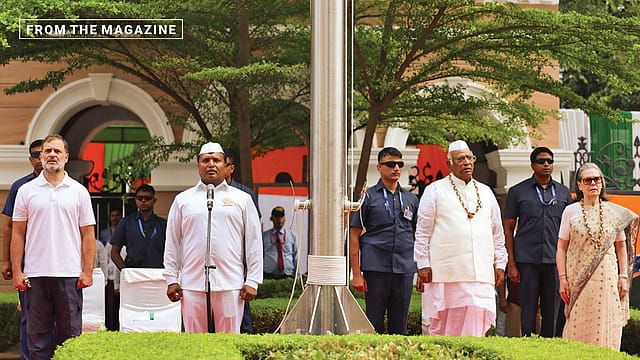
THERE COULD HAVE been better ways than how Congress handled the Sonia Gandhi episode of gesturing to stop the full rendition of ‘Vande Mataram’ at its headquarters on August 15. While initially the party said she had been asking for a chair for Mallikarjun Kharge, it later reaffirmed that she wanted to stick to the Congress tradition of singing only the first two stanzas.
The controversy was unnecessary. When perhaps for the first time Rahul Gandhi seems to have a better political strategy than Narendra Modi, to get dragged onto ground chosen by the Bharatiya Janata Party (BJP) looks like a zero-sum game. Because of this mishandling, Congress once again fell into the old BJP trap of setting the agenda for the day while the former ended up expending all its energy in explaining itself.
This is hardly a way the country’s main opposition party, which has a long list of issues to raise, should spend precious time in arguing whether a national song should be sung in six or two stanzas. BJP does not need Congress to agree with its agenda; it only needs it to take up the BJP agenda. Once that happens, BJP has already won half the argument. It is also one of many ways in which Congress has ceded nationalist ground to BJP. It could have done something much simpler. It could have just owned the song and sent a message that it was not going to litigate patriotism stanza by stanza.
In 1937, there was a context to Congress’ decision to stick to the first two stanzas. The party’s Working Committee (CWC) felt that the later stanzas alluded to religious imagery that other religious groups might not be comfortable with. Hence it was decided that only the first two stanzas would be sung at national gatherings.
But almost a century later, why should this still be a test of secularism? Does singing a poem containing references to a Hindu goddess make a citizen less secular? After all, how does the evocation of Goddess Durga in a country which is referred to as “Bharat Mata” amount to an act of religious allegiance?
Nobody should be compelled to sing the song. A secular republic should not force its citizens—Hindu or Muslim—to perform songs where religious motifs may be present. But that is an entirely different argument from saying that performing it somehow places the singer outside the secular tradition. This gatekeeping is also patronising since it assumes Indian Muslims are so fragile that the sheer mention of a Hindu goddess in a national song excludes them. It also makes our version of secularism so timid that it requires certain portions of our cultural inheritance to be amputated before we can claim to be inclusive.
Congress has to understand that it cannot defeat BJP and the allied Hindu right by becoming the anxious label-maker of what might be interpreted as insufficiently secular; it can only win by refusing to surrender Indian culture to it.
Like all figures of history, Bankim Chandra Chattopadhyay was also a product of his time. He had his own theories about many things, some of which would not go down well with people who think they are the only ones who sing all six stanzas. His most famous work, Anandamath, from which ‘Vande Mataram’ is taken, does not end the way many “nationalists” would like to believe. The novel concludes, as scholars have noted, by way of projecting English tyranny as divine dispensation. As one of his translators, Alo Shome, notes, Bankim Chandra accepted as a “wise assessment” an article written on Anandamath by a reader, published in the Liberal in April 1882. The writer says: “The English are profound masters of physical knowledge, and they are apt teachers too. Let us then make them kings. English education will give our men a knowledge of physical science, and this will enable them to grapple with the problems of their inner nature.” Does that make Bankim an “anti-national”? No, because Bankim was simply echoing the sentiment of the culture he grew up in which held that the British government in Bengal was a necessary evil.
But let us get back to the question of the “Hinduisation” of the later stanzas. At this point we must understand why Bankim felt the need to turn the country into a mother in the first place, which gradually turned into the goddess form. Scholars have maintained that in his essay ‘Bharat Kalanka’ Bankim says that his understanding of the nation had been shaped by his English education. This takes us into the heart of the making of Indian nationalism. Bankim did not discover the nation waiting as a seed inside Hindu civilisation; he understood the modern idea of the nation from the West and then gave that idea an Indian cultural form—a form that also tends to be Hindu. Rather than remaining an abstract concept, nation became a mother and its territory a body. In front of the mother the citizen becomes a child, thus forming an emotional relationship. As Meenakshi Mukherjee notes in one of her essays: “This was the first time the Hindu concept of the mother goddess with its connotation of Shakti was linked with the idea of the country as a political unit, and the symbolic power of this fusion was far-reaching.”
The nation that European political thought had described in terms of territory, citizenship, sovereignty and political community could be made to feel, in Bankim’s imagination, like a mother whom one worshipped and for whom one was prepared to sacrifice one’s life. It is in this transformation that the genius of ‘Vande Mataram’ lies. In Anandamath, the sanyasis who have renounced their families are asked to think of the country as their only mother. Ordinary attachments to family and home are replaced by a larger and much more powerful attachment to this Mother. The nation then is not merely a geographical territory of equal citizens; it turns into something sacred. This is why it is intellectually futile to even attempt to resolve the current controversy simply by separating the first two stanzas from the later ones; it is futile because the conceptual movement involved in making the nation sacred does not all of a sudden begin in these verses. It is already embedded in the architecture of the book the song is drawn from. It is just that the later imagery makes it explicit.
The irony of it is vital to remember. A song now being asked to take on its shoulders the burden of Hindu nationalism is in many ways a product of modernity. It must be seen like that: a 19th-century writer’s attempt to construct a national consciousness using ideas that he encountered in Western thought—Bankim Chandra’s essays are interspersed with his attention to Europe.
The left and liberal response is obsessed with reducing the matter to the proposition that the later stanzas are Hindu and therefore unsuitable for public nationalist use. The fallacy of that argument may appeal to some who see it is a matter of constitutional principle, but that is tragic because it leaves the history of the song untouched. It concedes the symbolic territory instead of contesting its interpretation. As Shome notes, at the end of his novel Rajsingha, Bankim Chandra writes: “Being a Hindu does not indicate being good. Being a Muslim does not indicate being bad. Both the communities contain good and bad elements.”
It is this lack of interpretation that has led Congress to repeatedly allowing itself to get pushed on to wrong grounds. Instead of seeking reason in why a 19th-century writer invented the idea of the Motherland in this form, it gets drawn into the stupidity of stopping a national song midway—a song that inspired generations of freedom fighters and revolutionaries. It only reacts to the right’s demand that patriotism be demonstrated through ritual. Instead of saying that a nation is large enough to contain disagreement over an old song, it allows the disagreement itself to become a referendum on patriotism.
The right wins this argument before the debate has even begun because it gets to decide what the argument is about. Through this unfortunate exercise, ‘Vande Mataram’ is then transformed from a fascinating and contradictory work of nationalist imagination into a loyalty test.