Trump’s Tariffs: Trading In A Multiverse
ON FEBRUARY 20 US PRESIDENT Donald Trump signed a proclamation imposing a temporary duty to address what he said was a fundamental international payments problem and to also rebalance trade relations. A day later Trump doubled down on his tariffs plan and said he would raise the global tariff rate to 15 per cent. When the fresh tariffs became effective on February 24, the rate was 10 per cent and, despite US officials asserting that a hike to 15 per cent was not ruled out, that is where things stand. And while this rate left some US trade pacts like the one with the UK unchanged, it brought down reciprocal tariffs on India from 25 per cent. After the February 2 breakthrough in India-US talks, the rate was to be reduced to 18 per cent and even if Trump raises tariffs to 15 per cent, Indian exporters would still be at an advantage compared to just a month ago.
Despite Trump’s fulminations over the US Supreme Court striking down the tariffs he had set for other nations and the “trafficking tariffs” directed against Mexico, Canada, and China for not doing enough to prevent the flow of synthetic opioid fentanyl into the US, the ruling could not have come as a complete surprise. Trump had spoken about alternatives to pursue tariffs if the court did not uphold his actions and the speed with which the fresh rates were announced suggests the homework had been done. What seemed to have sent him into a rage was the purported “defection” of two conservative justices he had appointed in his first term and whom he accused of betraying the constitution. The concurrence of justices Neil Gorsuch and Amy Barrett in the majority 6-3 ruling gave it a bipartisan colour amounting to a sweeping rejection of Trump’s tariffs. It prevented the president from driving home a polarising argument that he might have hoped for.
Yet, as the Trump administration fine tunes strategies to retain tariffs by using options such as Section 301 of the 1974 trade act that provides for investigation and penalisation of unfair foreign trade practices or Section 232 of a 1962 law to levy sectoral tariffs, the bottom line for India is the current level of tariff, even though it remains vulnerable to fresh impositions. With the policy flux in the US far from settled, a scheduled visit of an Indian delegation to the US for a discussion on the text of a bilateral trade agreement was deferred following mutual consultations. Although there have been suggestions that the US Supreme Court ruling provides an opportunity to tweak the agreement under consideration to improve the terms for India, the view in New Delhi is to let things be. For one, there is no clarity on the full implications of the ruling, over how it could impact Trump’s policies going forward, or the nature of legal challenges fresh tariffs may face. The February 2 phone conversation between Prime Minister Narendra Modi and Trump marked a crucial thaw in India-US ties on a rocky path since Operation Sindoor. Stabilising and repairing the relationship remains as important as the trade deal as it was the political turbulence in the relationship that led to Trump slapping a 25 per cent penalty tariff on India for importing Russian oil he said was aiding Vladimir Putin’s war effort. The political differences led to a downturn in ties rather than issues relating to tariffs. As Trump will almost certainly view anything that seems like a bid to take advantage of the court ruling with disfavour, “strategic patience” is India’s carefully considered choice.
The road bump in Trump’s tariff path does, however, offer an opportunity for India to build trade and security relations with nations equally wary of how US policies will play out. Aware that disengagement from the US—economically or politically—is not an option, indeed even undesirable, several nations, even those on a relatively good footing with Trump, are looking to “de-risk” ties with America.
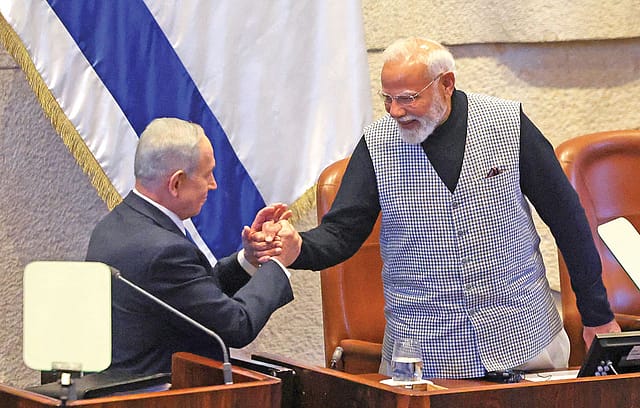
The search for reliable supply chains and trade deals to stabilise economies and protect mutually recognised security needs are drawing nations towards one another and India is at the centre of this churn. On Wednesday, February 25, Modi touched down in Israel on his second visit to the Jewish state after 2017, with a consequential agenda on the table. It did not include a security “alliance” as was speculated after Israeli Prime Minister Benjamin Netanyahu’s comments ahead of the visit, but a deep discussion on the Middle East and big-power competition was very much on the cards. India-Israel cooperation in joint research calls (co-funded initiatives), AI and cybersecurity is growing and discussions on a free trade agreement (FTA) are gaining momentum. A November 2023 framework has facilitated safe and legal employment of Indians and since then 20,000 workers have arrived in Israel. The two nations are members of I2U2 (India, Israel, UAE, and US), a cooperative framework that focuses on food security, renewable energy, trade, and infrastructure. Apart from the optics of the excellent Modi-Netanyahu relationship, the visit’s substantive outcomes serve to bind economic and political interests even more closely.

A few months ago, despite the exit of Justin Trudeau from office, India-Canada ties were more about reducing the bitter aftertaste caused by the former prime minister’s indulgence of Khalistanis. The upward swing in relations has been rapid with the Canadian minister for energy and natural resources, Tim Hodgson, participating in the India Energy Week held in January in Goa and a joint statement with Minister of Petroleum and Natural Gas Hardeep Singh Puri noted the importance of partnering in commercial and investment opportunities. “If Canada wants to be an energy superpower, we need to be trading our energy and natural resources with one of the world’s largest energy markets: India,” Hodgson posted on X. Canadian Prime Minister Mark Carney is due to visit India after Modi’s return from Israel and discussions for a trade treaty are on the anvil alongside defence, trade, and technology. The turnaround in relations since Modi met Carney in Canada in June last year during a G7 summit is remarkable given that allegations of an Indian state-sponsored plot behind the murder of Khalistani leader Hardeep Singh Nijjar caused such bitterness that it led to mutual expulsion of top diplomats in October 2024. The two sides have quickly and expediently found a way to get around what appeared to be insurmountable differences to chart a new path in bilateral ties. The newfound warmth, the Indian side hopes, will lead to a better understanding of the threat Khalistani and criminal gangs operating out of Canada pose to India and the leeway this provides to Pakistan’s Inter-Services Intelligence (ISI). The criminal organisations are closely linked to illegal migration, drugs and arms smuggling and are as much a concern for Canada as they are to India. The mood in Canada over liberal immigration policies has turned, as is the case in many Western nations, resulting in more traction for India’s arguments.
The recently concluded AI summit in New Delhi saw a reaffirmation of India’s relations with France with French President Emmanuel Macron confirming plans for a final assembly line for the production of Rafale jets in India while Modi’s talks with Brazilian President Lula da Silva resulted in a Memorandum of Understanding outlining India and Brazil cooperation across the full “value chain” for exploration, mining and processing of critical minerals. Modi’s visits to Argentina and Brazil in July 2025 had a strong element of rare earths collaboration and supply given China’s control of major mineral deposits. The opportunity for multipolarity coincides with a desire for a space outside big-power competition and there is little doubt that Trump’s destabilising effect on international relations spurred the European Union (EU) to close free trade negotiations with India. The swift conclusion after lingering talks was in turn a likely factor in the US-India trade talks reaching a denouement as it might have become apparent to the Trump establishment that India was neither being isolated on the world stage nor was its economy sinking. Rather, India’s resilience and ability to bear the pain of a cumulative 50 per cent tariff proved to be a strong point in ongoing trade negotiations. The US relationship is without doubt most consequential in India’s quest for developed-nation status and the Modi government is understandably keen to avoid any repeat of the 2025 tensions.
This is not an easy task given Trump’s desire to show every negotiation and deal as a victory for him and a submission for the other. The assertion that India has agreed to stop buying Russian oil, the absence of such a reference in the February 6 India- US joint statement announcing that a framework for an interim agreement on “reciprocal and mutually beneficial trade” had been reached, and the careful Indian references that national interest would guide energy purchases all reflect the tensions at play. Seasoned commentators feel India-US relations will need more time to get back on track while the domestic discussion in America over tariffs, the hardening of attitudes on migration and hostility towards Indian Americans is not a passing phase but a social and political inflexion point. These developments can be a prompt to seek improved relations with China too after the prolonged military standoff in eastern Ladakh. Though progress after the disengagement at friction points along the Line of Actual Control (LAC) in October 2024 has been halting, there are moves to lift some restrictions on Chinese investments and businesses while China has eased export controls. Direct flights between India and China were restored in October 2025 after the Kailash Mansarovar Yatra was restarted in June. Distrust and suspicion are not easy to dispel but China is Pakistan’s main backer and restoring a positive momentum in relations has benefits. It will not undo China’s diplomatic, economic and military support to Pakistan but an improved India-China equation could create room for creative diplomacy to advance mutual interests. A more durable peace on the borders will be a worthwhile objective, one that China might tacitly acknowledge.
RELATIONS WITH PAKISTAN remain a more tangled affair. Reports suggest that even back channels have dried up and there has been no significant bilateral interaction since the February 14, 2019 terrorist attack on a Central Reserve Police Force (CRPF) detachment killed 40 personnel. There is a view that a ‘no talks’ policy is limiting and some interaction is better than none over a period of time as it might reduce the possibility of misunderstanding. If terrorism is the bane, let that be the centre point of discussion. The issue is fraught as engagement has not prevented the Pakistan military from planning and masterminding terrorist incidents in India while civilian governments alternate between boastful claims and hostile behaviour. As things stand, there are no indications of a thaw in India-Pakistan affairs. Rather, there is a concerted build-up of military capabilities intended to inflict punishment on Pakistan in the event of the terror threshold being breached as was the case in Pahalgam on April 22 last year. India’s lack of interest in the Indus Waters Treaty and its efforts to disentangle itself from its commitments point in the same direction, as does the opening to the Taliban regime in Afghanistan.
India’s quest to balance relations in its neighbourhood, with developed nations, the Global South and the US is a near-constant tightrope walk requiring agility and even the ability to take a tumble or two in the midst of geopolitical uncertainties. Yet its credentials as a stable democracy, policy continuity, a growing economy, and strong leadership are advantages that are being recognised and can provide better opportunities to Indian citizens.