Trigger Warnings: The Return of the Underworld
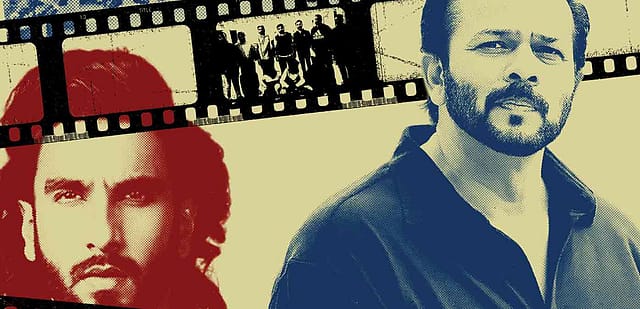
FILMMAKER ROHIT SHETTY’S house is hard to miss. Located adjacent to a prominent intersection in Juhu— the Hasya Kalakar Mehmood Chowk, named after the Bollywood comedian Mehmood Ali—and just a stone’s throw away from Juhu Beach, the building is 10 storeys high. On the wall beside the gate, the name ‘Shetty Towers’ is emblazoned in a large and stylised golden font. And if you were to crane your neck over the gate, you may even occasionally spot his many sports cars under the cover of a blue sheet with his name’s initials in gold.
Early on February 1, 2026, about 15 minutes or so before the clock struck 1AM, at least one scooter appeared on the road close to the house. We do not know exactly how many people were on that two-wheeler, but what is certain is there was at least one individual in his early 20s named Deepak Chandra. Chandra, who had arrived in the city only a few days ago from a remote location in Uttar Pradesh (UP), was carrying a gun. He had recced this spot a few times before, but his nerves had so got to him just before this moment that he had had to down a couple of drinks. The scooter reached close to Shetty Towers, and Chandra fired at least four rounds at the house.
Chandra and the others involved then dispersed and regrouped in Kalyan at a house where they had been staying, and from then on, took trains away from the city. We know all this from the police, who arrested Chandra and six others from multiples locations across UP and Haryana recently. They had already arrested five individuals right after the shooting, and are said to be currently searching for another four.
Even before the first arrests were made, what is by now a familiar approach of the Lawrence Bishnoi gang played out. Members of the gang uploaded a post on social media owning up to the attack, took a screenshot of this post, and after deleting the original post, circulated the image of this post on social media. This way the police would not be able to trace the URL link of the original post. “Also, screenshots don’t have much value evidence-wise and one can deny they had posted something like this,” a police official said.

The Bishnoi gang, which has been terrorising different parts of the country, has carried out threats and attacks on some Bollywood-connected personalities in the recent past, but this latest attack on Shetty’s house has created a new stir. Only a day had passed when a new threat coupled with the demand for money was sent, this time to Bollywood star Ranveer Singh, a threat that would be repeated a few days later. According to some reports, the police believe a few other Bollywood personalities have also received similar extortion calls, but none of them have come forward to file a complaint. And then there was the email Salman Khan’s brother-in-law, Ayush Sharma, received with such a threat, but the police think that one was probably a hoax. For much of the 90s, the film industry was in the tight grip of the underworld. Although many of the gangsters had relocated to safe havens abroad, they would terrorise the industry with their local networks in the city. They would routinely extort money from the biggest stars and producers, finance many of the movies, demand the foreign distribution rights of films, have a say in aspects like casting, get stars to drop everything to perform at their events, and every now and then, when someone wouldn’t toe the line, carry out a cold-blooded execution. Could these latest threats by the Bishnoi gang be the first signals of the return of that era? Could this gang which until recently was mostly a North Indian phenomenon, now with the growth of its profile after the execution of Punjabi singer Sidhu Moosewala in 2022 and threats against Salman Khan, be trying to fill the void left behind by the gangsters of yore?
“We are seeing this sort of activity after a long time in the city,” says a former senior police official, who was involved in tackling the threat of organised crime on Bollywood in the late 1990s. “But I don’t think we can compare it to that level just yet. The Bishnoi gang doesn’t really appear to have a local network. Look at all the people being arrested and those taking responsibility on social media. Almost all of them are outsiders. They are getting brazen, and we should be worried, but I don’t think they are there yet,” he says.
There is however a discernible change in the nature of the threats being issued by Bishnoi gang members. Khan was being threatened over his alleged involvement in the poaching of a black buck, an animal that the Bishnoi community reveres; politician Baba Siddique was killed because of his closeness to Khan and alleged links to the gangster Dawood Ibrahim; and the houses and establishments owned by figures like Kapil Sharma and AP Dhillon were targeted because they associated with Khan; there have been no such allusions to some higher motivation in the long diatribes the gang members have posted on social media or sent in voice notes against Shetty and Singh. Instead there are warnings to not “interfere in their work” (in the message posted after the firing at Shetty’s house) and threats like “we will deal with you in a way that your next seven generations will remember” (to Singh), and extended warnings to the entire Hindi film industry, which wasn’t the case before. Singh’s case, in fact, looks like a straightforward extortion call, where the individual reportedly asked for money. Some parts of these messages to Singh even refer to commitments that weren’t kept (“Baat se mukarne ki saza kya hoti hai tujhe bataenge” or “We will show you the punishment for going back on one’s word”) and threats to fall in line, which appear to suggest the gang members have been calling these Bollywood personalities for a while, even though the police haven’t revealed much about this yet. Could it be that having built enough street cred as the new big gangsters in the city, they are now indulging in straightforward extortion calls to celebrities?
“Bollywood celebrities are a soft target,” says D Sivanandhan, former Mumbai Police Commissioner, who during his tenure as the joint chief of police of the crime branch in the 90s and early 2000s, played an instrumental role in curbing the activities of the underworld. “They always have to be out in the public. And they can easily be threatened for money.” Sivanandhan points out that while the gang may not appear to have much of a local organisation in the city, but the threat they pose is very real. “They aren’t in a nascent stage. If they are going around shooting at homes and brazenly threatening individuals, they have gone beyond that stage,” he says.
There are many differences in the way these gangsters and those from the past operated. The Bishnoi gang’s use of first-time shooters, many reportedly recruited from social media, owning up to attacks on social media, and use of Voice over IP (VoIP) calls and communication platforms like Signal instead of phone calls, which cannot be traced, have added a new digital twist. The gangsters of the 1990s relied mostly upon established shooters in their gangs, many with records at the local police station, although Sivanandhan points out that many gangsters at some point or the other also relied on amateur shooters. But it is probably Abu Salem, arguably the gangster who mostly threatened the industry in the 90s, who bears the most similarity to the Bishnoi gang’s method of using amateurs for shooters. Journalist S Hussain Zaidi writes in his book My Name Is Abu Salem that the gangster came up with the then unconventional idea of recruiting novices after the police killed many of the sharpshooters of his gang in encounters. “Salem got in touch with his cousins and relatives back home in Sarai Mir [in UP] and asked them to look for boys who were unemployed, keen on travelling to Mumbai, hungry to earn a decent wage without working too hard and had the guts to do anything that was asked of them… Suddenly, Salem had a surfeit of boys willing to pull the trigger at his command. The police were baffled by these new entrants into the killing business. These youths had no previous record, no roots in Mumbai, came from nowhere and vanished into thin air after the killing. Never mind the shooters, the police could not even locate the middlemen or any other links to the killing,” he writes in this book.
MN SINGH, A FORMER Mumbai Police Commissioner who saw much of the gang violence in the city up close, has somewhat complicated feelings about the threats the film industry faced from gangsters. He points to the time when a top filmmaker came to his office seeking for help, because a gangster was forcing him to hand over the foreign rights of his new film. “He was being threatened. And it got so out of hand, with so many filmmakers and producers getting such calls that at one point they went in a big group to the chief minister asking for his help to end this issue,” he says. “But the thing is the industry was itself also to blame for how things had gotten to that stage.”
Movies, he points out, were routinely financed by gangsters, and many filmmakers and producers had connections with the underworld. The connections between these two industries ran deep. Casting decisions were influenced, disputes like those involving the release of two films on the same day would be taken to Dubai for Dawood Ibrahim to adjudicate upon, and sometimes gangsters were tapped into to have a rival in the film industry taken out, as it reportedly occurred when the music mogul Gulshan Kumar was murdered, allegedly at the behest of music composer Nadeem Saifi.
Refusing the gangster however brought with it very real consequences. Former Mumbai police commissioner Rakesh Maria writes in his memoir Let Me Say It Now how the refusal to cast a Pakistani actress Anita Ayub as the heroine in a film featuring actors Mithun Chakraborty, Vinod Khanna and Raj Babbar led to the murder of the producer Javed Riaz Siddiqui. “His crime was that he wanted to dump Anita Ayub from the film and asked for the signing amount of one lakh rupees to be returned... On 7 June 1994, Javed Siddiqui was shot dead in broad daylight on a busy street in full view of his hapless wife.”
Influencing casting decisions to favour actors and actresses close to the gangsters was a routine occurrence. The most famous of these was the story of a small-time actress, Monica Bedi, whose career graph saw an upswing once she got into a relationship with Salem. Despite having no connections in the industry or any extraordinary talent on screen, she was signed on for a number of films opposite some of the leading male stars. In Zaidi’s book on Salem, he recounts an episode about the film, Jodi No. 1, directed by David Dhawan and headlined by then top actors like Sanjay Dutt, Govinda and Twinkle Khanna. Dutt, despite having the bigger role compared to Govinda, was believed to have been aghast at being paired with Bedi. “He protested that if Govinda could get a top star like Twinkle, how come he was asked to work with a B-grade starlet like Monica Bedi? He considered quitting the movie, but one phone call made him change his mind. Sanjay was told in no uncertain terms that he had no option but to work with Monica and he was expected to be respectful to her—so much so that he was not even to hold her too firmly during the romantic scenes… The result was that throughout the movie, Sanjay and Monica did not so much as gaze at each other lovingly, let alone display any physical chemistry. Sanjay was no longer working with Monica the actress; he was working with Monica, his bhabhi,” he writes.
Recalling that period today, Singh worries about the spread of this new gang into the city. He believes that Mumbai police have the capability of tackling this new issue, but he thinks it will be challenging nonetheless. “For more than two decades, this issue had been weeded out,” he says. “But now things seem to be changing again.”