Travelogue: Footprints in the Salt
MORE THAN 20 years ago I was in the Sahara Desert. I ventured out on foot, alone, until I could no longer see signs of humanity, just horizon and dunes. I wasn’t lost, but very isolated, more than I ever felt. Fear and exhilaration grew as I breathed in the dry air. Something overcame me. I was compelled to turn, one by one, toward the four cardinal directions. Each seemed to have something to tell me. All four explained how within each of us, we can find the tendencies some associate with the idea of North, South, East and West.
I understood, in that anguishing and elating moment of freedom, that these inclinations—the proportion in which we feel northern, southern, eastern or western—can shift within us, just as the three gunas of the Bhagavad Gita: sattva, rajas, tamas, which we could see as harmony, dynamism and inertia; or, again, light, agitation and darkness.
When I found myself alone, in the Moroccan Sahara, at the beginning of the millennium, before I’d even read the Bhagavad Gita, I became aware that being centred consists precisely in understanding the impulses toward north, south, east and west, what they might represent, and that it’s possible to seek balance toward the centre of the compass.
In that moment, I experienced a mystical foreboding of what it means to move toward equilibrium, harmony and light, while trying to transcend passion, ignorance, excessive dynamism, mellow inertia, agitation or darkness. The desert whispered this epiphany.
Carl Gustav Jung’s The Red Book (Liber Novus) explained it concisely: “My soul leads me into the desert, into the desert of my own self.” He was describing what happened to me south of that oasis town of Erfoud, belonging to the Ait Atta Berber tribe, when I didn’t yet have language for it. The cardinal directions weren’t only geographical. They were the four corners of a fractured self, calling to be recognised, seeking shape.

The Desert Fathers, those early Christian hermits, ascetics and monks who lived mainly in the Scetes desert of Roman-occupied Egypt knew this. The desert does not erase the self—it reorganises it. It forces integration where there was only fragmentation. What I felt, there, that day at the centre of my own compass, is that it dries away the confusion. The soul, or psyche, once found in such desolation, can guide you back. Changed. Or mad.
If the Sahara was a door to the Absolute, the Rann of Kutch was a window into the Void. In this salty expanse, I encountered the duplicitous gift of vision: the mirage. What I felt there was the weight of nothingness. But also, perhaps, the place where God speaks loudest. Or where you can discover there is no one listening.
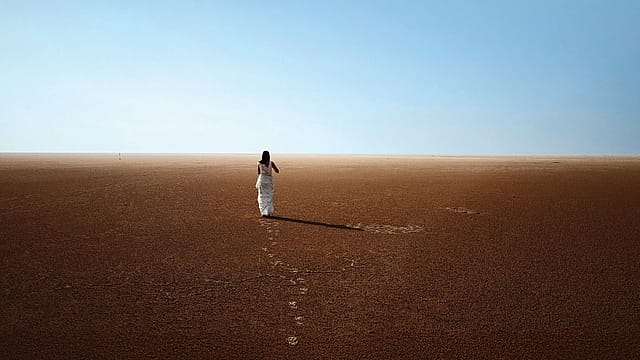
I was gazing at white footprints across a sprawl of arid, rust-coloured earth. Polyhedral crystals clinging to specks of sand. Waves of salt water painting the shores with whiteness. I followed dozens of tracks stretching toward the horizon, trying to discern whose they were, as they melted into the corroded infinite.
THE SAND THAT makes up beaches, dunes or salt deserts alike speaks to those who know how to listen. It reveals clues about the future that could save your life. A track in the sand is information—of a threat or of salvation. Learning how to read it can change everything.
This is how it works: freshness and dimensions declare the passage of a predator or a prey. It could save your life if you understand how to decipher the writing left by feet, paws, or, more importantly, reptilian scales. An exercise that teaches the wisdom of foresight. Beyond the dune lies dinner, water, a bandit or a feline predator refined by millennia of being faster than us, scrawny bipeds. Which one will it be, awaiting?
I followed the salty signs through rust-coloured sand compacted by centuries of non-time. Then I noticed a woman, turning her back to me, wrapped in a white and silver sari, walking away...she stopped, turned toward me, the wind sweeping her headscarf across her face, so that I couldn’t make out her features.
All around was a mosaic of sand transformed into cracked mud whose edges are covered in glittering salt. The weight of emptiness pressing against my ribs was stealing my breath. The desert can feel like desolation and revelation at the same time.
I was aware that the footprints of the woman I pursued across this expanse of earth—that seemed red but which, as the sun emerged into the firmament, became orange, then yellow, then salty shiny white—could vanish in a breath of wind. Time devours all it touches.
Was it a mirage? Steaming, stifling air dancing up into the blueness. Clouds turning into visions, ancient vessels sailing into the stratosphere. Seeing what is not there. Which could vanish at the first gust, as wind is the most distracted messenger there is.
Everything is built from tiny crystals, atoms of sand. What is recognisable unrecognisable. What is unknown, suddenly known.
I understood this as I realised the woman in my vision was none other than my own wife, walking ahead of me, lost in her thoughts. It was the desert, again, playing with me, or suggesting a track to read and interpret, in the Rann of Kutch.
There are still mysterious places in the world, like all the deserts I have visited— the variegated pools of colour filling the Danakil, the diamonds of green water etched in banks of salt that looks like ice, on the border between Ethiopia and Somalia, where I’ve watched nomads scrape the dirt for salt; in the expanse of Atacama, looking at the Andes of Chile and Peru; in the touristic and over-filmed Death Valley in the American West of many massacres; in the solemn Empty Quarter between Oman, Saudi Arabia and the United Arab Emirates; or, most of all, in the imposing Namib, where there are valleys, I believe, that no human being has ever set foot— the borderline of the unknowable.
The desert erases everything. It dismantles. Hones to bone. This is why mystics have always come here to seek: a God, a vision or themselves. The most famous of the Desert Fathers, Anthony the Great, spent decades amid Egyptian sands, tormented by demons, real or imagined—is there any difference between the two? Zarathustra returned from the dunes to announce that God was dead. And yet here we are, an era when religions thrive in the world. Was that a mirage, perhaps?
I once spent a few nights gazing into the rocky canyons of the Wadi Rum desert in Jordan, where Lawrence of Arabia threw his head back in laughter at the immense emptiness before him. He understood that the desert cares nothing for human ambition, always ready to obliterate it.
The desert does not bend. It watches you, indifferent. It offers itself as the backdrop against which to study the raw matter of existence. Without distractions. Without the chaos of organic or artificial details.
I walk. I seek. I listen. Here, the dichotomy between light and darkness is more uncompromising. This is perhaps why religions born in the deserts of West Asia, like the Sinai, leave less room for nuance, for the complexities of being. Religions born from the flow of rivers tend toward the labyrinthine; they find room for the varied shades of reality that a desert’s binary light simply burns away.
The limits of human understanding become more evident in this silence. Horror and liberation. Absurdity and profundity. Here old values come to die, purified by the brutality of elements, only to emerge transformed—if not deformed into an illusory Nietzschean Übermensch.
In Paul Bowles’ The Sheltering Sky, the Sahara doesn't kill you with heat—but with its clarity. Cormac McCarthy’s Blood Meridian presents the desert as a force that cares nothing for human morality; Judge Holden walks it knowing war is the only law the sand respects. Frank Herbert’s Fremen in Dune don’t conquer Arrakis—they read it, as for them survival means becoming attuned to patterns of scarcity most cannot perceive.
Across these narratives, a single skill emerges: the ability to read signs, to discern truth from illusion. The cowboys of American cinema stagger through bloody dust, half-dead, seeing salvation that may be the trap of a mirage. The wanderers of African cinema confront mirages both literal and existential. The Bedouin reads the wind. The salt miner understands salt. The herder navigates by hardly discernibly stars, winking in the dark. All possess the same knowledge the desert demands: not mysticism, but acute attention. Not revelation, but survival’s hard-won wisdom. The desert does not distinguish between the metaphysical seeker and the one seeking water. It presents the same test to both: learn to read or be erased.
ONCE YOU’VE LEARNED to read the desert, you can’t return to the world unchanged. You carry with you the knowledge of what the desert reveals—not as abstraction, but as weight.
The nomads of the Sahel are reading a different story now. They are reading the language of retreat. Where their ancestors read the sand for water, they now read the encroaching dunes—an obituary for their pasturelands.
In India, the Thar Desert also advances eastward year by year. Rajasthan’s herders watch it creep across what was a margin. The Aravalli Hills once held it back. Now their forests thin. Their rock exposed. Without them, the desert claims what it’s owed. The herder reads the same language as the Bedouin. But now both are reading backwards, deciphering a landscape that speaks only of retreat.
Creeping southward year by year, the aridity swallows pastureland, forces migrations that scatter families across borders. The knowledge these people possess—how to read the shifting edge between life and emptiness—was passed down through generations, through centuries. Now, it’s not enough.
Two billion people live in deserts worldwide. Most of them in poverty. Most dependent on what the desert gives: salt, minerals, sparse grazing, the few oases that water has not abandoned.
When I visited the troubled Danakil, between Eritrea and Somalia, escorted by armed guards aboard fast jeeps, I watched nomads scrape the earth, holding ancient tools with hands that have known no other work. Their grandparents scraped the same earth. Their children will, if the ground still yields the meagre white gold that seasons our plates. The knowledge they possess—the geometry of salt, the timing of extraction, the patience required—is indistinguishable from wisdom. But it’s a wisdom that increasingly speaks of scarcity, of thresholds crossed, of resources depleting. The desert provides livelihood only through relentless labour, and now that very labour grows more desperate, more exhausting, more uncertain.
Once you’ve stood in mystical silence and felt the desert teach you about balance and centredness, you cannot unsee what is happening in those same deserts now. Desertification—that creeping expansion of aridity—has become one of the world’s largest drivers of displacement. Wars have been born from drought. Migrations have reshaped continents. The Syrian conflict, the Sahel crisis, the slow emptying of the Aral Sea—all stories written in sand, in water’s absence.
They’re not distant stories. They’re written in the faces of people who have learned to read the desert not for enlightenment but for survival, and who are losing their ability to read what they need to survive.
This is why the desert matters beyond the personal journey, beyond mystical experience. Millions live inside the paradox: the desert is sacred ground and disappearing ground. It’s where the soul is found and where livelihoods are lost. It’s where prophets received visions and where families are forced to flee. The two cannot be separated.
In the traditions born from deserts there is a recurring revelation: the desert is not a punishment but a threshold. The Sufi poets understood it when they spoke of fanaa, the annihilation of the self in the presence of the Divine. Not death, but dissolution. The same word that describes what happens to salt when it dissolves into water, to footprints when wind erases them. The desert teaches fanaa without words.
We measure reality by what we can know. What we can touch, observe, record. But the deserts I have walked suggest a different proposition: that the unknowable might be as real as the known, simply inaccessible to our instruments.
BEFORE THE DUNES became a mirror for my own fragmentation, before Jung gave me language for what was happening, I understood only this: the desert is where the usual rules dissolve. Where time ceases to accumulate—or perhaps only reveals itself. Where the body becomes a liability and the mind reaches toward something it cannot name.
Stand long enough in such silence and you begin to suspect that deserts are not merely geological formations. They are openings. Spaces where the membrane between what is and what might be grows thin.
The ancients knew this. They did not see the desert as empty. They saw it as crowded with presences, visions, messages from what lies beyond the spectrum of existence. And they were right. Not because visions are unreal. But because in the desert, the boundary between vision and reality becomes indistinguishable.
A mirage is real—it bends light, it deceives the eye, it teaches something true about perception itself.
A vision is real—it rewires your understanding, it changes how you read the world.
The limits of the unknowable exist precisely there, in those deserted corners never seen by human eyes in Namibia. How different are they from the ones our satellites record on our solar system's planets? Since, up there, there used to be water, as there is here, perhaps in those deserted planets there was life as well. The great deserted spheres rotating in infinite space are what the Earth will become. And what it has been.
So I ask myself now, following my wife’s footprints across the Rann of Kutch, if deserts could be the closest physical analogue we possess to the state before birth and after death. Not as cosmic theory, but as lived experience. The baseline. The default condition. What the Earth remembers being, before life colonised it.
I return to the footprints. I return to the woman in the white and silver sari walking ahead, her features obscured by wind, neither fully present nor fully absent. She is the desert’s final lesson: the test of whether you can read correctly. Whether you can discern vision from reality, mirage from presence, the sacred from the desperate.
And the answer, standing here at the edge of the Rann of Kutch where the salt flats stretch toward infinity, is that it doesn’t matter. Both teach the same thing. Both lead to the same threshold.
The one thing the desert refuses to do is let you remain unchanged by what you see. It teaches you to read. And once you learn, you cannot unsee what you have discovered.