This Day That Year: 79 years ago, the Radcliffe Line was made public
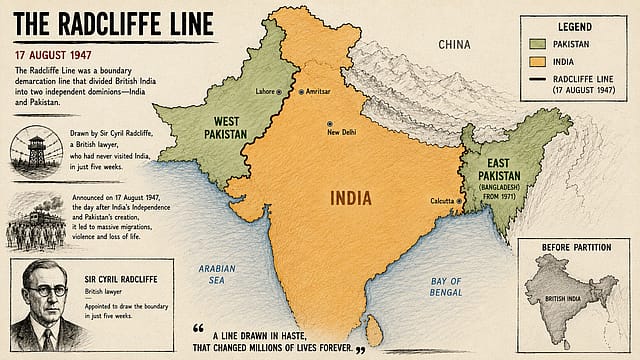
On August 17, 1947, the boundary awards dividing British India’s Punjab and Bengal provinces between India and Pakistan were made public. The line became known as the Radcliffe Line, after British lawyer Sir Cyril Radcliffe, who chaired both Boundary Commissions.
Radcliffe had never worked in India before and was given only a few weeks to complete the task. The Boundary Commissions were instructed to consider areas with contiguous Muslim and non-Muslim majorities, while also taking other factors into account. The proceedings involved public submissions and hearings, but the final decisions were made under intense time pressure.
The irony was that the borders were announced after independence. India became independent on August 15, while Pakistan’s independence was marked on August 14. Millions of people therefore celebrated the birth of the two countries without knowing precisely where the international boundary would fall.
The new border cut through villages, farmland, railway networks, irrigation systems and communities that had existed across the region for generations. Radcliffe himself acknowledged that the division would disrupt essential services, including canals, railways and electricity systems.

Losing Memory
16 Oct 2026 - Vol 05 | Issue 42
The making of a medical and social emergency
The consequences were enormous. An estimated 15 million or more people eventually crossed the new borders, with Hindus and Sikhs largely moving towards India and Muslims towards Pakistan. The migration was accompanied by widespread communal violence, particularly in Punjab, and resulted in a massive loss of life.
What was presented as a boundary between two new nations thus became much more than a line on a map. It reshaped families, communities, economies and the political geography of South Asia — consequences that continue to shape India and Pakistan nearly eight decades later.