The Truth about the Nellie Massacre
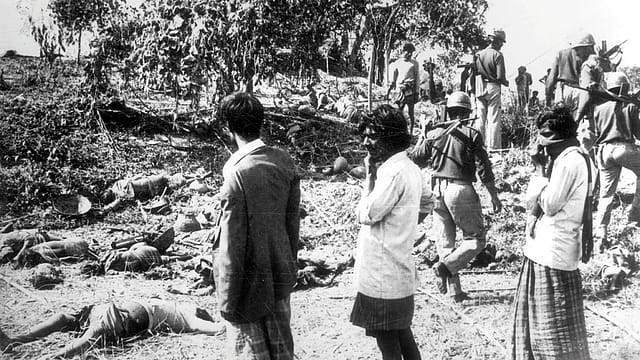
THE YEAR 1983 was Assam’s year of infamy. Parts of the state witnessed extraordinary violence in the wake of a long agitation against illegal immigrants from Bangladesh, leading to a demand for not holding Assembly elections that year. Thousands were killed and injured and largescale destruction of property took place. There was a time in 1983 when all authority, political and administrative, seemed to have vanished from Assam. Forty-two years later, the Assam government has tabled the reports of the two inquiry commissions that probed those incidents in the state Assembly.
The Tribhuvan Prasad Tewary Commission was the ‘official’ inquiry commission and the TU Mehta Commission was labelled the “Non-official Judicial Inquiry Commission”. The Tewary panel submitted its report in 1984 and the Mehta commission in 1985.
In his remarks prefacing the decision to table the two reports, Chief Minister Himanta Biswa Sarma said, “Placing a non-government report will be a first for the Assembly. We decided to table the Mehta Commission report on the 1983 election-related violence following a demand from the All Assam Students’ Union (AASU), which argued that the document should be made public so that people can get to know all sides.” He went on to add, “Both the Tewary Commission and Mehta Commission reports are valuable documents and the youths of Assam must know about them.” He described the Tewary panel’s report as “neutral”.

Global By Design
29 May 2026 - Vol 04 | Issue 73
Is the future of fashion Indian?
The chief minister was being polite. The reality is at odds with the Tewary Commission’s conclusions. Even a perfunctory reading of the 550-page report shows that. Despite the voluminous evidence it had at hand, the panel did not probe the nature and causes of violence in the manner expected of a commission of inquiry. If the violence that year was inexcusable, what the commission concluded was a travesty.
The Mehta Commission’s conclusions were sobering and closer to the truth. Its investigation of the reasons for violence was not constricted by politically convenient Terms of Reference (ToR). Its conclusion was that civil servants in Assam were “only” interested in holding elections on the command of the political leadership when the ground situation showed that holding elections was not possible in a peaceful manner. The two reports ought to be read together to understand the chain of events in 1983. One is the official version while the other version—politically unpalatable but more accurate—is closer to the truth.
This is hardly unusual given the history of commissions of inquiry in independent India. A majority of such commissions were devices tailored to pre-fabricated conclusions that suited the party in power. The chicanery began with the very ToR for such commissions: they were suitably truncated so that the real causes of trouble could never be explored. Then, the ‘right man’ or men would be appointed to man the commissions. Delays in submission of reports followed by their consignment to some administrative blackhole ended the story.

The Tewary Commission ticked all the boxes in this respect. Tribhuvan Prasad Tewary was a superannuated civil servant who went on to serve as the lieutenant governor of Pondicherry soon after he submitted his report in 1984. The ToR for the commission were to inquire into the circumstances leading to the disturbances in the state from January to April 1983; to examine the measures taken by the concerned authorities to anticipate, prevent and deal with these disturbances and find out if there was any deficiency on the part of authorities and individuals; and, finally, to suggest measures to prevent recurrence of such incidents in future. The commission was appointed in mid-July 1983, some five months after the worst phase of the violence—in mid-February in Nagaon district—had ended. It did not begin its actual task of taking statements after January 15, 1984, almost a year after those incidents. Its conclusions were, at best, ‘convenient’ for the then state government headed by Hiteswar Saikia.
To begin with, the government chose to appoint an IAS officer for the inquiry instead of a judge. The commission recorded that 3,023 people were killed in violent incidents and another 2,272 injured. More than 15,000 houses were burnt. Surely, such extensive violence and the very large number of people killed merited a judicial inquiry? But judicial inquiries can often be ‘wayward’ as judges try to get to the bottom of what they are tasked to investigate.
The historical record speaks for itself.
The worst bout of violence occurred in Nagaon district in the middle of February 1983. The infamous Nellie massacre in the district took place on February 18, in the middle of Assembly polls that were held between February 14 and 20. The state government and the political leadership of Congress, the party in power at the time, had ample warning that violence could break out in the district. From 1979 onwards, some four years before the election, the district had seen a string of violent incidents. These gathered pace in early 1983.
Much of this had to do with the huge influx of illegal immigrants from Bangladesh who had managed to enrol themselves on the electoral rolls of Assam. Most of these illegals were Muslims of Bangladeshi origin and the problem was especially acute in the middle Brahmaputra Valley districts of Darrang (on the northern bank of the Brahmaputra) and Nagaon (on the southern bank). It was in these districts and Lakhimpur that the bulk of the killings took place. Nagaon alone accounted for nearly 60 per cent (1,811 of the 3,023 recorded by the commission). Together, the three districts accounted for 60 per cent of the loss of life. It was here that the demand for cancelling elections was the strongest.
In his deposition to the commission, the deputy commissioner of Nagaon clearly stated that agitators were expected to “apply all methods and mostly violent ones to stop the election process.” Instead of heeding what civil servants knew, the government chose to press ahead with the elections almost as a show of strength.
At that time, Nagaon was a “geographically challenged” district with extensive tracts of marshland, forests and poorly connected villages. Road infrastructure was rudimentary. When coupled with political unrest, a recipe was ready for disaster. By his own admission, the then deputy commissioner classed 400 areas, villages and polling booths as “sensitive”. As a precaution, 1,046 arrests under the Code of Criminal Procedure were made and another 222 people were arrested under the National Security Act.
Anyone familiar with routine district administration in India knows that this is the stuff of bandobast during elections. But Nagaon was not—and is still not—an ordinary and ‘normal’ district. With police and paramilitary forces spread thin over a large district in the middle of an agitation spanning multiple years, the situation was like a powder keg.
The fuse finally ran out and the chain of explosions began on February 12, 1983—six days before the Nellie incident—in the Laharighat area of the district. A group of Assamese Hindus reached Gagalmari to burn down a bridge. They were stopped by “local immigrant Muslims”, the expression used by the Tewary Commission, and a clash ensued. Then began a sequence of action-reaction attacks by the two communities against each other, each round deteriorating the situation in a spiral that culminated in Nellie. The Tewary Commission’s chapter on events in Nagaon highlights these incidents in graphic detail. By the middle of February, law and order had broken down fully in Nagaon.
Yet, curiously, the report’s conclusions and recommendations were nothing more than a collection of stray observations. The commission fully exonerated the Nagaon district administration, stating, “The district administration had made adequate preparations for holding the elections and for maintaining law and order. The available resources were rationally deployed. There were lapses by certain public servants and the responsibility for such lapses is that of the individuals concerned.” If the commission’s report is to be believed, the blame for the events in Nellie and surrounding villages was the responsibility of one Bhadra Kanta Chetia, the officer-in-charge of the Jagiroad police station.
The Tewary Commission did not utter a word against the state government. Not that it was expected to. The ToRs had been suitably tailored to keep the political leadership and the state administration tucked away in a zone of safety. It is a monumental claim that a police inspector was responsible for one of independent India’s worst carnages but the state government was not. It was, and remains, a lie.
FROM A VANTAGE of nearly half-a-century, what can the Tewary Commission’s report tell us about contemporary Assam? If anything, the report points to a Sisyphus-like situation that has prevailed in the state for long. Laharighat, Dhing, Nellie, and scores of villages and hamlets in Morigaon district, the successor district hived off from the original Nagaon in 1989, continue to be sensitive zones until today. ‘Sensitive’ in this part of Assam is a code word for an area overrun by Bangladeshi Muslims.
The evictions in Darrang and other districts of the Middle Brahmaputra Valley and other areas under the current government are decried by intellectuals as “communal” but are welcomed by Assamese of all persuasion, cutting across caste, creed, region and—yes—even religion. Assamese Muslims have no love for their Bangladeshi co-religionists.
Historians, of course, have interpreted the events in Nellie as a clear sign of Assamese Hindus becoming ‘communal’. The reality is that the Assamese identity was, and still remains to an extent, an identity based on language. But that did not pass muster with historians. The charge of the Assamese being communal has been backdated in recent works—all the way back to Nellie. Perhaps historians ought to read the Tewary Commission’s report, whose pages describe in detail how Bangladeshi Muslim mobs rampaged Assamese villages in the days preceding the massacre in Nellie. But that is too uncomfortable a fact, one that sits uneasily with the neat reality of Assamese people being allegedly communal. The Bharatiya Janata Party’s (BJP) march to victory in 2016 was, in this reading, just a historical progression of ‘secularism’ being snuffed out in the state. Never mind the fact that from 1985 until 2025, Congress had ruled the state for almost 20 years.
The decade beginning 1983 could be labelled Assam’s lost decade. One can sketch an almost straight line in time from February 18, 1983 to Operation Bajrang in 1991 and then Operations Rhino, Blueprint, Cloudburst, and “secret killings”. It was only very recently that some districts in Assam ceased to attract the tag of ‘disturbed areas’ and the concomitant application of the Armed Forces Special Powers Act. It is, of course, a matter for historians to pin blame (and the Indian ones do that all the time) but the political ineptness and wilful unwillingness to address the issue of illegal immigrants from Bangladesh lies at the root of Assam’s troubles. It is unlikely that historians and politicians of a certain persuasion will admit that folly.
It is not surprising that Congress opposed the tabling of the two reports in the Assembly. Debabrata Saikia, leader of the Opposition in Assam, said, “I don’t understand why such an old report will be made public after almost 43 years of the incident. When the wounds have already healed, why scratch those now? Is it being done to instigate people ahead of the Assembly elections?” The sentiment is understandable. After all, the two reports do not cast Congress in a good light. It is also understandable that ‘civil society’ did not like the decision either.
The reports ought to be disseminated better and read even more widely. They offer an important snapshot of India’s recent history.