The Second Life of Sanskrit
THE SOUND IS OLDER THAN THE MEANING. BEFORE YOU can begin to understand a verse of the Bhagavatam, it is a shape in the air—long syllable, short syllable, an ancient metre. It has passed from mouth to mouth for as long as anyone has recited it. Prathosh AP, a 37-year-old assistant professor of machine learning at the Indian Institute of Science (IISc) in Bengaluru, decided to pass it through a machine, some 18,000 verses of it, chanted as a pandit would, in a voice that would never tire. During his ongoing semester break, Prathosh created and published a tool he called Vagdhenu, which can render any Sanskrit verse as parayana, the recitation that a pandit would give. “The response has been pleasant. I’ve got two million page hits worldwide. I didn’t expect this.” The model has been downloaded 1,500 times from the repository where he posted it. “People are not just using it for chanting,” he says, “but also for brushing up on conversational Sanskrit”. He is now trying to build a feedback system. “Imagine if you could chant a shloka to the tool and it could help you correct your mistakes.” Prathosh set out to preserve traditional chanting and has ended up, more or less by accident, building a tutor.
A small tribe of Sanskrit-speakers is tending the language the way you tend a fire you did not light, feeding it with what you have. Samashti Gubbi, called sanskritsparrow on Instagram, has perhaps the most daring approach. When she’s not rapping in Sanskrit, she curates Sunday mornings at Cubbon Park, in the centre of Bengaluru, where people gather to speak Sanskrit while they walk, play antakshari with subhasitas, count in the language and take a sun-kissed group photograph she inevitably tags suryachumbitam. She also runs a WhatsApp group with nearly a thousand members that goes by the name Kimbho— roughly meaning “what’s up”. The spoken-Sanskrit movement has, after all, always minted words for the world as it finds it— sanganakah for computer, duravani for telephone—and the new wave simply extends the mint to its own life, so that prajwalitam now does the work of lit.
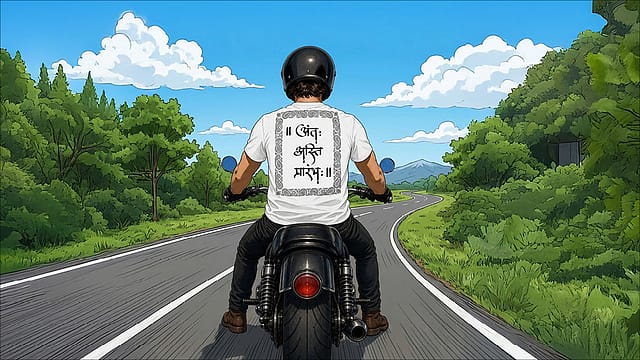
FOR GUBBI, WHAT began as a walk is now Kimbho Sanskrit Riders’ Club. The next one is scheduled for the second week of August. You ride a motorcycle from Bengaluru to a coffee estate in Kodagu and spend two nights speaking Sanskrit at the pitstops, during chai breaks, “while we eat, walk, ride, play games, sing”.
The language has even taken to the streets at a run. At the Tata Mumbai Marathon in January, 21 runners from Samskrita Bharati—the four-decade-old movement whose standing offer is that you can learn to communicate in Sanskrit in 10 days—ran under the theme of 150 years of Vande Mataram, while volunteers called out slogans in Sanskrit to the passing thousands.
When the Sanskrit Club at IIT Roorkee ran a free online spoken-Sanskrit course through 108 subhasitas—nuggets of wisdom—14,000 people registered, more than half of them in the 18-40 age band. For some who take up the language it is because of heritage, plain and warm; for others it is a Hindu-nationalist project. What is not in dispute is that it has gone from being seen as archaic to cool, and that it has shifted the fastest where the young already live: on their phones and in the unlikeliest classrooms.
Sanskrit’s public afterlife is much larger than the sum of those who claim it to be their native tongue. In the 2011 Census, only 24,821 Indians cited Sanskrit as their mother tongue, almost a statistical blip in a country of more than a billion. But the formal Sanskrit establishment is far from small. Central Sanskrit University alone lists 13 campuses, 260 affiliated institutions and 118 programmes. India promotes Sanskrit through three Central universities with grants for the promotion of Indian languages rising to `347.03 crore in 2025-26, and the Indian Knowledge Systems Division, set up under the Ministry of Education in 2020, now listing 91 centres, from IITs and Sanskrit universities to Ayurveda schools and cultural trusts. The new Sanskrit revival is at once a state project, an online market and, increasingly, a language trying to acquire users after having long possessed custodians.

There is, equally, a revival of interest in serious literary and philosophical works in Sanskrit, argues Radhavallabh Tripathi, poet, critic and one of India’s foremost Sanskrit scholars. “There is a renewed interest in modern Sanskrit writings,” he says, “and particularly in very serious writings, philosophical writings,” citing the example of Sachchidananda Mishra, member-secretary of the Indian Council of Philosophical Research, who has written a Sanskrit work on Carvaka philosophy, treating its epistemology, ontology and logic as a serious intellectual system. Tripathi has just translated into Hindi the early 20th-century scholar Ramavatar Sharma, whose work attempted to propose a seventh philosophical system after the six classical Vedic systems.
The second revival, he says, is literary. Sanskrit is not merely being translated into Indian languages; Indian languages are also being translated into Sanskrit. New journals, children’s books, poems, essays, radio plays, ghazals and even Dalit poetry in Sanskrit are appearing. Younger writers, many of them between 20 and 40, are translating Dalit and tribal poetry from Hindi, Gujarati, Manipuri and other languages into Sanskrit. He names Rushiraj Jani and others among a generation of writers expanding the range of the language. There are, he says, around a hundred Sanskrit periodicals and magazines still in circulation, with a readership of their own.
This, to Tripathi, is proof that Sanskrit has not frozen into antiquity. It has continued to borrow, absorb and remake itself. He gives the example of Harshdev Madhav, the Gujarati-Sanskrit poet who has written haiku, tanka and sijo in Sanskrit, bringing Japanese and Korean forms into the language.
In most modern Indian languages, the language of a century ago may already feel distant. But a serious student of Sanskrit can move from Kalidasa to a modern Sanskrit poet without the same rupture. Panini’s grammar, especially the Astadhyayi, allowed change without dismantling the structure of the language. This, he believes, explains the renewed global and Indian interest in Panini.
According to Tripathi, the problem of Sanskrit being narrowed to religion is a colonial inheritance. British Orientalists, he argues, created an image of Sanskrit as the language of ritual and one religious community, ignoring its vast Buddhist, Jain, Carvaka, scientific, theatrical, poetic and philosophical corpus. He gives the example of AB Keith, who wrote on Sanskrit literature and drama in the early 20th century while, Tripathi says, modern Sanskrit periodicals were publishing nationalist and anti-colonial writing. Such writing, he argues, was left out of the story. He is equally critical of present-day state of enthusiasm for Sanskrit when it amounts only to glorifying the past.
There is a useful parallel in the recent fortunes of Greek and Latin. In the West, the classical languages have acquired new fandoms through translation, publishing, pedagogy and the internet. Madeline Miller’s The Song of Achilles, published in 2011 and awarded the Orange Prize in 2012, found takers nearly a decade later through BookTok. By 2022, reports put its sales at more than two million copies. Emily Wilson’s Odyssey, published in 2017, was the first complete English translation of the poem by a woman, and her Iliad followed in 2023, turning Homeric translation into an unusually public literary argument about fidelity, violence and slavery. The trend has continued into the present. Penguin Classics’ 2025 volume The Penguin Book of Greek and Latin Lyric Verse brought Sappho, Horace, Catullus and their world into a large new anthology, while Laura Spinney’s Proto traced the prehistory of the Indo-European family to which Sanskrit, Greek and Latin all belong.
What has changed, then, is that while Greek and Latin have not suddenly become mass languages again, the old chain of custody—school, university, commentary, translation—has been joined by platforms, apps, recommendation engines and computational tools. A language need not be widely spoken to become newly visible, newly teachable and newly desired.
On October 26 last year, in the 127th instalment of Mann Ki Baat, Prime Minister Narendra Modi devoted a passage to Sanskrit’s afterlife on the phone. Sanskrit, he told the nation, had been “a language of communication” before the centuries of servitude and the neglect that outlasted Independence, and now the young were giving it back. He named them one by one, a strange roll-call for a head of government: Yash Salunke, whose short videos splice the language into Gen Z comedy; the anonymous humourist behind the Instagram channel Sanskrit Chhatroham; Gubbi, who “presents her Sanskrit songs in myriad ways”; Bhavesh Bhimnathani, who explains shlokas; and the sisters Kamala and Jahnavi. “Language is the carrier of the values and traditions of any civilisation,” Modi said. “Some young people are now fulfilling their duty towards Sanskrit as well.” Culture and social media, he concluded, had lent the language “a new life-breath”.
Harshdev Madhav, a Sahitya Akademi Award winning poet and writer, says Sanskrit may even be more popular the world over than many other Indian languages. “My Sanskrit works have been translated into 22 languages across the world but my Gujarati poems haven’t travelled much.” Thanks to modernising forces like Madhav, Sanskrit is adapting to the times, tackling subjects like corruption, modern history and feminism in ever-new literary forms. Madhav has just published science fiction in Sanskrit, adding to his impressive corpus of 180 books, including books on tantra, children’s literature, poetry, novels and stories. Hundreds of research papers have been written about his work. “We are reviving our language with new words and even new poetics,” he says, reciting an ironic couplet he wrote on Rajghat. “In the 20th century, 200 mahakavyas or epics were written in Sanskrit. In the past 20 years alone, there have been at least 400 major literary works in Sanskrit. No one has the patience to read epics anymore. And Sanskrit can produce amazing short literature. It’s a pity that only a very small part of contemporary literature finds its way into curricula.” That’s changing. One of his poems made it into the UGC curriculum and the Andhra Pradesh middle school curriculum includes some of his stories.
AS Prasad, of the Centre for Sanskrit Learning at IIT Bombay, says the centre began a spoken- Sanskrit outreach programme in Powai in 2022 with the ambition of Sahasramukhesu samskratam— Sanskrit in a thousand mouths. Prasad says there are now more than 1,500 people in Powai learning the language “not from a grammar-first approach but through spoken communication”. “We are building an ecosystem of Sanskrit speakers,” he says. The centre found, when it surveyed a nearby Kendriya Vidyalaya, that Sanskrit was the single most-hated subject in the school, and set out to reach the children with the spoken language, with games and songs, before the Class 6 curriculum could get to them and teach them to dread it.
The ecosystem Prasad talks about building is already thick. There are the tutors, dozens of them now across Preply and TeacherOn and Open Pathshala, teaching students in Israel, China, California and Gujarat, their motives sorting into a few clean streams: the yoga practitioners who hit a wall of untranslated terminology, the devout who want to chant the Gita with the vowels in the right places, the heritage-minded diaspora parents, and the programmers chasing the myth.
When Sunitha KN, 41, quit her guest lecturership at the Sree Sankaracharya University of Sanskrit in Kalady, Kerala, to teach online, it looked like a mistake at first. “When I joined Preply three years ago, there were barely any students. I taught five people in the first few months. Now I have dozens of students, many of them regulars. Some days, I teach for 12 hours.” Her roster is a portrait of who wants Sanskrit and why: a 20-something girl in Tamil Nadu whom she sits with an hour a day at 11AM over the Mahabharata; old men and women who want, at last, to know the meaning of the shlokas they have chanted their whole lives; a Chinese professor of Buddhism two years in, now bent on studying Kalidasa’s Kumarasambhava and the Yogasutra. “There is renewed interest from the young. Maybe it’s social media exposure. I am not sure.”
Deepshikha Kaushalya, 25, in Guwahati, has taught 67 students online since finishing a Master’s in Sanskrit and English, among them Indian children growing up in Europe, engineers at an AI company, a Swede who follows Sadhguru and a publisher who is now collaborating with her on a commentary on the Gita. “My parents want me to pursue a PhD but everyone has one these days. I value teaching experience and how fast I can level up when I teach.” Two or three times a week, Kaushalya sits down with Aishwarya Poddar, a 31-year-old from Delhi who helps out with her family’s international trade business during the day and writes fantasy fiction by night, to tackle the Mahabharata, verse by verse.
“We are about 180 shlokas into Adi Parva,” says Poddar, whose favourite word in Sanskrit is kautuhala—excitement. “I have always been fascinated by stories and the Mahabharata appealed to me even as a child. Then during the pandemic I read the whole KM Ganguly translation, and I read Bibek Debroy’s last year. It made me want to engage more deeply with the work in the original language,” says Poddar, adding that the experience has been “low key life-changing”, even if she is only months into it. From someone who was almost “phobic” about Sanskrit in school to spending about `5,000 a week to be able to read and understand shlokas, Poddar has come a long way.
IN MUMBAI, VG Shreehari has never been busier. His weekly online Gita classes are full; ad agencies write to him wanting Sanskrit copies; colleges keep asking him to pilot the language as a minor. He is a visiting professor at St Xavier’s, which three years ago made Sanskrit a two-credit course for its first- and second-years. His stated ambition is to “glamourise” Sanskrit. His YouTube channel, Sanskritshree, carries professionally produced Sanskrit versions of hit Hindi, Marathi and Telugu songs, some which have run into millions of views—the film songs act as the Trojan Horse, the language smuggled in on a tune the listener already loves. “The introduction of Indian Knowledge Systems and the growing amount of Sanskrit content,” he says, “could be the force multipliers for the next wave of learning.”
In Bengaluru, 50-year-old Prabhanjan Moleyar jokes that he left a job in Big Tech two years ago to escape late-night meetings, only to log into one without fail every Thursday at half past nine, a 90-minute free Sanskrit grammar class run out of worldsanskrit.net. “It’s highly interactive, and there are quite a few students, as well as instructors, from the US. Some instructors have a rule that we can only converse in Sanskrit.” He has circled back to the language all his life: first in school, then as an adult preparing for proficiency exams, then in the discovery that his grandfather had translated Sanskrit plays into Kannada. What drew him into the grammar course in 2024 is the thing that draws many coders to the language. “As someone who loves computer science and coding, I was interested in Panini’s Astadhyayi, which codifies all the grammar of the language in less than 4,000 sutras.”
Against this new fascination with Sanskrit’s capacity for precision sits an old condescension: the belief that Indian languages cannot quite carry the burden of modern thought. Earlier this year, Kunal Shah, the founder of CRED whom Meta appointed in June to lead WhatsApp, told an investor summit that most Indian languages lacked words for efficiency and productivity. The rebuttal, when it came, was itself a small proof of the revival’s confidence: Nityananda Misra, a self-taught Sanskrit scholar with a banking background, posted a three-minute video walking through the etymologies—daksata, ksamata, utpadakata—Sanskrit roots for exactly the qualities Shah said the languages lacked. Efficiency and productivity, Misra noted, were recent meanings even in English, industrial-age freight loaded onto older words.
In Mumbai, Aditi Madhavan teaches Sanskrit and sits on the Maharashtra textbook committee, and for years her mail has been full of teachers asking the same defeated question: how do you make Sanskrit fun. Now a second wave of them is asking: the teachers newly tasked with Indian Knowledge Systems (IKS)—the government’s push to fold classical science and philosophy into the curriculum—and finding they cannot do it without the language. “To be able to teach IKS properly you need a basic understanding of Sanskrit, but teachers aren’t being trained in it,” she says. The students, unexpectedly, are ahead of them. “There is growing interest among students. Increasingly, because of content on Instagram and YouTube, Sanskrit is seen as a cool language, and kids want to engage with it in their own way—through music, or by including shlokas in their projects.” Recently, a group of Botany students came to her wanting to enrich a project with Surapala’s Vrksayurveda, the 1,000-year-old Sanskrit science of trees. “Rhymes and simple conversation are now part of the early learning curriculum,” says Madhavan. Among the most popular rhymes out there are Aastha Ogale’s, whose 15-song album Sanskrit Nursery Rhymes has been on Spotify since 2020, teaching toddlers the language the way every language is actually first learned, through rhythm and repetition.
THOSE BOTANY STUDENTS are a small instance of a larger trend: the interest is moving past the language and into its classics. The Murty Classical Library of India has issued fresh bilingual editions of the Sanskrit canon—Kalidasa’s Raghuvamsa, Bharavi’s Kiratarjuniya, Magha’s Sisupalavadha. Online, the Gita, the Upanishads, Sanskrit poetics and classical literature have become course catalogues. Class Central alone lists 77 courses in Sanskrit literature.
Sanskrit is also finding a new life inside computers. In the machine-learning world, texts like the Ramayana, Mahabharata and the Puranas are being turned into datasets. This means that thousands of Sanskrit verses are being matched with their English translations so that computers can learn how the language works. One such dataset, Itihasa, pairs 93,000 Sanskrit shlokas from the Ramayana and Mahabharata with English translations. Another, the 2026 Mitrasamgraha corpus, is much larger. It brings together 391,548 Sanskrit-English pairs from a range of texts including ritual works, epics, philosophy, poetry and scientific writing.
Sampadananda Mishra, who in 2013 launched Divyavani, the world’s first 24-hour Sanskrit radio station, and single-handedly ran its programming for years, has helped design the Devabhasha curriculum now taught in hundreds of schools. Of late, he has watched his own podcast appearances find audiences he never expected. But he worries about what enthusiasm without craft can do to it. When Hindi film songs are translated into Sanskrit, he says, it is often done too literally, deaf to metre—and to demonstrate what is lost, he breaks, unprompted, into a Sanskrit rendering of Aaye ho meri zindagi mein tum bahaar banke in the pañcacamara metre, the syllables falling into a pattern the original never had. What troubles him more is how little credit goes to the slow work underneath the boom. “We don’t talk enough about the work that has gone into reviving manuscripts and interpreting them over the past 300 years,” he says. He has a stake in the work: the Vande Mataram Library, the volunteer translation project he helped float—conceived partly as an indigenous answer to the Murty Classical Library of India—aims, he says, to make hundreds of volumes of Sanskrit scripture and knowledge texts digitised and freely readable.
But the deeper question is not only how much of Sanskrit can be preserved. It is how anyone can be made to want it. It is the same wager Prasad is making in Powai and Gubbi is making at Cubbon Park and Prathosh, in his own way, is making with a machine: that you reach the language through delight or you do not reach it at all.