The Rise of Artistic Intelligence
WHEN 56-YEAR-OLD Charulatha Rajaram decided to hang up her lawyer’s coat to revive her 120-year-old family loom in Kanchipuram, Tamil Nadu, she hired artisans, restored the looms and procured thread and zari. “But I hit a roadblock with designs.” It wasn’t for lack of motifs—there were, in fact, too many familiar ones, from gopurams to paisleys, from the annapakshi to the peacock. “What if a sari could tell a story?” she says. “I want to train AI models on motifs associated with the land—motifs from Chola bronzes, frescoes, ponds and local flowers—as well as the history and the traditions of this region of Tamil Nadu. And I want to weave stories out of all this. For example, I can imagine a sari that’s a summer garden, with malli moggu (jasmine buds) and thazhampoo reku (spikes inspired by screw pine flowers) and the kuvalai (water lily) dancing on the edges of a pond. But AI can do much more: it can scan Sangam literature, find stories to bring alive on the loom, and help use the right motifs and colours,” says Rajaram, who lives in Coimbatore and aims to launch a bespoke Kanchipuram sari brand later this year. AI, in her plan, becomes the method by which the landscape of Kanchipuram, both physical and cultural, can be translated into the grammar of a sari without collapsing into the standard heritage lookbook. “A tool that can help you design a garment rooted in tradition, without it feeling predictable, can be a game changer.”
For decades, Indian craft has been described in the language of preservation. Heritage, tradition and continuity sound reverent but often mask inequality. Craft has been praised as cultural wealth while being priced as cheap labour. It has been framed as community knowledge while the economic and creative authority around it migrated to brands, exporters and urban designers. The artisan became a collective noun: the cluster, the sector, the handmade economy. In Odisha’s Balasore region, Rakesh Kumar Patra has lived through that shift. “My parents started working with sabai grass in 1996,” he says. “Traditionally, we made baskets.” While his parents’ products were competent, durable and locally meaningful, they couldn’t find a market and soon became outdated. “Designers and urban markets no longer had any use for them.” Patra, 34, has an MSc degree in Physics and an MA degree in Education and works for an NGO that provides sustenance to 500 women who work with sabai grass. A year ago, he came across Bare Craft, a Delhi-based consultancy that uses AI bots for onboarding and training artisans and builds digital resumes for them. “After six training sessions followed by assignments, I have learned to do story building around our products so that I can price them better. We have improved designs, added lifestyle items like laundry baskets and wall art, and we are rethinking our marketing strategy.” Bare Craft is hoping to use AI to match Patra with customers from across the world who are looking for sustainable and handmade lifestyle products.
Bare Craft has roped in AI for reorganising access to design, markets and legitimacy. The startup came into being during Covid, when the craft economy was at its most fragile, says its founder Himanshi Singh. Singh had been working with hundreds of artisans through a company that provided doorstep work in rug-making. She knew the intimacy of community work, the way you end up knowing not only artisans but their families. But when the pandemic arrived, the chain snapped. She tells the story of Kamla in Achirol, Rajasthan, who had trained in leather shoe-making for 25 years, and suddenly found herself out of work. Singh noticed two things happening at once. Artisans who had moved for work, into factories and production hubs, took a big hit as those spaces shut down. Meanwhile, small and medium craft ventures saw raw material costs shooting up, warehousing becoming expensive, and businesses that might have sustained artisan work shutting down. She thought about what she could really do to organise the craft economy. “We thought we could build an Uber for crafts.” If you are a small brand or an individual seller selling from home, the hardest part is finding the right artisans, sourcing raw materials and arriving at a design brief that won’t fail on the first order. Bare Craft tries to compress that friction. “You come to our platform and select the artisan and the raw material, depending on whether you just want one piece or mass production.” The company provides design consultation and creates a sample, no matter how small the quantity. A lean team with just five employees, it relies on chatbots built in-house to help customers place orders and to help artisans understand and execute them. The company is testing voice functionality to make it easier for artisans to interact with the bot. It is also building towards Bhashini integration to expand language access.
“I don’t see AI as a generator of motifs, I see it as a tool to reduce gatekeeping,” says Singh. In older craft systems, access to markets was controlled by traders, exporters, middlemen and a small number of designers who decided what counted as contemporary. The artisan was a producer, often anonymous. Bare Craft tries to give artisans something closer to an identity. “We create their digital resumés,” says Singh. The resumé includes what they have made, who they have worked for, what products exist as proof. If you are an artisan who wants to learn a skill, Bare Craft can train you through structured digital modules delivered via WhatsApp followed by assignments and apprenticeships at neighbouring clusters. “All you need to do is ask the AI bot how you can learn a particular skill.”
The platform works with about 5,000 artisans across 20 crafts, with block printing being the most sought-after category. “Globally, we are tapping into interior designers and fashion designers who want bespoke products. They often find traditional vendor networks too slow or too opaque. Bare Craft becomes a translator between a designer’s mood board and an artisan’s technique,” Singh says. At the buyer end, Bare Craft provides an “impact card” that shows traceability: which artisans worked on a product, what material was used and what waste was generated or converted, what footprints were saved, and what sustainable development goals were addressed. Their next vision is digital product passports—systems that make a product legible to regulatory frameworks and conscientious buyers. “We are prepping to put the artisan in a space where traceability is well-defined,” Singh says. “With AI, it is easier than ever before to make the artisan and the supply chain visible in a way markets increasingly demand.”

ARTIST RAGHAVA KK has a blunt take on craft’s displacement: “Who took power away from the artisans? The individual artists.” Modern art elevated the heroic individual; craft became “tradition”, “community” and “heritage”. The artisan became background. The artist became the author. The artisan became the labourer. Raghava once made a provocative proposal to a crafts economy veteran: train AI not only on motifs and techniques but on the cultural logic that gave them meaning, then allow it to generate new routes for that logic to travel. “He was appalled,” says Raghava. The resistance was territorial: Who gets to be the guardian of tradition?
Raghava recounts a more recent rejection, one that exposes how quickly questions of technology become questions of power. He was invited to take over a space at the Kochi Biennale for machines that would create paintings. The robots were assembled and everything was set when the call came from a sponsor, dubbing the project an “assault on the integrity that we have stood for”. The project was shut down. The incident is a reminder that AI entering art and craft will not be decided only by what is possible. It will also be decided by who feels threatened.
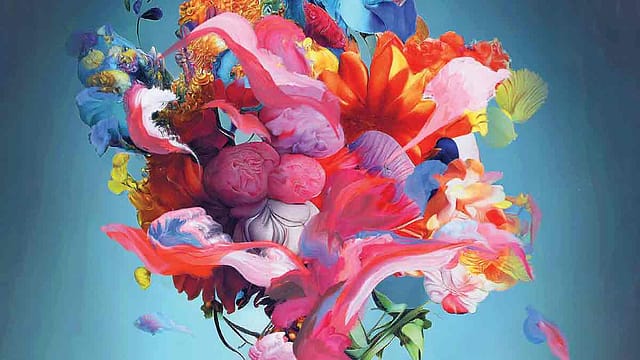
Raghava’s own practice refuses the simplistic frame of replacement. Over the past two decades, he has moved from experimenting with neuroscience-driven interactive works to sustained human-machine dialogue, treating AI not as a novelty but as an evolving collaborator in questions of authorship, identity, and perception. “All my conversations with AI are confrontational. My whole fun with AI is it will take me to a place I may not ever go.” His Impossible Bouquet series, for instance, is a dialogue with AI that has reshaped his hand. He trained an AI on his brushstrokes, strokes that came from “certain feelings and some thought behind it”. He also trained it on thousands of brushstroke images. He then trained a separate AI on the composition of his bouquets, works that had sold well. The machine produced “glitchy, weird strokes” that fascinated him. Then he began learning how to imitate those strokes. “I started reprogramming my hand to paint.” He created works with this altered hand, trained the AI again, generated another set, then painted over them. He describes a point where neither he nor the machine could claim sole authorship. “We don’t know who learned from whom.” Here is a richer model for AI’s entry into making art, not through automation, but entanglement. The tool shapes the hand. The hand shapes the tool. Authorship becomes collaborative without becoming meaningless.
A recent study at the International Research Journal of Multidisciplinary Scope surveyed young Indians on their preferences for AI-generated versus human-created art. The researchers showed participants artworks without initially telling them whether AI or a human made them. In those first impressions, participants did not show dramatic differences in engagement between the two categories. Both kinds of images could hold attention and evoke responses. When the study introduced authorship, perception shifted. Once participants were told which works were AI-generated and which human-made, human-created works were rated higher on qualities like authenticity and aesthetic value, showing that perception is not only visual; it is moral, cultural and narrative-driven. Viewers do not only look, they ask: who made this, and what does that tell me about what it is worth?
If perception is shaped by authorship, then AI’s entry into art and craft cannot be understood only at the level of output. It reorganises authorship itself. AI can unsettle the chain of intermediaries, redistribute access to training, recalibrate taste, and complicate the idea of origin. Used narrowly—as a quick generator of motifs—it risks producing sameness, drawing from shared datasets and converging toward familiar minimalism. Used expansively, it could serve as archive and amplifier, retrieving motifs that have slipped from circulation, connecting artisans directly to markets, documenting provenance with clarity, offering structured learning to those who did not inherit technique, and rendering craft legible beyond its area of origin without dissolving its material intelligence.
The question is not whether AI will enter this world. It already has. The question is whether it will narrow the field of imagination, or widen who gets to inhabit it.