The New Growth Mantra in the Time of Oil Shock
WHEN THE BHARAT Audyogik Vikas Yojana (BHAVYA) was announced by Finance Minister Nirmala Sitharaman as part of her Budget speech on February 1, the proposal for 100 “plug and play” industrial parks was viewed as part of an effort to encourage manufacturing in India and a device to get around the municipal permissions that slow down the process of setting up a factory. Less than a month later, the outbreak of war in the Middle East provided more grim evidence that global trade and stable energy prices—the oil that turns the wheels of economic activity—were subject to sudden and violent disruption. Once it received instructions to step on the pedal, it took the department for promotion of industry and internal trade 40 days to work out the guidelines for the parks with the first tranche of 20 to be awarded in two months and a further 30 in the following couple of months. By the usual pace of government functioning this was quick work indeed.
Speaking to the media on May 23, Commerce Minister Piyush Goyal said it was a measure of the government’s agility that the ₹33,660 crore scheme was being rolled out without delay. “The idea of allotting 20 parks in two months is to get the scheme rolling. Another 30 will be awarded in the next two months,” he said. The parks are expected to become functional in two-to-three years and differ from the special economic zones (SEZs). “The parks can be used for supplying the domestic market or exports. States can form partnerships with private sector to run the parks as well,” he said. The size of the parks could range from 100 acres to 1,000 acres with the size of the land parcel pared down to just 25 acres for hill states. States are expected to compete and offer earmarked land that meets set criteria. “The scheme envisages creation of ‘investment-ready’ industrial ecosystems with plug-and-play infrastructure, multimodal logistics connectivity, reliable utility systems, worker-support infrastructure, digital governance systems, and sustainable development features,” an official statement said. The BHAVYA scheme, said Goyal, is part of efforts to encourage investments, including foreign capital, and pointed to $94.5 billion in FDI in 2025-26, which is a 16.7 per cent growth, the fastest in the past six years. Analysts have pointed out that net FDI was $7.7 billion but the minister underlined that inflows have not dried up. Other estimates point to sustained domestic investments that have prevented a more dramatic slide in the stock market.
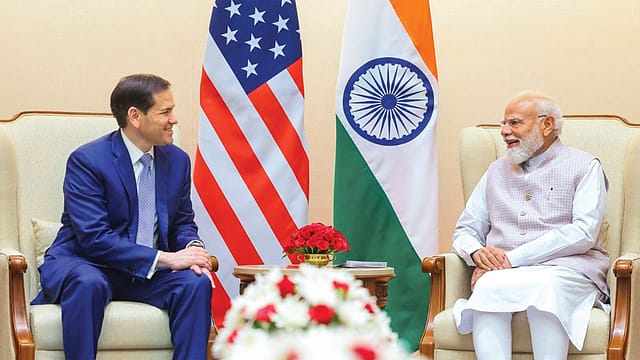
While the Modi government was paying attention to domestic exigencies, it played host to an important meeting of the Quadrilateral Security Dialogue (Quad) foreign ministers that also meant the presence of US Secretary of State Marco Rubio. There were strong complementarities in domestic objectives and External Affairs Minister S Jaishankar’s focus on energy security and safe passage in international waters clearly brought that out. Rubio’s visit was an exercise in repairing India-US ties after a rough 2025 and continuing bumps thereafter. Addressing the media alongside Rubio at their meeting, Jaishankar spelt out that US President Donald Trump’s idea of ‘American First’ would not mean a subordination of India’s interests. “We also have a very strong interest in ensuring that globally energy prices are kept low and that energy sources are more available. So, we are both countries—obviously each one of us has our own national interest and policies, but partnerships and relationships are built on what you share,” Jaishankar said. For good measure he also stated that while India and the US cooperate to deal with illegal and irregular mobility, India expects legal mobility will not be adversely impacted. “After all, this is very relevant to our business, technology, and research cooperation,” he said. Although Rubio sought to clarify that American relations with any other state do not come at the cost of ties with India, Trump’s frequent reference to Pakistani army Chief Asim Munir as “field marshal” in a laudatory tone does not go down well in New Delhi. Rubio would have got the sense of the mood in India when he was asked a question about an increase in racist comments on Indian Americans. Noting that there are stupid people in both countries, Rubio said, “There are stupid people in the United States that make dumb comments all the time. I don’t know what else to tell you other than the United States is a very welcoming country.” The moment passed but it could have gone badly.
Although the dates for a leadership summit were not announced, the Quad meeting was a significant step in reviving the grouping’s relevance and also provided a fresh wind to the sails of the India-US relationship. The outcomes of the Quad meeting specifically include use of economic policy tools and coordinated investment and mobilising $20 billion for critical mineral supply chains, the first Indo-Pacific Maritime Surveillance Collaboration (IPMSC) to boost information exchange, an expanded partnership for maritime domain awareness, an Indo-Pacific energy security initiative, port development in small but crucial Pacific nations, a secure undersea cable network, and work on a common digital standards protocol. There was a separate Quad statement on Indo-Pacific energy security with a clear mention of the need for unimpeded passage through the Strait of Hormuz.

The India-US framework for secure supply in mining and processing of critical minerals and rare earths signed by Jaishankar and Rubio pledged cooperation in supply chains, mining, processing, recycling, and investments. A joint statement on ‘India-US AI Opportunity Partnership’ was similarly intended to signal forward movement. The exchanges at the official level, including a meeting with Modi, could see an improvement in relations if the Trump administration took the right cues.
Most of the claims of an alleged ‘crisis’ in the Indian economy rest on two developments. One, the decline in the value of the rupee against the dollar and the alleged ‘drying up’ of FDI. This has led to calls for ‘reforms’—the standard prescription in such situations—without spelling out what these might be to solve a problem largely confined to the external sector of the economy. Sitharaman on May 25 put a spotlight on the problem, saying Prime Minister Narendra Modi’s call to conserve dollar expenditure should be seen in the context of fuel, fertilisers and foreign exchange. On the other hand, the government has acted to cushion consumers from the impact of rising fuel prices, absorbing a ₹1 lakh crore revenue loss due to reduction of excise duties on fuels.
A sober look at the facts helps. In 2004-05, gross FDI inflows into India amounted to $6.1 billion. With repatriation and disinvestment of around $0.1 billion, outbound FDI from India amounted to $2.3 billion, adding to a net FDI of $3.7 billion. Now, 22 years later, in 2025-26, provisionally, the gross FDI figure has rocketed up to $94.5 billion, or 15.5 times the figure in 2004-05. But at the same time, repatriations/disinvestment also shot up to $53.6 billion, or 536 times the amount in 2004-05, leaving a net FDI of $7.7 billion. Along with this, Indian FDI flows abroad also rose dramatically to $33.3 billion, or 14.5 times the level in 2004-05.
Several conclusions can be drawn from this data. Any investor who brings money into India will want to repatriate profits at some point. A situation where investments would continue flowing into India without the country permitting the outflow of profits/disinvestment is untenable. This is likely to lead to a situation where future investors would turn wary of investing in India in the first place. These flows also show that companies and investors are generating healthy returns in India and Indian investors, too, are exploring other markets for investments. This is the logic behind globalisation—of not just financial flows but also investment opportunities.
The number often cited as evidence of the ‘FDI crisis’ is the net FDI of $1 billion in 2024-25. In that year, India had a gross FDI of $80.6 billion, the second highest since 2004-05. But 2024-25 also witnessed high repatriations and outbound FDI from India totalling $79.7 billion. In making claims about a crisis, these figures are often ignored as are the reasons behind them, and the focus is set on the net FDI figure.
INDIA HAS BEEN exemplary in its conduct in these matters. FDI has been welcomed—in contrast to even 12- 13 years ago when there was much heartburn over permitting FDI in multibrand retail—even as repatriations have been smooth. It is worth pointing out that from 2014-15—the beginning of the Modi years—gross FDI inflows witnessed a qualitative jump as did net FDI. At the same time, periodic surges in outbound FDI are not new: from 2005-06 to 2010-11, there was not one year when these outflows were less than $15 billion. At that time these were not held as examples of an alleged crisis of confidence in India. There is no reason to hold that belief now, when macroeconomic fundamentals are much stronger.
These numbers show that panic over the ‘rupee and FDI crisis’ is overblown. The reasons for the rupee’s decline are well-known and are transitory in nature. Letting the rupee find its correct value by allowing it to find its market-determined value is the best corrective mechanism. RBI’s stance of preventing volatility in the currency market without trying to defend a particular value of the rupee is the sound policy to pursue. Any other claim, or fears such a speculative run on the rupee, is fantasy. India needs to focus its energies on pursuing higher growth and not firefighting some imaginary crisis situation.
What India needs to do now is plan and invest for the future. It would be facetious to call such changes reforms, the favourite expression of some commentators and economists.
There is, however, a strong case now for India to vigorously pursue industrialisation in a planned manner. The pursuit of industrialisation now has a very different logic from what was put forward after India gained independence. In those early decades after 1947, industrialisation was largely reserved for the public sector. After 1991 various areas were opened up for the private sector as state-led industrialisation was not considered to be the primary vehicle for growth. Today, under the Modi government, this goal is being pursued in a broad-based manner without ideological blinkers. To cite one example, India’s defence manufacturing exports touched ₹38,424 crore in 2025-26. Out of this, the private sector contributed ₹17,353 crore and the public sector ₹21,071 crore. The private sector is a recent entrant to this market and has largely expanded after 2014 when it received encouragement and opportunities.
The path to industrialisation—the immediate goal being that of manufacturing accounting for at least 25 per cent of GDP—is not easy. This process will have to be government-led, with the public sector likely to play an outsized role again. This is largely due to interlinked reasons. For one, China now has vast industrial capacity that can supply any quantity and at throwaway prices. This is enough to deter even the hardiest private corporation anywhere. For another, the traditional basis for industrialisation was its nexus with export-led growth. Here again, it is now impossible to compete with China with almost the entire range of industrial goods, ranging from chemicals to batteries and from steel to robots. There is nothing left for any country to export. A reason for tepid private investment in India is the continuous shocks to the system since the Covid pandemic of 2020. While it will still take time for confidence to build up, it is worth considering the counterfactual that private sector economic activity could have been even slower if the government had not cut corporate tax and restructured the Goods and Services Tax (GST).
An assessment of India’s economic opportunities and challenges rests on hardnosed calculations. Traditional theories of export-led growth rest on comparative advantage. A country will export a commodity in which it has comparative labour productivity advantage. China has defied this cornerstone of economic thinking by exporting virtually everything it makes. The situation now is so one-sided that some months ago a Financial Times correspondent noted that ships from China laden with containers reached European ports but returned home empty. China wants to sell everything it makes but does not want to buy anything. A more resounding failure of the intellectual idea that underpinned modern trade-led growth would be harder to find.
The result is that today even the World Bank has come round to the idea that industrial policies can work. In March, the Bank released a report titled ‘Industrial Policy for Development: Approaches in the 21st Century’ that made a case for industrial policies in developing countries. The report noted: “The older import-substitution model—using high tariffs to build domestic industries—was largely abandoned by the 1980s after repeated failures. Success stories come exclusively from countries with large domestic markets and abundant resources, as in the US tinplate industry of 1890. But some are now wondering whether import substitution could be revived, given the expansion of the middle class and thus the size of domestic markets in developing economies.”
There are ample reasons why that set of ideas can work in India in different, more propitious circumstances compared to the past.
One reason why the export-led miracles of the past are no longer feasible is China. The other reason is that the geopolitical circumstances of the Cold War, which took a peculiar form in Southeast Asia—specially Malaysia, Indonesia, and Thailand— and parts of Eastern Asia—Japan, Taiwan, and South Korea— no longer exist in the 21st century. Back in the 1960s and 1970s, the starting points of these export-led growth miracles, the US was battling China and the Soviet Union for influence in these countries. Many of these countries were also dealing with communist insurgencies. In those circumstances, the US opened its markets to these states. Their growth and ‘miracle’ performance were in no small part due to the political choices of the US as much as they were due to the economic choices made by these countries.
Those conditions do not exist anymore. The US is no longer the ‘buyer of last resort’ even as the ‘seller of first resort’—China—is locked in competition with anyone and everyone in the world. In these profoundly destabilising circumstances, is there a way out? For India, there is an option. It now has sufficient domestic demand for a variety of goods. If sectoral planning and investments are carried out properly, a virtuous cycle of growth is possible. Back in the 1960s, when industrial policies were first tried in the country, the Centre had practically no capacity to discipline firms and manufacturers. That ability exists now and is coeval with the growing capabilities of the Centre. If industrial policy is to succeed today, that strength needs to be increased further and not allowed to ebb in the name of federalism or any ideology.