The Last Gasp of Maoism
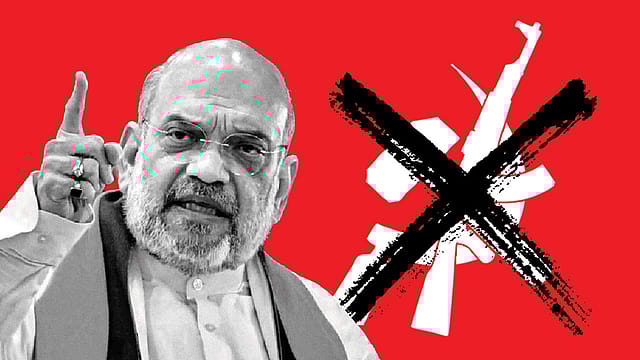
WHEN UNION Home Minister Amit Shah rose to speak in Lok Sabha on March 30, he had good news to share with the country. The decades-long fight against Maoism was at an end and democracy had proved to be superior to what an armed revolution sought to impose on India. Shah’s speech came a day before the deadline set by him to finish-off Maoism in the country.
Shah dwelled at length not just on the contemporary fight with Maoism but the history and dynamics of the ecosystem that created and nurtured it over the past many decades. He highlighted the close links between India’s civil society and Maoists that reached the highest levels of India’s political system. In the 1990s, the nexus between politicians and criminals was considered a major threat to India. It won’t be wrong to say that the nexus between Maoists, civil society, and politicians was the 21st-century variant of this 20th-century problem. This was before Narendra Modi became prime minister in 2014. Since then, the difficult fight has been prosecuted with vigour under Shah’s direction and Modi’s guidance.
The results are for everyone to see. From the situation where Maoists held sway over 12 states, 70 per cent land mass and 200 million people, Left Wing Extremism (LWE), the official designation for Maoists and their organisation, has been eliminated in a root-and-branch manner. The toughest part of the fight, waged over the past six-odd years, took place in the remote jungles and hills of East Central India.
The process of ending Maoists took place in a sequence. The first step was BJP coming to power in 2014. This allowed careful planning of the campaign against Maoists. Then came the actual task of clawing back territory from Maoist control. In between, multiple other details had to be ironed out: state governments complicit in protecting Maoists had to be defeated politically; civil society members had to be warned; and the sources of their funding shut off. This was not just a security operation but a multi-domain political and social problem.
What came through Shah’s speech was the clarity with which the problem was understood and tackled. Gone were the spurious debates around “security versus development” that dominated the headlines in the first decade of this century. Gone, too, was the dubious claim that Maoism was the result of injustices meted out to Adivasis. The prescription that flowed from these pernicious claims—talks between Maoists and the government as equals—would have proved extremely damaging to India’s unity and integrity. Sooner or later, other terrorist groups and separatist elements would have demanded the same treatment. This was dismissed by Modi and Shah. That these ideas and prescriptions came from India’s civil society is not surprising to anyone who has seen the course of Maoism and separatism in India. It was Shah’s determination not to be taken in by these ideas that ultimately paved the way for a decisive end to the Maoist problem.
There is one big lesson that can be drawn from Shah’s speech. Lawlessness and political violence are the product of political vacuum. The Maoist problem arose in the first place because governance was kept away from these remote regions. This was on the basis of the Nehruvian theory that Adivasis must be allowed to develop on the basis of their own genius. As a result, Maoists occupied these zones and made sure there was no development. Leftist intellectuals and civil society then turned this observation on its head and claimed that Maoism arose because there was no development. The moral of the story is simple: no area in India should be divorced from government control, preferably centralised control.