The Inverted Food Pyramid
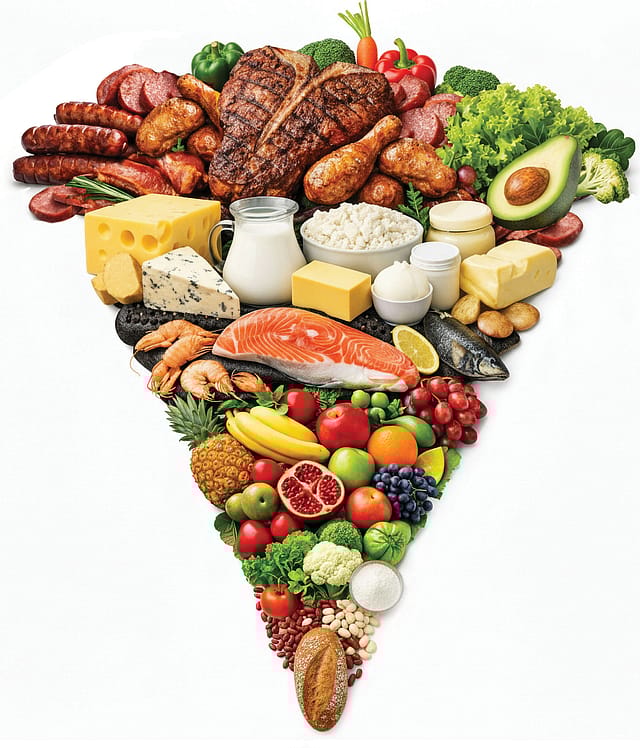
ON JANUARY 7, THE US government released a new version of what used to once be called the food pyramid, or technically speaking, Dietary Guidelines for Americans, 2025–2030. It upended much of what was earlier considered a good diet revolving around carbohydrates. The new US guidelines turn protein the centrepiece. Compare what they recommended earlier with the present. From 0.8 grammes of protein per kilo of body weight as recommended daily intake, it has now doubled to 1.2-1.6 grammes. If you weigh, say, 65kg, you will need to take around 100 grammes of protein, the equivalent of 15 eggs. And while that might sound excessive to the Indian conditioning, chances are the need for Indians to convert to such a diet is as much as that of Americans.
The reason cited by the US government for the overhaul of the diet is the explosion of lifestyle diseases. As their press note said, “The U.S. faces a national health emergency. Nearly 90% of health care spending goes toward treating chronic disease, much of it linked to diet and lifestyle. More than 70% of American adults are overweight or obese, and nearly 1 in 3 adolescents has prediabetes.” India has an equal issue with these ailments. In population percentage terms, it has as many suffering from diabetes and in absolute numbers, they are over 100 million, making up for the largest block on the planet with the disease. But there is also underreporting, so the numbers are much higher. Like Americans, Indians are becoming increasingly obese and a variety of lifestyle conditions afflict them, starting from their early youth.

Travel Issue 2026
15 May 2026 - Vol 04 | Issue 71
The Cultural Traveller
The idea of what is good food is intimately connected to politics and commerce. Researchers do extensive studies on what makes for a nutritious diet, but someone needs to interpret all of it and then give a recommendation. Governments take on that role because the health of citizens is part of their remit. There are also however huge industries around food whose objective is profit. They make food as tasty as possible to get returning customers. Foods are therefore processed to extraordinary lengths. The new US guidelines openly recommend against consuming them. The press release says, “For the first time, the Dietary Guidelines call out the dangers of certain highly processed foods – a common-sense and vital public health point. The guidance calls to ‘avoid highly processed packaged, prepared, ready-to-eat, or other foods that are salty or sweet’ and ‘avoid sugar-sweetened beverages, such as soda, fruit drinks, and energy drinks’.” Sugar, a hidden ingredient in many foods, too has been targeted for the first time with the guidance noting “no amount of added sugars or non-nutritive sweeteners is recommended or considered part of a healthy or nutritious diet.” It asks parents not to give any sugar whatsoever to children under four.
The food pyramid had its beginning in the mid-1970s in Scandinavian countries, but it was when the US came out with one in 1992 that it became a global “eating right” tool. A controversy accompanied it. The person tasked with creating the food pyramid was a nutrition researcher called Luise Light. She came out with recommendations and submitted them to the US Department of Agriculture which had commissioned it. In it, the main food group to be consumed was fruits and vegetables, with moderate foodgrains and sugar being the most minimum. But when the final pyramid was published by the department, much of it had been changed. From two to four servings, the consumption of grains had been increased to six to eleven. Fruits and vegetable portions were decreased and instead of sugar, fat became the most minimum. The word “whole” was also removed from grains. All this was thought to be at the behest of the food industry which thought the original recommendations not good for business. Light protested and warned her superiors about the consequences. She wrote a book later called What to Eat and recounted that episode: “These changes would undermine the nutritional quality of eating patterns and increase risks for obesity and diabetes, among other diseases. No one needs that much bread and cereal in a day unless they are longshoremen or football players, and it would be unhealthy for the rest of us, especially people who are sedentary or genetically prone to obesity and diabetes. What’s more, bulking up on baked goods and pasta would knock other important foods out of the diet—people won’t have room for less popular fruits and vegetables, which are critical for improving nutrient levels.” And over the decades, that was how it played out as obesity and lifestyle diseases zoomed.
It also became a worldwide problem as other governments followed suit mirroring the US in coming up with their official food pyramids. India’s National Institute of Nutrition, too, created one for the country in 1998, with the main difference being that it also included legumes (dal) along with grains as the main food group. Vegetables and fruits were next in order. Meat and proteins were the third group, only to be eaten in moderation. And last were sugars and fats. India, unlike the US, was already on a carbohydrate-driven diet and so the food pyramid by itself didn’t do damage, but it still missed the importance of the level of proteins making for a healthy diet.

IN 2011, FOOD pyramid as a concept made way for MyPlate by the US, in which the visual was a plate with portions of food groups allocated space in it. Grains moved a little down the ladder at 30 per cent with vegetables being the main component of the plate at 40 per cent. Proteins were at 20 per cent. Other countries then used the same concept. India only got around to it in 2024 when its revised guidelines also had a “My Plate for the Day”. It was still overwhelmingly carbohydrate-dominated, with 42 per cent coming from grains and millets. Pulses, eggs, and flesh foods were 14 per cent. Proteins, therefore, remained a minor component.
The new US guidelines bringing protein to the top of the diet chain is backed by cogent reasons. Increasingly, research is showing the importance of protein consumption in human health. It is necessary for maintaining muscle, improving immunity, repairing cells. A big advantage of consuming a lot of protein is that it keeps one satiated for a longer period, reducing the need to repeatedly eat. Meanwhile, carbohydrates, especially refined grains, are immediately converted to glucose, leading to spikes and drops in blood sugar, fuelling repeated hunger pangs. Even before the US guidelines, proteins were becoming popular leading to an industry of protein-fortified foods booming. It has been happening here too. India however faces an issue when it comes to protein consumption because people are overwhelmingly vegetarian on a daily basis. Non-vegetarians might be a majority, but most only eat meat or fish occasionally. Without them, to maintain the target of proteins is extremely difficult. It requires a vegetarian to eat the equivalent of 600 grammes of paneer daily. Last December, the Council on Energy, Environment and Water (CEEW) published a study, which found that most of the protein Indians consume is from cereals, not the optimum source. Looking at the 2023-24 NSSO Household Consumption Expenditure Survey data, it said that Indians ate 55 grammes of protein daily. Their press release said, “The study finds that cereals alone supply nearly 50 per cent of this protein despite their low-quality amino acid profile and poor digestibility. This contribution of cereals to protein intake is far above the NIN-recommended 32 per cent, crowding out higher-quality protein sources such as pulses, dairy and eggs/fish/meat. Protein supports the body’s growth, repair, and immune function. The CEEW study further finds under-consumption across major food groups, such as vegetables, fruits, and pulses, and overuse in cooking oil, salt, and sugar intake.”
That dietary guidelines of a government can have an impact on the health of a population stretching decades is evident in the correlation between the 1992 US food pyramid and lifestyle disease increase. With protein no longer ‘demonised’ now, Indian health agencies should also start to re-evaluate its place in the diet. Only a small affluent segment is consciously consuming protein at present. The wider population remains deficient and even that comes from suboptimal sources. India, in fact, may be doing the opposite. Eggs, a key daily protein source in a vegetarian universe, are being increasingly removed from free meals served to schoolchildren. If Indians are to not get metabolic diseases in their 20s and 30s, the food pyramid might need some inversion here too.