The ‘INA Three’ Trial the Raj Lost
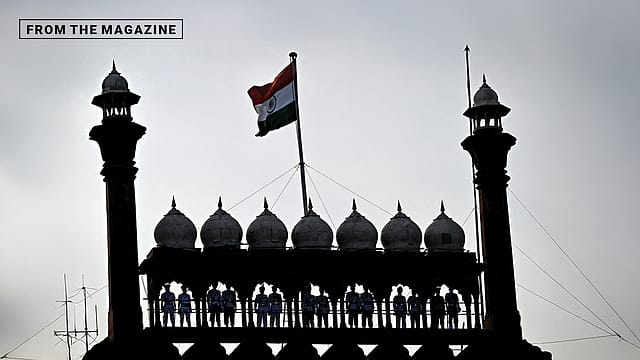
A REGULAR VISIT TO THE RED FORT after paying an entry fee online takes you through history, but through a diminished echo of what was once called the Blessed Fort (Qila-i-Mubarak), the seat of Mughal imperial power and the residence of emperors for close to two centuries, from the time of Shah Jahan in the late 1630s to September 1857. That was when British East India Company troops stormed the fort to crush the 1857 First War of Independence, dethroning the already-puppet king Bahadur Shah Zafar, around whom Indians had rallied against the British.
Within a year, the British Raj replaced the East India Company, and the magnificent fortress became a military garrison, with residential spaces replaced by barracks after large areas inside were looted and destroyed. Under the Raj, it was fortified to such an extent that it became a symbol of their military prowess, having first put Bahadur Shah Zafar on trial, then convicting and exiling him to Burma. As much as it was meant to brandish their superiority, the British used the fortress, which had outlived multiple raids from within and elsewhere, as far away as Persia by Nader Shah, to hold a public court-martial of their former officers, those captured for fighting against them under the banner of Subhas Chandra Bose’s Indian National Army (INA), to make an example of them. Their trials, which came to be known as the Red Fort Trials of 1945–46, were meant to humiliate and crush the spirit of those officers, including Prem Sahgal, Gurbaksh Singh Dhillon and Shah Nawaz Khan.
The British wanted to do to them what they had done to the Mughal legacy: to deride and demean and finally punish severely. There was symbolism in everything they did. They had transformed the Diwan-i-Aam, or Hall of Audience, which had a balcony for the emperor to address the people, into an army hospital. Projecting absolute military dominance was the aim this time round, too.
Before we turn to the trials, let’s first examine what the British had done to the Red Fort when the Mughals fell, to understand better the stark contrast that was to unfold.
In her long essay titled “Commemorating and Remembering 1857: The Revolt in Delhi and its Afterlife”, Nayanjot Lahiri writes, “British soldiers plundered whatever they could find in the Red Fort—portable artefacts, ranging from the jewels, weapons and the clothes of the royal family to in situ marble slabs and inlay work. While the copper gilt domes of the Hall of Special Audience (Diwan-i-Khas), the Musamman Burj and the Pearl Mosque (Moti Masjid) were sold by auction (Hearn 1906: 14), property worth Rs 10,000 was dug out of the Sriramji temple by the Prize Agents (Sen 1957: 114). Elsewhere in the city too, soldiers and officers were equally thorough.” She adds that the Zinat-ul-Masjid, one of the most impressive mosques in the city, was converted into a bakery for troops.

Clearly, such measures were carried out with a single-minded focus: to assert and reassert their power and project their imperial justice. The intention was no different in 1945 either.
But then the outcome was vastly different, because these trials captured the imagination of a country of 34 crore people in a way they had not done before. Professor Sugata Bose of Harvard University, a grandnephew of Subhas Bose, wrote about the heightened patriotic fervour of Indians in a foreword to the 2025 edition of Major General Shah Nawaz Khan’s 1946 book titled My Memories of I.N.A. & Its Netaji (currently published by Roli Books). “During the trial in November and December 1945, the story of the saga of Netaji and his Indian National Army reached every corner of India. The Indian people expressed themselves forcefully on the side of Netaji’s soldiers… The slogan ‘Lal Qile se aayee awaz, Sahgal, Dhillon, Shah Nawaz’ reverberated across the length and breadth of the country. On 31 December 1945 at the Red Fort, the three were found guilty and sentenced to deportation for life, the same punishment that had been handed to Bahadur Shah Zafar in 1858. Within three days, on 3 January 1946, the British Commander-in-Chief Claude Auchinleck was forced to release Sahgal, Dhillon, and Shah Nawaz to a heroes’ welcome from the Indian public.”
How did that happen? How did the best-laid plans of the British go awfully wrong?
Perhaps a foreword to the same book written as early as 1946 by Jawaharlal Nehru offers a clue. Nehru wrote, “I had judged rightly, for immediately there was an amazing reaction in the whole of India and even the remote villages suddenly knew about the INA and wanted to do something which might help in effecting the release of the men being tried or imprisoned. Those men, whatever they were as individuals, became symbols of India’s struggle for freedom and because of this, the people of India, with an amazing unanimity, stood by those symbols and sought to protect them.” Nehru then goes on to exclaim about “a wave of excitement” passing through the land. He also notes that every other question, more vital in its larger significance, became secondary for the moment. “The trial of some of these men conducted with great ability by Shri Bhulabhai Desai held the stage in India and Sri Bhulabhai’s final address became a classic,” wrote Nehru.
Subhashini Ali, daughter of Prem Sahgal and another INA veteran, Captain Lakshmi Swaminathan, recalls her father narrating the precarious nature of their lives, as well as worries about fellow comrades, while in British custody. “My father’s initial barrack was near the railway line that passes adjacent to the Red Fort. One morning when he was walking there, a train packed with demobbed INA soldiers arrived. One of them was almost falling out of the door. He was Jagannath, my father’s batman. Their eyes met for a few seconds. They were both overjoyed to see that the other was alive,” the former Member of Parliament recalls her father telling her. “Much later, Jagannath joined my father in Kanpur and worked at the New Victoria Mills where my father was the general manager. His wife worked as a nurse in my mother’s small nursing home.” Captain Lakshmi Swaminathan was a physician practising in Singapore when Netaji Subhas Chandra Bose arrived there. Soon, she came under the spell of Bose and joined the INA.
Ali narrates details about the defence put up in favour of the three. “My grandfather, Shri Achhru Ram, was a sitting judge of the Punjab High Court, who was most generously given leave to organise and guide his son’s defence! He was responsible for Shri Bhulabhai Desai agreeing to come to Delhi in spite of his failing health to defend the ‘INA Three’. He was also responsible for insisting that all three be part of one defence,” she explains.
Ali also shares details about the INA Three, with whom she has, obviously, enjoyed a special bond. Khan died aged 69 in 1983, Sahgal, her father, died aged 75 in 1992, and Dhillon died aged 91 in 2006. Her mother lived on until she was 97, and died in 2012.
Ali says that Khan’s family was a fauji family with a deep sense of loyalty to the British Indian Army. “Only his brother visited him in the Red Fort, and he expressed his anger and disgust. His attitude did change subsequently. Shah Nawaz did not have a single relative in post-Partition India, but he insisted on opting for India. His eldest son was actually with the family in what became Pakistan, and he stayed on there,” she points out.
As regards Dhillon’s family, she says that they were not well off and were very disturbed by what “he had done”. She goes on, “His father even tried to plead for clemency, and Dhillon refused to meet him.” Ali remembers her grandparents treating all three as their sons. “Food from their home would come for all of them (during the trials). Dhillon and Shah Nawaz would always touch my grandmother’s feet whenever they met—my father never did!” Ali says that her father and two comrades always knew that they could even face execution if found guilty and yet did not for a moment contemplate begging for mercy.
JUST AS THE charges were serious, including waging war against the empire, the British also brought unfounded allegations against INA members while they were being court-martialled in the Red Fort, stating that they had committed atrocities against Indian prisoners of war. Khan would write later, “Even the prosecuting officers in the trial were forced to admit that the tales regarding the concentration camps were grossly exaggerated and unfounded in reality.”
Subhashini Ali, a former member of the politburo of the Communist Party of India (Marxist), or CPM, also remembers stories of massive mobilisation by close relatives, friends and others who were young enough to remember and take part in the protests against the Red Fort Trials. “Throughout my life, I met people everywhere—in trains, in different places—who had vivid memories of huge rallies for the Red Fort Three and for INA soldiers. People in Kerala remember walking from Kuttippuram station, across the Bharathapuzha riverbed to our ancestral home in Anakara village (Palakkad) following my mother when she came to visit her grandmother after returning from Singapore,” she says, adding, “In Parliament [when she was an MP], Bansilal told me that as a young boy he would leave in a bullock cart at dawn from his village in Haryana. It would be one of hundreds, all headed for the Red Fort. He would spend the whole day there, return at night and then get up again to leave at dawn.” She, however, rues that even recent history is not remembered. “So many who did so much have never been remembered! So I am happy that many have at least heard of the INA.”
Now, the fact that a Hindu, a Muslim and a Sikh officer were being tried together gave rise to a powerful image of national unity. The INA, in that sense, became a symbol of resistance. As a result, when ratings of the Royal Indian Navy in Bombay rebelled in February 1946 over poor food, racial bias, pay and working conditions, they raised slogans including “Jai Hind” and displayed portraits of Subhas Chandra Bose. As the naval revolt spread to other naval establishments, British forces panicked, although they succeeded in suppressing it. Overall, the trials proved the appeal of the INA, and the naval revolt demonstrated that discontent could enter the British Indian armed forces, meaning Indian soldiers in the British Army could no longer be trusted. Compounding the woes of the British were post-war economic pressures, alongside the INA phenomenon, the Quit India movement, changing international circumstances and the rise of new powers.
The Red Fort Trials, in that sense, brought the India-versus-Britain conflict to its fullest extent, influencing even the world of the armed forces that had zealously and loyally protected the interests of the British Empire for far too long. Political scientist Sumantra Bose, director of the Netaji Research Bureau, Kolkata, in an interview to Open, says: “It turned out that our British colonial masters were hopelessly out of sync with both the Indian people and the Indian armed forces. But it was a chronicle of an imperialist disaster foretold.” (Read the interview at openthemagazine.com)
The much-hyped trials, intended to teach Indians a lesson, badly boomeranged and, alongside other factors, demonstrated to Britain that its colonial system was becoming not only difficult but increasingly unviable to sustain.