The Class of 2035
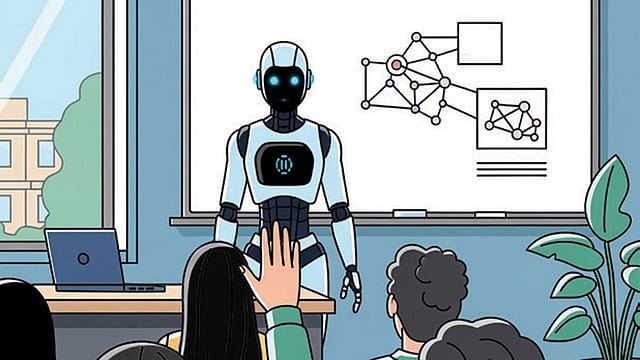
ON A BRIGHT Monday morning in 2035, the “classroom” at a leading business school looks nothing like the tiered amphitheatres of old. A few students are physically present in a flexible studio space; many more join as holographic avatars or on screens from Mumbai, Manila, São Paulo, and Jakarta. An AI facilitator tracks engagement and quietly prompts the professor: “Raj in Mumbai has a counterpoint based on last quarter’s data from his logistics startup.” The case being discussed was written a week prior—by an AI co author, using real-time market data.
This scene might sound futuristic, but the forces pushing management education in this direction are already here. As businesses confront climate risk, geopolitical volatility, and AI-driven disruption, schools that train future managers are under pressure to reinvent themselves. The question is no longer whether management education will change, but how radically—and how fast.
For decades, the Master of Business Administration has been the gold standard for aspiring leaders. A two-year, full-time immersion promised a reset: a break from work, a concentrated curriculum, and a powerful network. Yet in recent years, the traditional MBA has been under scrutiny. Critics point to the cost, the opportunity loss of years out of the workforce, and a curriculum that can lag behind practice.
The emerging model replaces the one-shot degree with an ongoing relationship. Think of it as a “leadership subscription”:
◗ Professionals dip into short, intensive sprints—six weeks on AI strategy, four weeks on sustainable finance, a weekend on persuasive storytelling.

Iran After the Imam
06 Mar 2026 - Vol 04 | Issue 61
Dispatches from a Middle East on fire
◗ Credentials are modular and stackable. Micro-certificates in analytics, product management or ESG can add up to a degree over time.
◗ Alumni don’t “graduate and leave”; they remain part of a learning ecosystem returning for updates as industries evolve.
This shift mirrors the reality of careers that no longer follow a linear ladder. As workers switch industries, start ventures, or lead transformations, their educational needs spike at different moments. Successful schools will become platforms that anticipate those moments and deliver just-in-time learning.
If the last decade belonged to online platforms and Massive Open Online Courses (MOOCs), the next will be shaped by artificial intelligence (AI), which won’t replace management professors, but will profoundly change what they do and how students learn.
AI will first personalise the learning journey. Instead of everyone moving through the same course at the same pace, adaptive systems will diagnose each learner’s strengths and gaps in areas like finance, negotiations or systems thinking; recommend tailored reading, simulations, and assignments; provide instant feedback on analysis, memo or presentations, allowing class time to focus on debate and reflection.
Then AI will enable high-fidelity simulations. Imagine a crisis-management course where an AI-driven news cycle responds in real time to students’ decisions, or a negotiations lab where virtual counterparts adapt tactics as skillfully as seasoned executives. These environments will help students practice making decisions under uncertainty, with ethical stakes woven directly into the scenarios.
Lastly, AI will act as a personal leadership coach. Using language models trained on best practices in communication, conflict resolution, and emotional intelligence, students could rehearse difficult conversations—firing an underperformer, pushing back on an unethical request, advocating for a controversial project—and receive structured feedback on tone, clarity, and empathy.
The challenge for schools will be to avoid turning education into a solitary, screen-based experience. AI’s greatest value will come when it augments human connection, not replace it—freeing faculty to facilitate deeper conversations and mentoring, while algorithms handle drills, diagnostics, and routine practice.
The iconic case method, pioneered by elite business schools in the early 20th century, is itself under pressure. Cases have always been a double-edged sword: rich in narrative and ambiguity, but often frozen in time and limited in perspective. Tomorrow’s management education will increasingly replace “cases” with “contexts” and “live challenges”.