The Civic Nightmare of Indian Cities
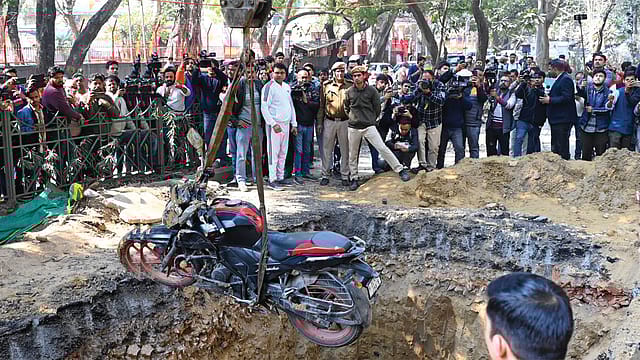
THINK OF A MAN RIDING HOME AROUND MIDNIGHT IN DELHI, the way thousands of residents do every night. Their experience of the city keeps them alert; they are careful but not cautious enough to imagine death waiting in the middle of the road. That is how our man, Kamal Dhyani, was driving back home from work, hoping to make it in 10 minutes, right in time for a cake his family was supposed to cut for their parents’ wedding anniversary.
But Dhyani never made it home. His bike fell into a construction pit dug by a government agency for sewer work. He lay there unattended the entire night, as his family kept asking apathetic policemen for help. Dhyani’s body was discovered the next morning. Next to his bike, his contorted body served as a chilling counterpoint to the manufactured civic pride of “I Love [Insert City]” installations planted at traffic circles and promenades, engineered less for belonging than for Instagram. What does this “Love” mean except that it cannot conceal the rot so much as mock it?
By next morning, Delhi had already begun its rituals of forgetting. The ditch, now covered with green mesh, remained, as if nothing irreversible had happened there hours earlier. Indian cities, which have perfected the art of absorbing tragedy without altering course, registered one more death and moved on. Before Dhyani’s death, in January, a young software engineer, Yuvraj Mehta, died after his car plunged into a water-filled pit in Noida. On February 10, a daily wage labourer, Birju Kumar, died after falling into an open manhole in Delhi’s Rohini area.
These deaths are not an aberration. It is the logical outcome of how Indian cities now function. No city has been spared—not even those once known for their quiet order, nor those whose bureaucrats boast of miracle makeovers in cleanliness and control. Beneath the brochures and rankings, the same disorder seeps through. The breakdown is no longer confined to megacities, where chaos can still be dismissed as the cost of scale. In the terrible civic disorder that big and small cities have now become an emblem of, there is no answerability of any kind. Responsibility is fragmented across agencies that do not speak to one another and answer to no one. Warning signs appear after accidents, not before. In this system, survival is left to individual reflexes.
“One big reason for this civic disorder is that government plans are not designed for outcomes,” says V Ravichandar, who calls himself a “civic evangelist”, and has been working with state and civic agencies on urban issues for over two decades. Suppose, he says, a city wants to make its traffic smooth. Now this would typically involve agencies like transport department, road works, traffic police. These agencies will announce budgets for projects that are specific to their department. For example, filling of potholes. But that is project-specific, not outcome-specific, which in this case would have been that the traffic of the city must be smooth.

Since there is no collaboration, it only leads to no outcomes, except taking lives of people or making their life miserable. The people seem to have internalised the idea that the city is a hostile terrain and that navigating it is a private battle. These have become places where safety and quality of life are only meant for those who can permanently retreat into gated bubbles—and there, too, if one is lucky.
“The planning of our cities has moved away from sustainable development,” says Vikas Kanojia, a Delhi-based urban designer. “Rapid urbanisation is happening keeping in mind only a certain section of society, and now the ill-effects of such development are showing.” Across urban India, stray dogs roam unchecked, roads collapse without warning, traffic congestion turns routine commutes into endurance tests, airborne and waterborne diseases cycle through the year, crime becomes ambient, and bad air cuts short lives. Responsibility is so thoroughly dispersed that it effectively vanishes. Municipal bodies blame state governments, states blame agencies, agencies blame contractors, and contractors disappear. Even triple-engine sarkars are reduced to idling loudly while the carriage burns. There is no fear of consequence because there is no expectation of accountability. In places like Delhi, the chief minister gets away with making a mockery of crucial issues like the cleaning of Yamuna by saying that even the canal in Venice is a drain. Citizens adjust instead, driving harder and faster, fortifying their homes with higher walls and cameras, buying air purifiers to simulate clean air, keeping their children indoors as if the outdoors were a risk zone. Opportunity remains the city’s billboard promise; precarity becomes its everyday contract.
“Where does one go, we built our life in the city and now we don’t know what to do,” laments Meera Khanna Kilam, who has been living in Gurugram for 30 years, since the time the now-sprawling market next to her home was just a photocopier shop. Last year, in November, Kilam had to rush her three-and-a-half-year-old daughter to the emergency after she complained of breathlessness. Someone in the neighbourhood had burnt a pile of leaves, and already breathing the highly-polluted air, the child’s lungs could not take it any longer. She was shifted to intensive care unit where doctors had to administer her steroids. Her heart rate was elevated as well. Three months later, the child is still on medication. “She is scared and refuses to go out anywhere without a mask,” says Kilam.
But it is not as if there will be reprieve after winters are over. “So many children are now confined to home. Soon we will have dengue season, and after that something else. How is a child supposed to live?” wonders Kilam.
How is anyone supposed to live in a city that once had aspirations of becoming India’s Manhattan and has only managed to become a glorified garbage dump? The only Manhattan in Gurugram now appears in haphazard growth of malls and condominiums, whose Western-sounding names cannot hide the stench of civic chaos around them. On the once-picturesque Gurugram- Faridabad highway, at the foothills of the Aravallis, broken toilet pots and other construction debris kept accumulating till it spilled on both sides of the road.
Over the past decades, Delhi has become one of most stressed urban economies, with development pushing far beyond earlier planning frameworks. It is a leviathan that sprawls into neighbouring urban districts, resulting in immense pressure on transport, drainage and road infrastructure. This fragility becomes apparent every time it rains, especially in the monsoons, when the city experiences severe waterlogging, grinding traffic. The city’s drainage is marred by outdated infrastructure, made worse by encroachments.
Delhi and the National Capital Region (NCR) collectively generate over 14,000 tonnes per day (TPD) of municipal solid waste, out of which 3,000 TPD waste is left untreated. This goes to landfill sites, which are now towering hills of garbage. They should have been shut long ago, but continue to function as open dumps rather than engineered landfills. Despite more than two decades of electricity privatisation, Delhi’s overhead wiring remains a stubborn hazard. In dense neighbourhoods, this results in a chaotic overhead network vulnerable to snapping during storms and accidental contact, which has taken several lives in the city.
A recent assessment by Central Ground Water Board (CGWB) points out that around 13-15 per cent groundwater locations in Delhi have uranium concentrations higher than permissible limits. The implications are severe for vast areas where piped supply is inconsistent. In unauthorised colonies, for example, water mostly comes from borewells.
An October 2025 paper based on satellite assessments by the journal Nature Sustainability says that over 2,400 buildings in Delhi and other metros are at high risk of structural damage due to ongoing land subsidence. It says that if the current subsidence rates remain unchecked, in 50 years, the risk could rise to over 23,000 buildings. In cities like Delhi, subsidence is a result of unbridled groundwater extraction and dense construction.
“There was a time when housing in Delhi helped create social cohesion. We had community-nurtured neighbourhoods where public interaction was prime focus. Most of those spaces have gone away. We only have segregated enclaves now, and every road outside is like a highway,” says Kanojia.
How have India’s cities slipped into such a low? Experts say that it has its roots in constitutional defects at birth. “The Constitution endowed powers to the Centre, and to the state, and then it was supposed to create a level of governance at a local level. This tier was simply termed as ‘local bodies’, which have become vassals of the state government,” says Ravichandar. He points at the failure of the 74th Constitutional Amendment Act (1992), which was supposed to empower the urban local bodies (ULBs) in India. But it remained toothless as state governments often retained control, resulting in a diffusion of responsibility. “Today, the governance framework is such that if you asked chief ministers whether they would like to run a state or the main city in the state, they’d prefer the city. They know this is where wealth is,” he says. From the citizen point of view, he says, these local bodies are hardly in charge of delivering in the real sense of the term. Typically, departments like electricity, transport, development authorities, traffic police are outside their domain.
In short, there is no way out in the current model. Meera Khanna Kilam cannot leave Delhi-NCR, but many others who felt that Delhi has become unliveable, especially because of its dangerous pollution levels, have shifted to other cities.
But what is the quality of life elsewhere in India?
Bengaluru’s Boom and Gloom
IN BENGALURU, A NEARLY 100-METRE STRETCH OF NH-44 near Chandapura caved in, bringing traffic to a halt on one of the city’s busiest southern approaches. The collapse occurred amid excavation work for an overpass intended to ease congestion on an accident-prone stretch, triggering hours-long delays for commuters heading to Electronics City and Hosur.
In the last five years, the Union Ministry of Road Transport and Highways has reported 55 instances of structural collapse or damage on NHAI projects nationwide—covering roads, bridges and tunnels—with 40 occurring during construction and the rest on completed stretches. Only two cases led to disciplinary action against government officials, while contractual action was
initiated in most others, according to data placed before Rajya Sabha.
Not that city roads in Bengaluru are in better shape. Despite repeated resurfacing drives, Bengaluru’s roads continue to deteriorate quickly because drainage design, utility works and road engineering are handled separately. Poor camber and inadequate side drains allow water to stagnate during rains, accelerating surface failure, while freshly laid roads are repeatedly cut open by multiple agencies without unified restoration standards.
In 2025, the state earmarked ₹1,100 crore for road repairs and construction in Bengaluru as part of a citywide pothole-removal programme, and officials said around 7,000 potholes had been fixed, with another 5,000 still pending. Without enforceable warranties and integration with stormwater works, road maintenance remains cyclical rather than corrective. Bengaluru has an estimated 842km of primary and secondary stormwater drains. The Bruhat Bengaluru Mahanagara Palike (BBMP) data submitted to the Karnataka Assembly identifies 1,712 encroachments along these channels. More than 1,300 cases remain at the survey or inquiry stage, leaving physical restoration pending.
The effect is visible during heavy rainfall. In one four-day spell in 2024, BBMP logged over 18,000 distress calls and more than 1,000 rain-related complaints, many from neighbourhoods that experience repeat flooding, with BBMP officials citing factors such as encroached and clogged drains and desilting gaps. The state has since committed to a World Bank–assisted programme to complete pending drain works.
“From the 1990s onwards, Bengaluru repeatedly underestimated the rate of its own growth,” says Karnataka Revenue Minister Krishna Byre Gowda. “The city expanded faster than any other Indian urban agglomeration over the last 25 years, but planning institutions remained reactive. The master plan lost authority, violations were regularised, and unauthorised layouts proliferated. Infrastructure—roads, drains, utilities—followed population rather than anticipating it.”
MV Rajeev Gowda, former MP and former IIM Bangalore professor of Public Policy, who is part of the BS Patil Committee that worked on the Greater Bengaluru Authority legislation, says a central concern is that large volumes of urbanised land remain outside municipal limits, governed by village panchayats and non-metropolitan bodies. The proposed authority, he explains, was structured to bring multiple corporations and state-run parastatals—transport, water, electricity—onto a single coordinating platform, which is why it sits under the chief minister rather than operating as a standalone municipal body. “The boundaries of governance don’t match the boundaries of the city as it actually exists,” he says.
The Gridlock of Mumbai
MUMBAI LIKES TO DESCRIBE ITSELF AS THE financial capital of India, and its municipal corporation—Brihanmumbai Municipal Corporation— commands a budget that rivals, and sometimes exceeds, that of several smaller states. On paper, it is a city flush with resources. In practice, it often feels structurally strained.
New infrastructure projects signal ambition. Metro lines are being laid across arterial corridors, promising to reduce dependence on the city’s famously overburdened suburban rail network. Yet for millions, daily commuting remains an exercise in endurance: overcrowded local trains where peak-hour travel defies basic standards of comfort and safety. The roads offer little relief. They are perennially gridlocked, choked by private vehicles, buses, freight traffic and construction diversions. Each new flyover is introduced as a corrective measure; many end up redistributing congestion rather than resolving it.
Two years ago, BMC became the subject of widespread ridicule when it inaugurated the reconstructed Gokhale Bridge in Andheri—an important east–west connector that had remained shut for nearly seven years. Touted at the time as an “architectural marvel”, the bridge was opened only for officials to realise that it did not properly align with the adjoining Barfiwala flyover it was meant to connect to. The mismatch forced another closure, prolonging traffic disruptions for nearly a year before the alignment was corrected and the bridge reopened. What should have been a milestone in urban repair became shorthand for institutional dysfunction.
A similar controversy is now unfolding around a flyover in Mira Bhayandar being developed by the Mumbai Metropolitan Region Development Authority (MMRDA). Images circulating online show a stretch where the carriageway appears to taper abruptly from four lanes to two, raising concerns about design logic and future congestion. While MMRDA has publicly rejected suggestions of a flaw, insisting that the narrowing is part of a planned traffic-calming measure, reports indicate that officials are reviewing aspects of the project amid mounting criticism.
These episodes are not merely public relations embarrassments. They point to a deeper pattern: infrastructure in Mumbai is frequently conceived as a series of isolated interventions rather than as components of an integrated system. The problems are not confined to new construction. Maintenance, load assessments, inter-agency coordination and long-term urban design often appear reactive rather than anticipatory. For a city with the fiscal capacity and institutional depth that Mumbai possesses, the recurring spectacle of misaligned bridges and questionable flyovers suggests that the crisis is less about money and more about governance.
The recent traffic jam on the Mumbai-Pune Expressway that stretched for over 30 hours may have been caused by what seemed like a freak accident—the overturning of a gas tanker carrying highly flammable propylene—but that something like this occurred isn’t all that unpredictable. Long jams have become increasingly common on the expressway. There is poor lane discipline, very little enforcement of rules by the police, and the absence of fast incident response teams at choke points where vehicles often break down or get into accidents.
If transport in Mumbai is a nightmare, the one aspect where the city had less to complain about—its relatively clearer skies—is rapidly changing, with the city increasingly witnessing more days of alarming drops in the Air Quality Index (AQI). One big contributor here is the large-scale construction work being carried out across the city. New norms meant to incentivise redevelopment of old buildings such as granting more FSI (Floor Space Index, through which the government decides how tall buildings can be) has meant that buildings are being torn down and new ones erected in almost every other lane or street in the city. The dust and pollution this has thrown up has led to guidelines being framed for construction sites on the insistence of the Bombay High Court which includes measures like installing air quality sensors and water sprinklers, and placing covers on vehicles transporting construction material. But these are, experts say, rarely followed.
Waste management is another area of concern. Although BMC sets aside huge sums for waste management—it allocated `5,548 crore for solid waste management in its budget for 2025- 2026—one can draw the measure of its failure from the city being ranked 33rd out of 40 cities with a population above 10 lakh in waste management in the Swachh Survekshan report last year.
Rishi Aggarwal, the founder of the Mumbai Sustainability Centre, points to how BMC even fails at getting waste to be segregated. “Picking up and taking mixed waste to dumping grounds is an absolute crime. You need to enforce segregation of waste at source. But BMC has neglected this,” he says.
In 2004, when the waste management rules had first come up, Aggarwal, who has been active in the sustainability space, would travel with BMC officials to get housing societies and corporate offices to comply with guidelines, such as those concerning waste segregation. But today there is very little effort in that direction.
“You can’t even blame the public. You have all the resources. BMC’s waste management budget is over `5,000 crore, which is an obscene amount. Other cities and towns in the country cannot even think of `500 crore. You have almost 600 junior overseers just in the waste management department spread across the city. You have the power to serve notices, you have the power to fine people. Yet, you’re choosing not to do that. Of course, there is a whole corruption racket in all the transporting and centralising [of waste],” he says.
Kolkata’s Romance and Refuse
TURN INTO FREE SCHOOL STREET (OFFICIALLY Mirza Ghalib Street since 1969) opposite Middleton Row (Sir William Jones Sarani since 1996) at the crossroads bisected by Park Street (Mother Teresa Sarani since 2004). Walk till you are diagonally across from what used to be the heritage Dunlop House (now a mall). In under half-a-minute and after 50-odd metres, you would have left the sights and sounds (and smells) of what is still Calcutta’s (Kolkata since 2001) most iconic thoroughfare far behind. For here, an almost 20-metre stretch along the footpath and gutter is piled with rubbish, sometimes including rotting carcases of canine and feline roadkills, that might still be there if you retraced your steps six months later. Keep multiplying this random instance of a sanitation nightmare and you could give a fresh spin to Amit Chaudhuri’s likening of Kolkata to a Tarkovsky film where different time zones or historical periods coexist, atmospheric but stagnant in the absence of a linear plot.
Chance erected and chance directed, then as now. And yet, garbage disposal is a problem that, with a little municipal determination, better logistics and citizen awareness, could be easily solved.
Easier than the politics of renaming.
Not so with the space crisis. Kolkata is a hyper-dense city that infamously has about 6 per cent road space. Compared with Delhi’s 20 per cent, this easily explains the perpetual traffic bottlenecks. Pedestrians risk life and limb walking on roads since the footpaths belong to hawkers. “Hawkers rule pavements. The narrow roads have made driving almost impossible. It’s risky to walk on broken pavements. The roads are potholed. It’s as if the Kolkata Municipal Corporation doesn’t exist,” rues Soumitra Das, author of A Jaywalker’s Guide to Calcutta (1993). Despite prolonged work on expanding the Metro (India’s first) network, public transport has worsened: the environment-friendly and intricately routed trams are nearly gone, state-run buses are far fewer (a decline of about 6,000 buses, both state and private, in the last 25 years), and traffic rule-agnostic autorickshaws are the princelings of transportation.
While Kolkata is often the second most-polluted Indian city in winter, year-round air quality has worsened, thanks partly to ageing commercial vehicles and a high number of diesel engines raising NO2 and O3 levels. The city is a bowl; pollutants don’t dissipate quickly. But perhaps the greatest risk comes from the condition of buildings and fire hazards. The danger is immediate and persistent. It doesn’t take a fire safety expert or long-time resident to take one look at the market of Burrabazar, for instance, to pronounce it a death trap. Fire engines on call are obstructed by narrow lanes and low-hanging electrical wires compound the problem with frequent short circuits. Kolkata has thousands of dilapidated buildings, both heritage and condemned, which remain occupied, either legally with disputed tenancies preventing repair and renovation, or taken over by squatters. Both law and necessity get in the way of improvement. Meanwhile, genuine heritage structures disappear.
The city hits the high notes of disaster every monsoon. Nothing exposes Kolkata’s systemic problems more than seasonal waterlogging. Because the city’s skeleton is still colonial-era, the sewerage system is more than a hundred years old, and the fact that it is a combined system (sewage and rainwater use the same pipes) makes matters worse for an urban sprawl that keeps expanding even as new, vertical townships on the fringes are added to the city. The rapid geographical spread of the city often outpaces the laying of drainage pipes and sewer construction.
“Calcutta, which was a beautiful city till the 1960s, has gradually turned into an ever-growing favela,” says Das.
Cumulative Paralysis in Chennai
THERE IS SOMETHING DISTINCTLY DYSTOPIAN about the image of a city already struggling with floods, garbage and the uncontrollable expansion of its industrial sprawl now witnessing birds dropping dead from the sky in vast numbers. This, then, is Chennai in 2026, where, in the first week of February, an estimated 2,000 crows died in the space of just a few days all over the city, later confirmed to be due to an H5N1 outbreak, better known as bird flu, by the Tamil Nadu Animal Husbandry Department, which instructed civic bodies to “thoroughly disinfect” the affected areas.
The dead crows are not just victims of a virus; they are very evident symptoms of systemic neglect. Avian flu in Chennai is thus not merely an animal health issue, but another reminder that environmental decay, poor governance and public health are inseparable. And that without urgent reform, crises will continue to surface in ever more unsettling forms: the worst of which took place in 2015, a year when, most incredibly, the locals—used to severe drought and shortage of water until then—came to fear the rains.
The Chennai floods of 2015 remain one of the most devastating urban disasters in Tier-1 India’s recent memory. The city hadn’t quite seen anything like this before, learning the hardest way just how fragile its foundations were, just over a decade ago. That November and December, the Northeast monsoon did not so much arrive as descend. More than 400 people died, not only because it rained hard but because the water simply had nowhere to go in the city.
Older residents still speak of a time when Chennai was threaded with lakes, marshes and canals that quietly absorbed excess rain. Today, many of those buffers exist only on paper or in fading survey maps. Pallikaranai, once a vast marshland, has shrunk behind garbage mounds and half-finished apartment blocks. The Cooum and Adyar rivers crawl between concrete embankments, narrowed and foul with sewage. Stormwater drains double as dumping grounds. When Chembarambakkam, a critical rain-fed reservoir supplying drinking water to the city, releases water, neighbourhoods downstream hold their breath, watching the level inch up staircases and compound walls.
Even now, it takes very little to paralyse the city. A few hours of rain are enough to flood Old Mahabalipuram Road (OMR), Chennai’s IT corridor and one of its most rapidly developing zones. Cars stall outside glass tech parks. Employees roll up their trousers and wade to office entrances balancing laptops over their heads. Water pools beneath the Perungudi flyover and seeps into basements. In T Nagar and Pondy Bazaar, shoppers pick their way past shuttered stores. Suburban streets in Tambaram, Mudichur and Perungalathur turn into brown streams that swallow potholes and manholes alike. Buses crawl. Ambulances stall. Everything slows to a miserable halt.
Between floods comes the opposite crisis. At dawn, water tankers idle outside apartment blocks in Medavakkam, Sholinganallur and Pallavaram, hoses snaking across gates as residents queue with plastic pots and aandas, steel buckets. Buyers bargain by the litre. Tempers flare. Lakes that once sustained these neighbourhoods sit green and stagnant or have disappeared behind construction scaffoldings. What should have been commons have become real estate.
Until the city treats its wetlands, drains and public health systems as infrastructure rather than afterthoughts, the disasters will keep returning, sometimes as water at the doorstep, sometimes as thirst in the summer, sometimes as birds falling silently, apocalyptically from the sky.
India’s Urban Crisis has No Periphery
IN SMALLER, ONCE-MANAGEABLE CITIES, THE failure is starker precisely because expectations were higher. In Pune, a booming IT economy sits atop collapsing roads, chronic water shortages, and traffic congestion so severe that distance has lost meaning. Chandigarh, designed as India’s great modernist promise of order and rationality, is fast losing that equilibrium: vehicles now outnumber residents, its peripheries swell with unregulated construction, road safety has deteriorated, and administrative torpor has hollowed out its founding ideals. Indore, repeatedly celebrated as India’s cleanest city, reveals a harsher contradiction. Civic rankings coexist with unsafe roads, polluted water bodies, and informal sprawl that has outgrown the city’s governing capacity. The illusion of efficiency shattered when contaminated drinking water in a working-class neighbourhood led to a deadly outbreak, claiming at least 33 lives—a grim reminder that cleanliness campaigns cannot substitute for secure public health infrastructure. Dehradun, meanwhile, groans under traffic paralysis, shrinking water tables, and rising pollution levels.
“The mistake many smaller cities committed was to blindly ape metros, which has led to the same problems,” says Kanojia. These cities were meant to be alternatives; instead, they demonstrate how India’s urban crisis is portable, replicating itself through the same problematic development models.
But, is there a way out? Experts say the answer is a bottom-up approach towards development. “We need to make people from all walks of life come together when we decide what a city may need,” says Kanojia.
Ravichandar calls it having “vulnerability framework” as guideline. “We need to start building cities from the point of view of those who are most vulnerable. For example, on roads, pedestrians and cyclists,” he says.
But, there is not even a faint hope currently that some of these issues will be addressed. The deeper danger is not simply that our cities are faltering, but that we have begun to normalise this decline, mistaking endurance for resilience, and bare survival for citizenship.
(With Lhendup G Bhutia in Mumbai, V Shoba in Bengaluru, Aditya Iyer in Chennai, Sudeep Paul in Kolkata)