The Capital of Mobilisation: Delhi and the unfinished argument of the Republic
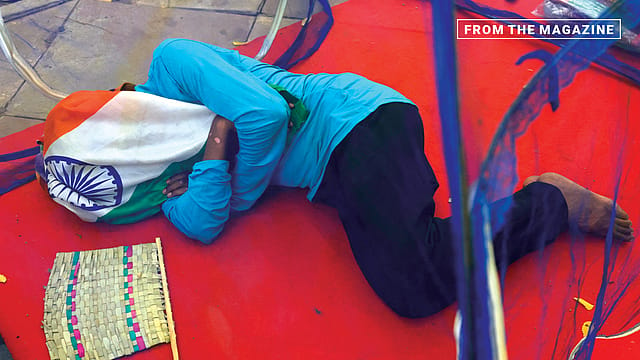
SOMETIMES IT IS TOUGH TO BELIEVE that the moral grandeur of India began with those famous words in Nehru’s speech involving tryst and destiny. That midnight where we were supposed to awaken to life and freedom, something else was unfolding. It was a catastrophe involving the arrival in bewildered streams of refugees from Punjab and the Northwest Frontier Province—people who had seen unspeakable things, people who had abandoned homes, businesses, and the corpses of their family members. Makeshift camps spread across Delhi brought along a violent streak which led to the massacres of the Muslim populace around the time we were told the country had turned a new leaf. It was so bad, as the scholar Rotem Geva notes in Delhi Reborn, that rioters entered bungalows of diplomats in New Delhi, looting, and killing Muslim domestic servants, leaving the government embarrassed.
That juxtaposition, that dialectic, has never quite disappeared. Delhi continues to remain an arena where India’s idea of freedom is repeatedly evoked and repeatedly questioned. The Constitution was drafted here, but some of its gravest deviations took place here as well. Every generation looks at the capital and feels that it must redefine what liberty asks of it. Delhi remains inseparable from that argument; it is the place where the argumentative Indian debates with herself.
The idiom of argument has changed over the decades, of course. The generation that came out waving flags at each other in 1947 derived their own meaning from the idea of freedom. Their children argued over democracy and authoritarianism. The one after them first debated caste and equality, then markets and opportunity. Now the vocabulary has changed to questions of citizenship, identity, and surveillance and belonging. In that sense freedom remains a conversation in continuum.
The city itself exists in layers than in a single historical moment. Next to Mughal tombs stand Metro stations; refugee colonies are prosperous enough for IKEA to open mega showrooms; villages got and continue getting swallowed by urban expansion. But with it also came the divide of class, sometimes influenced (or reinforced) by difference in religion. Scholar Sunil Kumar demonstrates this poignantly through an event mentioned in his book The Present in Delhi’s Pasts. In 1990, after a burglary in a block in South Delhi’s Saket colony, the bridge leading to the Muslim-dominated Hauz Rani was demolished, severing any chance of fraternisation between the two worlds. The young people who now make Instagram Reels around ruins hardly have any sense of how much the past holds and how much it has to reveal, provided one is to pay attention.
In many ways, the post-Independence ethic of a relentless appetite for enterprise stayed. It acquired more significance in people’s lives than constitutional ideals. But along with the commerce, Delhi also became the intellectual workshop of the republic. The city’s cafés, university campuses and newspaper and magazine offices produced arguments, nurturing democratic life. The Coffee House became its unofficial academy, with editors, poets, trade unionists, diplomats and civil servants drifting through its doors. In those days the toxicity of political binaries had not permeated lives. Marxists could debate cultural Right, Hindi writers could debate those writing in Urdu, journalists questioned politicians. In Brewing Resistance by Kristin Victoria Magistrelli Plys, socialist Parasnath Chowdhary remembers those days: “Everyday, a mass meeting would take place. But a mass meeting not of one opinion, but of many opinions. There was not one political party that was not represented there. That was the character of this coffee house. It was a highly… happening place, representing all sections of society… the minute you go there, you feel that the place is promoting discussion. You start to enter into discussions. You cannot help discussing things the minute you are there… And it was a loud and animated discussion. It was never a low decibel discussion. I call it a furtherance of democracy.”

The setting was ordinary, but the conversations made that space important out of proportion. Democracies, it was believed, depended also on such places where disagreement did not fuel perpetual outrage, turning politics into an ugly spectacle. The republic, one could argue, was rehearsed over coffee. It was also a time when ideologies arrived in universities from Europe, Latin America and the Soviet Union and students imagined themselves as participants in national rather than campus politics. Many of them eventually became ministers, journalists, historians or activists; in their later avatars many quite forgot the legacy they were supposed to carry forward.
The confidence in public argument as witnessed in the Coffee House encountered its greatest test during the Emergency. The June of 1975 revealed how fragile democratic habits can become when confronted with concentrated power. As newspaper editors began to submit and opposition leaders disappeared, the capital of the world’s largest democracy acquired the atmosphere of a city speaking in lowered voices.
The Emergency left behind physical as well as psychological scars. In neighbourhoods such as Turkman Gate, the
bulldozers, which we now have normalised much, forced demolitions carried out in the name of urban renewal. But it also made Delhi discover that freedom could not be assumed simply because it had once been won; that it required citizens willing to question authority, even authority exercised in the name of national progress. When the Emergency ended, it also marked the corrective capacity of democratic politics.
That discovery would be tested repeatedly in the decades that followed.
THE FIRST SIGNIFICANT confrontation of the new era arrived in 1990 with the implementation of the Mandal Commission’s recommendations. The image of Rajiv Goswami, the Delhi University student who attempted self-immolation, became an emblem of a generation anxious about its future in a fast-changing world. Both upper-caste students and historically disadvantaged students spoke what they believed was the language of justice, but they meant profoundly different things by it. One emphasised merit while the other highlighted historical exclusion, and neither vocabulary could simply erase the other.
Barely had the Mandal moment subsided when another transformation overtook India, of which Delhi became the billboard. Liberalisation, announced in 1991 as an economic necessity, gradually altered not only India’s markets but also its imagination. The Delhi which was run through waiting lists gave way to the Delhi of MNCs and gleaming towers that in no time stretched towards Gurgaon and Noida. The language of the Coffee House in Delhi was replaced by a language alien to the old India—a language of aspiration and of guiltless consumerism. That the young wanted things and were no longer impressed by their relatives settled in America gifting them cans of Coca-Cola ceased to carry the faint moral suspicion it once had. It also meant that the opportunity in the open marketplace itself became a democratic value.
As the free market launched its victory parade, it also sharpened contradictions that Delhi could neither conceal nor resolve. Luxury apartments rose beside illegal settlements. The EMI became the emblem of a generation of young people, especially from small towns who made Delhi their home. Delhi could no longer accommodate their living requirements, so they went to the suburbs. Later the Metro arrived, connecting neighbourhoods separated by startling differences in wealth. The city’s physical landscape became an atlas of unequal freedoms. This contrast has only increased. One could say that this contrast is not merely economic; it is a contrast between different shuttles to the same republic.
One of Delhi’s striking features is that moments of profound civic mobilisation have often emerged from the most unexpected coalitions than organised parties. The anti-corruption movement of 2011 illustrated this possibility. Anna Hazare’s fast at Ramlila Maidan attracted all kinds of people, from civil servants to students, lending to it an almost festive quality, as though politics itself had briefly become a public celebration rather than a partisan contest. Its limitations, as we can see in hindsight, notwithstanding, it told us that Delhi remains capable of producing civic energy that exceeds the calculations of political parties. It is something about Delhi as a place which makes ordinary citizens believe that assembling here could reshape the moral direction of the nation.
The same sentiment shaped another mobilisation a year later after the rape and murder of a young physiotherapy student. The demonstrations altered public discourse. It was not about elections or institutions but about the ordinary act of walking home after dark. The protest also exposed Delhi’s inability to expand its moral horizon. Many argued that the protests happened because those who came out could identify with the victim, Nirbhaya, but so much else was happening around the country which evoked no such response.
It is perhaps because of this that Delhi continues to attract people who believe that the republic can still be changed by occupying its public spaces, even if in some cases, it only occupied space of a cardboard carton’s size at Jantar Mantar before Gen Z took over it. It remains so even as politics is now increasingly being conducted through television studios, messaging groups and social-media feeds. The physical journey to the capital has retained an almost archaic significance; from farmers to those who want to highlight a small act of injustice in some mofussil town, the symbolic distance between a citizen and the state is nowhere smaller than in the capital.
GEN Z HAS INHERITED this complicated city at a particularly uncertain moment. They are the first generation for whom the internet feels like a natural habitat. They have grown up with the state, corporations and platforms all capable of knowing things about them that earlier governments could not easily know. Surveillance, once associated primarily with the police or the intelligence services, has acquired a form that is ubiquitous. Privacy is no longer simply the right to be left alone; it has become a question of who owns the information produced by what one does online.
The young also inhabit a Delhi shaped by extraordinary inequality. They can order almost anything to their homes, travel across the city in an air-conditioned Metro or Uber, study abroad, work remotely for a foreign company and become popular from innovative videos on Instagram. But, around them, millions who keep the city functioning remain precariously employed and poorly housed—sometimes they die in sewers because we don’t believe what Nehru said in his midnight speech applies to them. Freedom of choice is real, but its distribution is not equal. This remains the oldest problem in the city’s history: political freedom and social freedom have never advanced at precisely the same pace.
The refugee who rebuilt his life in 1947 wanted security; the student protesting Mandal wanted opportunity; the woman on the streets after the Nirbhaya case wanted safety. The young person posting Instagram Reels from a Delhi bedroom today may want something more intimate: the right to construct a self that does not conform to the expectations of family, caste, religion, gender or nation. This is why the history of Delhi cannot be reduced to a history of which government was in power at Raisina Hills. They have changed, sometimes dramatically, but the city’s deeper history lay in the claims made upon them. The important question is not only who occupied the seat of power but who was standing outside it, and what they were asking for.
There is a temptation, especially in moments of political polarisation, to imagine that freedom belongs naturally to one side of an argument. Delhi has tried resisting that as much as it could. The language of liberty has been used by the Left and the Right, by student movements and governments, by those demanding greater state intervention and those demanding less. The republic becomes impoverished whenever one group assumes that it has acquired permanent ownership of the word.
That is the lesson Delhi always tries to impart through its own example. It has been rebuilt many times; it has survived emperors, colonial rule, Partition, wars, political upheavals, communal violence and extraordinary demographic change. Each rebuilding has left something behind.
The city is therefore less a monument than an accumulation of arguments.