The Age of AI-Ready MBAs
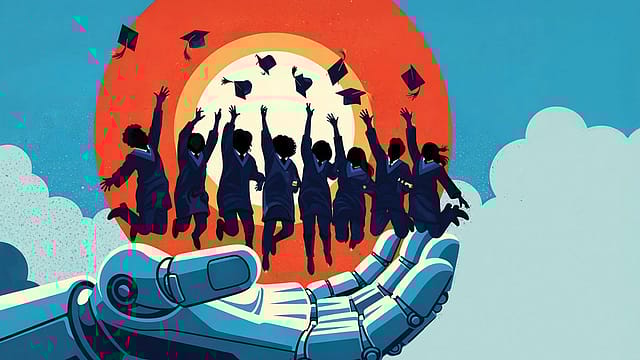
ON THESE PAGES OVER the past many years, we have dwelt at length on the challenges and opportunities for B-Schools as the world continues to get buffeted by technological tsunamis that are quickly transforming the world in the way the most imaginative of our sci-fi writers had forecast the future. This year, much more than ever before, we saw artificial intelligence (AI) behemoths enter India with the aim of surviving competition and as a means of cementing their next stage of growth. Players such as OpenAI, Perplexity, Anthropic and others betting big on their India foray and other established players like Google (Gemini) and X (Grok) expanding their footprint by tying up with governments, educational institutions or other federal agencies and corporations, or seeking future growth—all this is proof of their designs in the most populous country in the world, our India, one of the biggest users of AI products.
We may not be big as makers of AI products, but we are an AI powerhouse in terms of usage of generative AI tools, a recessive trait of sorts that make us crucial as a market. While the US remains the biggest user base of many AI giants, India is the biggest user of their products when it comes to students, especially of OpenAI’s ChatGPT. In the face of intense competition in the crowded US market, tremendous pressures of regulations in Europe and formidable local competitors in China, the tech companies that make these products find it a necessity to cast their net wider in India in order to stay ahead of the race and survive.
Well, let’s get back to B-Schools.
Facts, first. AI products, especially Large Language Models (LLMs), are no longer mere teaching aids. They are a systemic force reshaping capitalism, labour, decision-making, and much more. They are increasingly determining how to learn, what we need to do and what we don’t need to do in a world where job functions keep appearing and disappearing at a fast clip, often leaving a trail of despair and devastation among those without the privilege of reskilling themselves to be job-ready in a rapidly changing market.
It is in this context of the emergence and rising presence of AI as a potent force in everyday life—and as a phenomenon more revolutionary and disruptive than previous parallels such as the internet, financial modelling software and so on— that business education has to be reviewed and reassessed. Endless questions arise, especially in the Indian situation: are our business schools adapting to new challenges critically or just cosmetically to cut corners? Are we short-term oriented or are we aware of long-term challenges? Are we conscious of industry needs that are changing at breakneck speed? Are we mindful of the plight of the educationally unemployed, especially unemployed MBAs? Is there return on investment in business education in the country or, for that matter, elsewhere? The whole idea of education in general and business education in particular is under the scanner over more profound reasons, too: is the whole exercise to equip students to form judgements or to optimise outcomes in the jobs they are going to take up? Tensions within B-Schools are palpable as some of them debate such pressing topics.
Recently, I met Nobel Prize-winning German astrophysicist Reinhard Genzel, who is co-director of the Max Planck Institute for Extraterrestrial Physics, at an interaction in Hong Kong, where he said that he would not judge a student anymore based on what he or she writes alone but through oral exams and interaction in labs or work-like situations. His observations may appear contrary to conventional views of education but they are perhaps indicative of changing expectations about how to examine the qualities and job-readiness of a student. To a large extent, the celebrated physicist was casting doubts about the trustworthiness of our excessively AI-enabled education system, be it at B-Schools or an institute that teaches pure science. At a time when machines tend to outperform humans in probabilistic reasoning and are also capable of creating fakes, such doubts are going to linger for long or may never cease. The challenge therefore for B-Schools, which, as such, are facing an existential crisis in the face of cheaper alternative sources for learning, will have to bring in more creative ways to equip their students to the demands of jobs of the future, and to enable them to take up leadership roles without relying excessively on machines.
AI is obviously useful in teaching. It has its myriad advantages. It will get rid of routine tasks and help students and future employees focus more on creative work— at least that seems to be the hope we have and we are going to be proved right by all indications. True, heavy reliance of corporations on pattern recognition, and predictive frameworks in their jobs make AI an excellent choice because these are areas where it outshines humans, especially in the time of Big Data. Which is why we are seeing the trend of jobs that involve analysis, strategy frameworks, financial modelling, etc, becoming increasingly automatable.
Notes Sreejith Sreedharan, Bengaluru-based author and Aula fellow: “AI has the potential to change business education in a way classrooms have struggled to do for decades: closing the gap between theory and real work. Not by adding more content, but by making learning responsive to reality on the shopfloor. Instead of relying on case studies frozen in time, AI can continuously translate live market shifts, organisational failures, and emerging patterns into learning material almost as they happen.” Adds Sreedharan, whose latest book is Future of Work - AI Augmented Autonomous Decentralised: “Personalised AI tutors can adapt to how people actually learn, not how syllabi assume they do. Simulations can let students test decisions, experience consequences, and adjust, without waiting years to find out what worked. The result is not smarter courses, but more honest ones. Education that prepares people for ambiguity, trade-offs, and change. And that benefits students, employers, and institutions far more than another polished framework ever could.”
NONE OF THESE changes are without pitfalls, however. As more people rely more on generative AI for case preparation, simulations and other tasks, AI tutors and adaptive learning platforms will keep replacing faculty and meaningful interaction between human teachers and students. This not only results in loss of jobs for educators but also in a rapid decline in human-to-human interaction to help learn from each other, a practice that has helped us hone our skills in problem-solving and logic for thousands of years.
Sreedharan points out that the main risks to watch out for are becoming too dependent on AI and losing important human skills. If people rely on AI too much, their ability to think critically, use judgement, and lead effectively could weaken. There is also the risk that biased algorithms repeat poor business practices instead of challenging them. “Another concern is losing the value of learning from peers, building relationships, and informal conversations that traditional programmes offer. While AI is a highly self-empowering technology, it also carries the risk of social isolation when learning becomes overly individualised. Business schools need to use AI for efficiency without neglecting what only humans can do well, such as ethical thinking, emotional awareness, and creative problem-solving. The real challenge is not whether to use AI, but how to use it in a way that strengthens, rather than replaces, human judgment and relationships, especially at a time when the value of business education is already under scrutiny,” he explains.

Some analysts are of the view that since the march of technology is often unstoppable, the focus of teaching in B-Schools and others in this age of AI must change from teaching how to analyse to how to interrogate analysis, stressing again on human interaction. Incidentally, there is a growing argument that emphasis must be placed on asking the right questions, not just in generating answers. They aver that MBA students are taught to comprehend model biases, data provenance and algorithmic limits—in order to be in control of multiple workplace scenarios.
Still, we are at a stage where there is greater fear of redundancy or marginalisation of the teaching staff. Moreover, we will undoubtedly face uneven AI literacy across generations and disciplines— which is par for the course because of the unequal nature of educational schools, including B-Schools. Many futurists have also long cited the risk of excessive managerialism creeping into academic governance, thanks to ‘efficiency’ arguments. The point is the faculty will have to think out of the box to reclaim roles as interpreters, critics and ethical guides.
From the viewpoint of future employers of B-School graduates, they are going to look at AI fluency among new recruits as baseline, not specialisation. Such changes are sure to bring in concomitant difficulties for both B-Schools and employers. While B-Schools will grapple with the need to upgrade AI competence of students, corporations will see more managers deferring decision-making to machines, generating issues over ethics and learning. Again, B-Schools, many analysts suggest, may become an appendage of BTech and lose its relevance further. Students becoming augmented workers would be the outcome.
For each advantage, there is a disadvantage and vice-versa, and traditional ways of learning and working are set to change.
The brighter side is that AI will more or less democratise access to high-quality simulations and analytics, facilitate more interdisciplinary teaching (for instance, linking business with philosophy, sociology, or public policy); and lay greater focus on real-world complexity rather than sanitised case studies, besides other possibilities.
We could go on and on about pluses and minuses because of the uncertain nature of the impact of AI and because our forecasts are based on current values concerning education, management and work. Ethical issues, too, will surface like never before—they have already begun to worry policymakers. These are about the biases in the data used to train business AI tools, which are sure to reinforce existing inequalities: between the poor and the rich, between elite schools with access to better tools, data, and partnerships and the others, between the Global North and the Global South. That AI is an amplifier of the typical shareholder-centric logic will also hurt the interests of the majority, as is always the case in a discipline that values profit maximisation more than anything else. But the hope is that there will be a backlash and rise of critical perspectives going forward—that encompass feminist economics, labour studies, non-West contexts and so on.
As we can see around us, there is a massive increase in the demand for “AI-ready MBAs”. That many institutions are forced to do that without substantive curricular changes will make the marketing cumbersome and open to scrutiny once these candidates are hired.
The fact that AI tools are trained largely on Western corporate data will precipitate matters because there would be a likely mismatch between local business realities and algorithmic assumptions. This is, in fact, a blessing in disguise, if you care to see it differently—it gives an opportunity for B-Schools in the Global South to develop alternative models and obliterate the risk of intellectual dependency mirroring older development hierarchies.
Now, the questions we have asked on these pages in previous years continue to be as relevant or more: Is the two-year MBA still defensible in an AI-accelerated world? After all, the battle is between modular, lifelong learning models versus degree-centric models.
Last year, we had discussed a lot about challenges B-Schools face from Massive Open Online Courses (MOOCs), which disrupt traditional models of higher education by offering free or low-cost tuition, forcing institutions both in India and elsewhere to justify their high tuition fees. MOOCs are agile, regularly update content to reflect industry trends, and business schools, from top-notch to new ones, often struggle to revise curricula at the same pace. (‘The Making of the Intelligent Manager’, December 16, 2024).
The growing perception among B-School watchers the world over and especially in the Global South is that AI will not kill business education, but will expose its weaknesses, and that schools that treat AI as a shortcut solution will hollow themselves out. However, those that embrace it critically can reassert their intellectual and social relevance.
Sreedharan, meanwhile, does some crystal-gazing. “With many future roles still undefined as per WEFs latest Future of Jobs report, business schools must move beyond preparing students for familiar or specific jobs and focus instead on building adaptability. As AI absorbs more specialised tasks, the human skills that matter most are becoming broader and more generalist in nature. This calls for curricula and pedagogy that develop learning agility, comfort with ambiguity, sound judgement, and effective human-AI collaboration. Equally important is strengthening capabilities that remain distinctly human, such as ethical reasoning, creativity and emotional intelligence. Rather than optimising for fixed career paths, business schools should emphasise continuous learning models that enable people to reskill, adapt and reinvent themselves over time. The core function is no longer training for known roles, but equipping graduates to navigate constant change with resilience and discernment,” he states.
While academics, AI watchers and technologists in general remain cautiously optimistic about how AI will change education as a whole and B-School education in particular, they also warn that the real test is not whether B-Schools can use AI, but whether they can teach students when not to, so that they may retain an edge in leadership and critical thinking to complement the functions of AI.