Temple-Mosque Disputes: The Missing Middle Ground
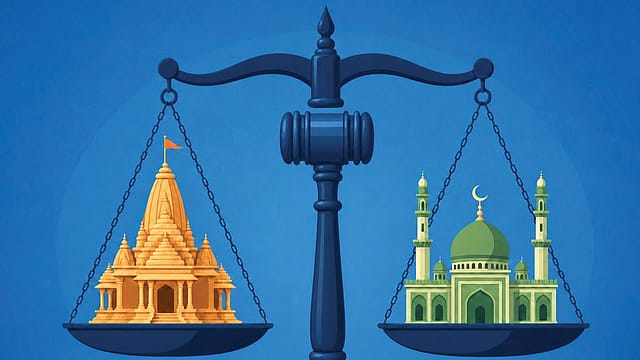
IT IS A PITY that the Supreme Court’s efforts to find a mediated solution to the temple-mosque disputes at Krishnajanmabhoomi-Shahi Idgah at Mathura, the Kashi Vishwanath-Gyanvyapi mosque at Varanasi and the Shahi Jama Masjid-Hari temple at Sambhal have failed. The lack of success is not surprising given the past record, but it is disappointing that there might be no recourse to extended and polarising court proceedings that will inevitably mean one side will end up being the loser.
During the long court process that preceded the November 9, 2019, Supreme Court verdict upholding the rights of Ram Lalla to the site in Ayodhya where the Babri Masjid once stood, there had been several attempts at resolving the dispute through negotiations. In February 2002, the Vishva Hindu Parishad (VHP) said it was ready to accept a court verdict on its temple claim in the course of discussions with the All-India Muslim Personal Law Board (AIMPLB). This was a significant concession as VHP had held the Ram temple at Ayodhya to be a matter of faith.
The discussions, facilitated by Kanchi Shankaracharya Jayendra Saraswati, failed, and the deadlock continued. A publicly stated agreement to accept a court ruling by both sides would have encouraged the judiciary to settle the matter speedily while reducing room for political partisans to play spoilers. Yes, one side would still have been a likely “winner”, but a thaw and mutual accommodation might have created room for a more amicable settlement of a dispute going back hundreds of years.
It was near impossible for Muslim leaders who struck a conciliatory chord in private to alter public positions even as the 1991 ‘A historians’ report to the nation’ penned by Left academics claiming no Ram temple pre-existed the Babri Masjid stood exposed by the findings of the Archaeological Survey of India (ASI). The ASI’s excavations revealed the presence of a large ancient temple. Truth be told, the Left authors should have been asked to explain why they led the Muslim community up the garden path, claiming that it had a strong case.
An argument leveraged to oppose negotiated settlements in temple-mosque disputes is that the Muslim side might be pressured into accepting an unfair deal. That the majority religion’s claims might assume disproportionate weight. But what’s the harm in serious and sincere negotiations? If one side feels disadvantaged, the judicial option is still open. Will the side that ‘concedes’ be belittled? In weighing this question, it is important to consider if both sides are willing to engage in a frank discussion on the evidence supporting their contentions. It is also important to recognise that parties—not just the political ones—egging on disputants may not be interested in solutions. Politicised activists and religious fundamentalists should be kept out, and talks conducted away from public glare.
A negotiated settlement will not leave a bitter aftertaste on either side. Rather, since there is concurrence on the part of both parties to the dispute, there is a real prospect of improved communal relations. If a sense of magnanimity were to prevail, could it not be possible that the future would be less contentious than the past? This might seem removed from reality and at odds with our polarised times. Actually, a willingness to cast away blindfolds can deliver unanticipated results.
For quite some time, during the VHP’s long struggle for the Ram Mandir, its leaders said that if Muslims were prepared to accept Hindu claims at Ayodhya, Varanasi and Mathura, time could be called on any other such disputes. “Three sites for 3,000” was how the VHP put it. The point was that the VHP would agree not to raise any other claim beyond three disputes that were particularly significant for Hindus. After the construction of the Ram temple, the Rashtriya Swayamsevak Sangh (RSS) said it did not envisage an Ayodhya-type agitation. But things have taken a different turn with the high court upholding the Hindu claim in the Bhojshala case and a judiciary-monitored archaeological survey conducted at Varanasi. In the Mathura case, ASI has said a 1920 British gazette does record the demolition of a temple.
This is not to argue that claims to a mosque in the three disputes the Supreme Court referred to special Lok Adalats must necessarily suffer if negotiations are not considered. In the Mathura dispute, the Muslim litigants failed to turn up before the designated court. In the Varanasi case, both Hindu and Muslim sides sought a judicial verdict. In the Sambhal dispute, the Muslim petitioners said that since the case concerned the faith of two communities, only a judicial verdict would be acceptable. If this be the case, then a judicial pronouncement, howsoever unpalatable, must be solemnly accepted by all sides to the dispute and respected by governments and political leaders. A quietus must then prevail.
The problem lies in evidence that courts are subjected to deliberate procedural delays by litigants hoping to prolong and obfuscate proceedings. A battery of expensive lawyers, many guided by their political beliefs, do their best to ensure no solutions emerge. In the Ayodhya case, the attitude of the Central government was an important factor. The United Progressive Alliance (UPA) government had no interest in the matter being resolved. On the other hand, the National Democratic Alliance (NDA) felt the Hindus had a strong case and wanted an expeditious conclusion to the case languishing in the Supreme Court since December 2010, when appeals were filed against the Allahabad High Court’s order dividing the disputed 2.77-acre plot between Ram Lalla, Nirmohi Akhara and the Sunni Waqf Board.
If indeed there is no other way but to opt for a judicial verdict, fast-track courts must be set up to specifically consider such cases with explicit instructions not to brook attempts to delay proceedings through legal manoeuvres. It must be recognised that while disputes over religious sites provide political parties an opportunity to consolidate vote banks, their non-resolution denies genuine devotees the right to worship enshrined in the Constitution.
ASI’s excavations at Ayodhya uncovered evidence about the destruction of a temple that lay not far below the surface. Attempts to delay resolution of other disputes can delay, but are not likely to prevent similar truths from emerging from the detritus of history.