Suvir Saran: Swaying to Satsang
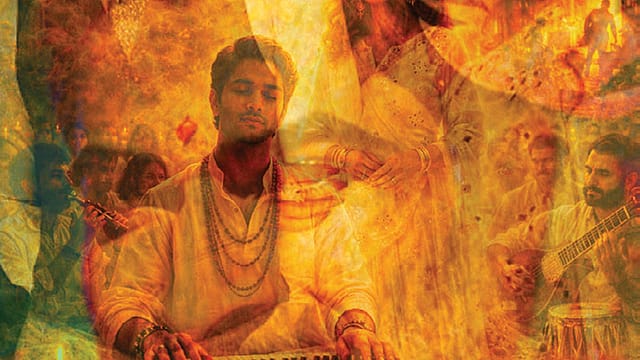
IN A CITY THAT has forgotten how to open its doors, a house on Malabar Hill remembered. It did not announce itself. It did not assert its grandeur. It simply stood— serene, self-assured, steeped in a silence that spoke of another time. A time I had only known through black-and-white photographs of Bombay and Delhi’s old mini-palaces, where wealth was not loud but lasting, not displayed but distilled.
The driveway did not lead to an entrance; it led to an arrival. Room after room revealed itself not in spectacle, but in sequence— moulded ceilings, mirrored walls, carved wood, photographs that felt less like decoration and more like documentation. A fan hung low from an impossibly high ceiling, and yet the space expanded, like memory.
And somewhere in that expansion, I felt it— déjà vu not as illusion, but as inheritance. I had been here before.
As a child, singing at Birla House in Delhi, guided by Ustad Amjad Ali Khan and Nalini Kumaran, marking the memory of Mahatma Gandhi—his evening discourses, and the unbearable knowledge that he was taken from that very space. Sitting here at the satsang now, those memories did not return; they rose. This time, I arrived because of my friend Anandita De, who insisted I come. I came not as a believer but as a sceptic. I came wondering if this would be one more performance of piety, one more carefully curated spirituality.
And then I saw Nirvaan Birla. Tattooed, modern, entirely of this moment—yet deeply at ease, deeply assured. There was no effort in him, no need to convince. The kind of presence you might imagine cast in a film—something of Jacob Elordi—that brooding, beautiful stillness, the suggestion of strength without display, of interiority without insistence.
For a fleeting moment, I wondered if this was all a set. If somewhere behind the satsang’s singing, a silent heist was unfolding—shadows slipping past sculptures and canvases while we surrendered to satsang and song. It felt that cinematic, that surreal. And yet, nothing about it was false.
The gathering was stripped of excess. No offerings, no spectacle—just water, just welcome. The house did not show itself off; it shared itself. Its wealth spoke not of accumulation but of continuity. Then the music deepened. A Shiva bhajan, low and excavating, drew us inward. It was not sound, but descent. Just as it reached its quiet depth, Avanti Birla entered. There was no announcement. Only a shift. The energy rose. The hands moved, the tempo lifted, and the room surged into a shared crescendo. It felt like catharsis—grief and grace meeting in one breath. She had arrived carrying her own world, and yet her presence released ours.
When I told her I had sung at Birla House as a child, her eyes widened—with recognition, with pride. Time folded. Past and present held hands. This, I realised, is what the family does: they do not preserve history—they practise it. Around me, young musicians played without ego. No showmanship. Only surrender. And in that surrender, we found our own. I sang too. A voice trained, yes—but also a voice returned. To childhood. To truth. To something unguarded. And what stayed were not the words, nor even the music—but the energy. A room where nothing was being taken, and everything was being given. Where people dissolved into one another building the satsang.
And at the centre stood Nirvaan—not as a godman, not as a spectacle, but as a conduit, completely present. A young man, entirely comfortable in himself, creating a space where, for a few fleeting moments, we could step outside our suffering and into something shared. I had arrived a naysayer. I left, not converted but connected. And in a fractured world, perhaps that is faith enough.