Solar Urgency: India has made a smooth transition to green energy
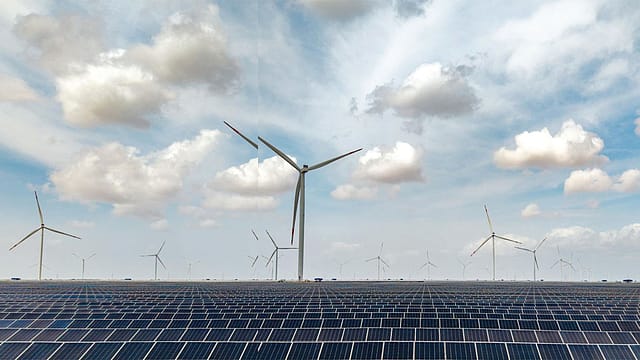
ON JUNE 29, the national capital witnessed a huge surge in demand for electricity. At 17 minutes past 3PM, demand surged to an unprecedented 8,748 MW of energy. But far from stressing the national power grid, the managers of the system were able to handle the situation with aplomb. This was in no small measure due to the abundant availability of solar energy across the country. Not only are renewable energy sources helping India meet its galloping energy demand but they are also powering a green transition.
This situation stands in stark contrast to the largest blackout India experienced in recent history. On July 30 and 31, 2012, India suffered a collapse of its electricity grid. At its peak, more than 600 million people were without electricity. It took the better part of a fortnight for normalcy to be restored. Behind the official obfuscation about “inter-grid” collapse lay a fundamental reason: power demand outstripped supply and at some point the grid gave way.
A decade later, the situation is a reverse of what prevailed in India’s “dark age”. Thanks to the vast increase in renewable power generation, India now enjoys healthy power surpluses.
India’s situation is unique in many ways. Sustained investment in renewables in the last one decade is now bearing fruit. This is in contrast to the on-and-off approach seen in many countries where political problems and investment bottlenecks often derail plans. India, instead, spent close to $42-45 billion (depending on the exchange rates) on non-fossil sources of energy in 2025 according to the International Energy Agency (IEA). The country’s share in polluting, fossil-based energy sources was just $10 billion that year. This is a marked change from the situation in 2015 when investment in fossil fuel-based energy generation was higher than environmentally friendly generation at $15 billion. Since then, every single year, investment in renewables has continued to outpace “dirty energy”.
All this began much before India agreed to do its bit for the safety and future of the planet. In 2021, during the Covid-19 pandemic, Prime Minister Narendra Modi made five commitments at the United Nations Climate Change Conference in Glasgow. Two of the five commitments pertained to India’s transition to a green energy future. These commitments were that India would increase its non-fossil energy capacity to 500 GW by 2030 and also meet 50 per cent of its energy requirements from renewable energy by that year.
The second commitment was reached five years ahead, in 2025, when the country clocked 250 GW of renewable energy capacity, well ahead of the 2030 deadline.
At the end of June this year, India had an installed power generation capacity of 548.2 GW. Of this, 251.48 GW was fossil-fuel based. This is 45.82 per cent of total installed capacity while non-fossil fuel power—that includes renewables, hydro-power, and nuclear generation—was just a tad short of 300 GW at 297.36 GW. This is a remarkable achievement for a country that even a decade ago was pleading with Western powers for “climate finance” to fund its green energy ambitions. Ultimately, there was little doubt that a switch to renewables made great economic sense. The West Asian crisis—the war between the US and Iran—and the consequent squeeze on India’s hydrocarbon energy flows from the region once again highlighted the danger of energy dependence on other countries in a volatile world.
India’s reliance on hydrocarbons now is mainly due to their necessity in transport and as feedstock in various manufacturing processes. In other neighbouring countries (Pakistan is a good example) the use of LNG for power generation only reinforces India’s choices for power generation that do not depend on imported energy. In fact, Pakistan is purchasing very expensive LNG cargoes just to its keep power plants humming. Its power sector is, by design, crisis-ridden.

Given the scale of India’s energy investments, the first commitment is likely to be met by 2030. The challenge for India now is to reduce the carbon intensity of its economy by less than 45 per cent by 2030. India’s success towards achieving its green energy transition goals has created its own set of peculiar problems. Two are noteworthy. The first, interestingly, is about problems associated with the rapid increase in solar power generation, where success is now creating fresh challenges. India is now facing a “problem of plenty” in its solar power system. The second challenge involves the “coal economy.” How will India unwind its coal sector now that a green energy transition is well on its way? These two issues have created their unique challenges.
Consider solar power. Its contribution to India’s energy security is unquestionable. Installed solar power capacity stands at 29 per cent of total power generation, up from barely 2 per cent just a decade ago. But along with this huge increase in solar generation has come a different set of problems. Solar power generation takes place during daytime and quickly tapers off as soon as the sun sets. At that point, the demand for other sources of power generation goes up dramatically. This can be seen from the so-called “duck curve” that traces the net load on the grid system, the total load minus the contribution from renewable sources of energy. This goes down as soon as daylight breaks and then begins to inch up in the evening when solar generation drops quite fast.
The problem for India is that its solar generation has grown by leaps and bounds but its power storage capacity is still stuck at a low level. A recent analysis by members of the Prime Minister’s Economic Advisory Council noted: “The shortfall is overwhelmingly a battery shortfall: against the National Electricity Plan’s projection of 8.68 GW of grid-scale batteries for 2026-27, only 0.27 GW was in operation till January 2026, even as pumped hydro very nearly reached its mark at 7.2 GW of the 7.45 GW projection.” The contrast with solar generation that stands at 162 GW and storage capacity that is not even 1 GW outlines the problem starkly.
This is taking a toll on solar power generating companies. Solar power, at least during daytime, is well above the average daytime demand. In plain language: much of the energy generated goes to waste as India lacks the capacity to store it. India needs to invest heavily in storage capacity, especially high-capacity batteries. So far, India has not developed these technologies domestically on the scale they are needed. India tends to buy technology off the shelf instead of investments in solving problems. The case of electric vehicle (EV) batteries is a case in point. Power storage at GW scale is a different and far more challenging problem.
Some parts of the problem can be solved by tweaking the regulatory system. For example, if batteries are considered to be a part of the power generation system, then investments may have a better chance. Similarly, India currently has a system of long-term power purchase agreements between power generating companies and only a much smaller fraction of power is traded on electricity exchanges. If India is to ramp up non-fossil fuel generation, then market-based power trading and price discovery have to increase dramatically. Many of these problems can be solved by amending the Electricity Act, 2003. A draft amendment Bill has been ready since 2025 but political opposition and street protests by farmers, especially from Punjab, have led to the Bill being consigned to cold storage.
Then there is the issue of the coal economy. Thermal power is at the top of India’s non-renewable sources of energy and accounts for nearly 41 per cent of installed capacity of 548.85 GW of energy. This figure has come down substantially from the nearly 74 per cent of energy being generated by thermal power stations just a decade ago. While the rapid increase in renewables has been hailed, the transition away from coal is not so simple. India currently employs nearly four lakh people in coal mining and associated activities. Nearly 10 times that number, around four million, is dependent on the coal economy in one way or another. Most of this manpower is unskilled or possesses rudimentary skills. This large number of workers cannot be wished away even as India powers its way to a green future. The problem of the transition is that as the proportion of renewable energy goes up, the productivity of this pool of labour will go down. This cost is part and parcel of the green energy transition.
Both problems pose significant policymaking and financial challenges. On one side is the large number of people who have to be absorbed in other parts of the economy so that they are not left stranded. On the other are technological and legislative challenges that need to be addressed if renewable and non-fossil power generation have to take off. Can these be solved? There should be no doubt about that. A decade ago, when the government talked about increasing solar power generation, critics scoffed at the plan. There is no reason to doubt that India will manage its green energy transition successfully.