Sikkim: Buddha on the Lake
WE WAKE UP BEFORE THE ALARM. It is close to 4 in the morning, but an inky blue light has already filled our room. Outside, the first stirrings of daybreak are here. There is the shuffle of feet in the corridors, presumably those of the hotel’s staffers preparing for the day; a cough here and there in other rooms, muffled probably by layers of woolens drawn up to their faces; and somewhere in the distance, there is the rumble of a jeep being started to warm its engines. When we stand by the windows, we see dark shapes coalescing into the outlines of houses, and, one by one, lights begin to emerge in them. Somewhere in this town, there is an old monastery atop a hill, but right now in the semi-darkness, we can only hear its presence in the form of chants and clashing cymbals.
We are in Lachen, a remote town said to number around a thousand or so, in the higher reaches of northern Sikkim. The three of us had been riding on two motorcycles for over two days, starting from the town of Kalimpong in northern Bengal, and then travelling via Gangtok in Sikkim and Kabi, a village where we halted for a night, to finally reach this distant location. Our final destination for this leg of the trip—the sacred Buddhist lake known as Gurudongmar Lake—now lay only a few hours away.
We had begun our journey just as a storm was building two days ago. But what had at first appeared a slight unseasonal rain had turned into a torrential downpour and we had arrived in Lachen at night drenched to our bones. What had remained of our spirits had shattered upon finding there were no meals at the hotel. But a kind couple in a house nearby opened their kitchen to us, and, making us sit around a fire, went about preparing a meal.
“I don’t know if you can make it,” the husband said. He was walking around the kitchen, opening a fridge that I was amazed to find was filled entirely with the meat from a yak slaughtered that morning (it even contained bottles filled with blood to be used for making gyurmas or blood sausages), taking out chunks of meat, passing it on to his wife, who silently hacked at it and prepared a meal of rice and yak meat.
“Just look at the day,” he went on. We followed his gaze out through the window into the dark night outside where a storm raged. “Only god can allow you to make the journey.”
I lay awake on the bed that night offering tentative prayers, even as the rain lashed against the window of my hotel room and roared on its tin roof. Although travel guidebooks will not list September, when we had made this journey, as one of the ideal months to travel to this region—the best windows are those between March and June, and October and November—but it isn’t usually considered a bad time either. The rains let up by this time and the clearer skies of October are usually upon us. But tonight, as the storm continued to rage outside, I wondered if we had made a mistake. Had we travelled all this way up only to have to stop here? Would we reach Gurudongmar Lake, provided we even managed to ride to that spot, only to see nothing but fog around?
The prayers did not appear to be working through the night, but we awoke the following day to a quiet morning. The storm had passed, even though the skies still remained gray.
After rushing through our breakfast, we lay the articles for our trip on a bed. There were our helmets, our first-aid kit, medicines for altitude sickness, chocolates to help with the fatigue, a small oxygen can which we hopefully wouldn’t need, our rain suits, and khadas (the Tibetan ceremonial scarves) to offer at the lake. After saying a little prayer at the altar set at the hotel reception, and feeling not entirely unlike pilgrims, we started out for the sacred lake.
Gurudongmar Lake, located at an altitude of around 17,800 feet and just about five kilometres from the border with Tibet, is considered one of the highest lakes in the world. It derives its name from Guru Rinpoche or Padmasambhava, the 8th-century Indian tantric master who brought Vajrayana Buddhism to Tibet and who is believed to have blessed this lake during his travels here. Padmasambhava, often referred to as the Second Buddha, is a central figure in Tibetan Buddhism. There are several sites spread across Tibet and other parts of the Himalayas which are associated with him, often places where he is believed to have meditated or subdued spirits, and these are today revered as pilgrimage spots.

Padmasambhava is believed to have regarded Sikkim as a particularly sacred space for meditation and dharmic practice. In an article about the role the 8th-century tantric master played in disseminating Buddhism here, Thupten Tenzing from the Namgyal Institute of Tibetology in Sikkim quotes from the works of Dorje Dechen Lingpa, a high lama and scholar in the late 19th and early 20th centuries. “This hidden land of Sikkim, where formerly even the Buddhas would not have dared to set foot, was surrounded by forest and rocky terrain which was difficult to pass through. It was the home for apes, wild animals, cave demons, dreadful Nagas, and evil spirits where not even a single human species lived,” Tenzing quotes from Lingpa. “It was then visited by Padmasambhava. He blessed these terrifying and dangerous places of deep recess, steep rocky formation, impassable trail, empty caves, a dwelling place of demon and vampire as a centre of meditation and spiritual practice by converting the harmful sprits inhabiting these landscapes into the protectors of dharma.”
Padmasambhava is believed to have arrived at this lake during his journeys, and, upon learning of the locals’ plight who suffered from a water crisis during winters when the lake froze, touched a small portion of the lake, blessing it to remain unfrozen forever. Many will recount this story as you travel to the lake. And that spot, according to them, continues to remain unfrozen.
WE ARE TRAVELLING now upon a road that rises steeply up the hills. Boulders lie scattered from recent landslides and massive waterfalls rush down the sides of the hills. We had been climbing narrow precipitous roads over the last two days, but it is nothing compared to the rapid climb now, and the motorcycles groan under the pressure. Around us the views are changing every minute. Green hills are giving way to snowy mountains, and the green forests are turning into the dry desert-like conditions of the Tibetan plateau. We ride silently through this cold morning, taking in the views with awe, stopping only occasionally to show our permits to the designated Army posts, before reaching what has been dubbed the “world’s highest dosa point”. This is a dosa canteen, opened only a few years before and run by the Indian Army’s Madras regiment, but it turned out to have been shut for several months now. We settle instead at a shack nearby, sipping on sweet milky tea, as the local who ran the establishment spoke of the wish-fulfilling abilities of this lake.
From here, the roads to the lake get even higher. But after a few hours, it suddenly settles into an entirely flat land. It is at this moment when you feel as though you have reached some higher realm. The grey sky has now turned into an unnatural blue, and it appears to hang so low that you can be tempted to feel you can grasp it.
The condition of the road however keeps worsening, and one often needs to step down and walk several stretches. It is at these moments when you feel the pressures of the high altitude. Your boots hang heavy on your legs and every step feels like a massive exertion.
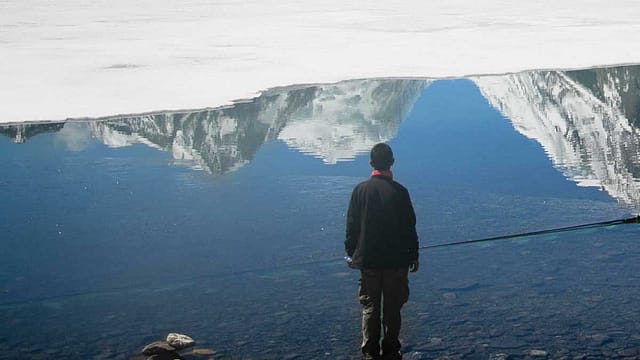
We travel this way, riding under wide open skies and stepping down occasionally to walk beside the motorcycle, until we spot a small structure at a distance. I have to step down yet again, and making my way up a small path strewn with tiny pebbles, I arrive at this structure breathless, to find beside it the lake we had been chasing all this time. Gurudongmar Lake, a large turquoise lake ringed in by snow-capped peaks, spreads out right in front of us.
There was both revelry and pilgrimage here. Some tourists, thrilled by the sights, blast music from cars. Elsewhere, pilgrims are moving about silently reciting sacred verses, burning juniper as offerings and stringing up prayer flags. Others like me, exhausted from the exertions of getting here, just collapse on whatever benches we can find.
An amusing aspect at this lake is the dispute that has arisen in recent years over a temple that has been built beside it. Some Sikh Army officers stationed in this area, convinced that the lake and the myths that have sprung up around it must be associated with Guru Nanak, began constructing a small gurdwara at its shore sometime in the 1990s. This created a furore in the state, with the dispute reaching the Supreme Court. It was not unlike the disputes over places of worship elsewhere in the country, but here the animus has been less bitter. A temporary solution was arrived at where the structure would be handed to a caretaker monk from Lachen monastery, with the Army providing “logistical support”, and so far it appears this arrangement has held.
There is however neither any caretaker monk at this structure today, nor are its gates open. I walk around it, moving under the many prayer flags that have been strung up beside the structure, and join a group of pilgrims walking by the banks of the river. I walk with them for some time and then sit on a wooden bench to catch my breath. It is advised that no person spend more than an hour here given the low levels of oxygen. I rest for a moment and tie a khada at a post beside the lake. On the way back, the low levels of oxygen and the exhaustion from travelling would make me fall sick. But for that moment, right beside that pristine lake, I couldn’t have felt better.