Sign of the Times: A language that has enabled deaf navigate everyday life
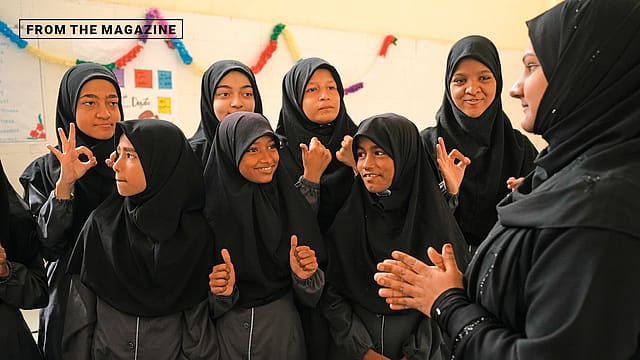
BREAK TIME AT NOBLE SCHOOL’S second block, a four-storey building for the primary classes, is a small mess of cucumber slices, fruit bowls and unfinished homework. Independence Day is approaching, and children trade news about rehearsals, lessons and snacks. Some conversations are spoken, others are signed. In the sunlit courtyard, Ameen Zehra, 22, has settled a group of Class 4s with their activity books even as older kids rehearse a dance and a march past in the playground outside. Zehra teaches 26 deaf children at Noble School, where she was herself a student. She is, according to school officials, the first deaf girl from Alipur to complete Class 10. A job was not the future her father had imagined for her. “I used to be at home. Now I have a new life, a job and a chance to bring change to many lives,” she signs, as social worker Mir Fazil Raza interprets. After Class 10, Raza tried to enrol her in a nearby pre-university college. The college refused to admit her, he says, and she did not study further. The job at Noble School came to her after that door had closed.
The children join dots, colour, and talk and sign among themselves. They discuss possible careers—art, writing, engineering, sports. Areej, who is nine and cannot speak, signs that she wants to become a police inspector—a remarkable ambition, except no one here seems to bat an eyelid. In Alipur, a sentence may begin in Urdu, turn on a gesture and end in English, and all three languages share the same rank on the street.
Alipur is often described as a place with a large deaf population where everyone knows sign language. Its residents have learnt enough of its homegrown sign language to allow deaf people a public life: they shop, work, visit tea stalls, exchange jokes and take part in religious and family life without always requiring an interpreter. Older deaf residents became electricians, cooks, carpenters and construction workers. They were visible in society and often valued for their skills, but very few acquired formal qualifications. That is starting to change now.
The privately-owned Noble School began its programme for deaf pupils in 2017 and now teaches 38 of them. The younger children learn with Zehra and 12 secondary-level children receive signed instruction from a deaf special educator from Maharashtra. The school teaches in Indian Sign Language, which is used across the country and may help students navigate college and work. Alipur Sign Language, or APSL, remains the language of homes, trades and friendships.
Alipur lies roughly 80 kilometres north-west of Bengaluru. Beyond Doddaballapura, the city gives way to the low, rain-green hills around Ghati Subramanya, the lake at Gunjur and rust-red fields that lay bare thanks to a delayed monsoon. Alipur appears as a dense settlement in this open agricultural country, a Shia Muslim enclave whose upgrade from gram panchayat to town panchayat was approved by Karnataka’s cabinet in July 2025. Residents like to call it little Iran. Here, Ayatollah Khomeini stares down from shopfronts, mosques and work desks. It is an insular world. From settling disputes to finding a spouse, residents say Alipur has generally preferred to rely on its own social institutions, the most powerful of them the Anjuman-e-Jafaria.
At a tea shop on the highway, Mohammad “Tiger” Ali, who runs a firewood business, says there is no police station here because all disputes are solved internally. Almost everyone of his generation married within Alipur. A few families have started to bring brides from Bengaluru and Karimpur, but they are still exceptions. “There are deaf and mute people in every family, so we all understand the local sign language to an extent,” he says.

During Muharram, the deaf have a sabeel of their own, a steel-framed shelter clad in black where religious discourses held in the evening are interpreted for them and a feast is held. The deaf also have other local haunts, including a community centre that is now undergoing renovation, and a tea shop run by Aziz Hussein, who is also deaf. It was shuttered at the time of our visit, but by evening, regulars say, it becomes the town’s deaf meeting point, with between 20 and 30 people gathering there on any given day.
Raza and others in the town put Alipur’s deaf population at around 200, although there is no current official count. The linguist Sibaji Panda, in a sociolinguistic profile published in 2012, counted about 150 deaf residents in a population of roughly 20,000. Residents now say the numbers have climbed to 200 out of 25,000. Residents and researchers have long associated the comparatively high incidence of congenital deafness with generations of marriage within a small, endogamous community, though no Alipur-specific genetic study appears to have been published.
APSL has its own grammar and lexicon. Linguists classify it as a village sign language, a technical term for languages that arise in small, closely connected populations where hereditary deafness has been present over several generations and residents also learn to sign. Similar shared-signing communities have existed in Bali, Ghana, Turkey and, historically, on Martha’s Vineyard.
When Panda began fieldwork in Alipur in 2007, family histories suggested that APSL had been used for at least six generations although its origin remains unknown. It was used in shops, homes, work and religious life. Residents had sign names, and conversations did not depend on first translating a thought into Urdu, Hindi or Kannada. Deaf children born in Alipur acquired the language from the people around them, at the age at which other children acquire theirs.
MUCH OF ALIPUR’S public conversation about its deaf residents passes through Raza. A former gram panchayat chief and member of the Anjuman-e- Jafaria, he runs A2Z Electronic Clinic, which repairs wall clocks, computers, watches and household appliances and sells photostate copies, lamination and photographs. Taped to the glass door is a notice about a scholarship portal, with the last date to apply and the classes eligible. During our conversation, a man comes in seeking help with a voter-ID application, and Raza turns to the computer. “This shop too is a public service,” he says. Raza says researchers have come to Alipur, recorded its language and left without materially helping its deaf children.
For close to a decade now, families have sought him out over school admissions, fees, government forms and disputes involving deaf residents. At the school and in the shops, questions and references are routinely deferred to him. He interprets between deaf and other residents, organises Islamic classes in the evenings and devotes time to teach at Noble School. He has accompanied many a student to examinations and negotiated with colleges over admissions.
He describes APSL’s vocabulary by moving through the domestic life of the town. He says it distinguishes between different lentils, oils and kinds of roti—there are signs for roomali roti and lachha parantha—and between shades of colour and degrees of sweetness, salt and heat. A local expression for the passage of a year invokes the return of Muharram. APSL uses the distance between the hands to mark large magnitudes, and has a subtractive system. For instance, 195 may be expressed as 200 minus five, and 48 as 50 minus two.
To Raza, APSL is the best sign language in the world. But for much of Alipur’s history, knowing the local language did not lead to formal education. When researchers first arrived in 2007, they found only two deaf residents who could read and write. The Unity School for the Deaf opened in 2008 with deaf teachers and APSL as the medium for developing English literacy. It was informal, and it closed in 2014 when funding ran out. The older generation nevertheless worked. Director and Principal of Noble School Nakeer Syed grew up signing with a deaf uncle who became a sought-after electrician, took contracts and helped wire the building that houses Noble School. His uncle never attended school and did not leave Alipur to study or work. His son learnt the trade from him. Acceptance therefore came with limits. Deaf boys were taught trades their families already knew. Deaf women had fewer opportunities to meet and sign outside their immediate families. A study recorded discriminatory dowry arrangements and resistance to marriages between two deaf people. Familiarity reduced the communication barrier, but it did not confer literacy, qualifications or the right to make decisions on equal terms.
Noble’s programme, begun on Raza’s initiative, has been changing these expectations since 2017. Syed says the first challenge was training teachers, who did not know sign language or how to adapt lessons for pupils with different language needs. Many deaf children had spent years outside a school system and had to learn its routines. Parents needed convincing too. Some believed a deaf child could not benefit from academic education and should simply be taught a trade. Others remained in denial for years, waiting for a child to begin speaking.
The school held orientation sessions and brought deaf role models from Bengaluru to meet families. It hired special educators and counsellors, and developed what Syed calls a hybrid model: deaf pupils spend time with their classmates and receive separate, direct instruction in sign for lessons they have not understood. Noble has since taken its first deaf pupils through Class 10. Some have continued studying or found work. “The formal education made them free,” Syed says.
On the first floor of the main block, in the secondary classroom for “Special Students”, 12 children sit before a digital panel while a deaf educator teaches an English lesson on adjectives and their opposites: happy and sad, big and small, hot and cold, black and white. Boys sit on one side of the room, and girls in black hijabs on the other.
Syed Taher, Noble’s vice-principal, says most mainstream teachers still do not know ISL. In their classrooms, deaf pupils may rely on lip-reading, help from hearing friends and explanations provided later in the signed classroom. He says they spend much of the academic day in the dedicated room.
Mir Khayyam Ali, who owns Naaz Hospital and the medical store that stands in front of it, says eight to 10 deaf students from the town now attend college in Bengaluru. His own son has completed the second year of BCom at SRN Adarsh College in Chamarajpet. Ali proudly brings out the marksheets and points to the impressive grades. When he first asked Noble to admit his son, he did not imagine the boy would reach college. He wanted only to ensure that his son did not grow up believing he might have attended school had he been able to hear. “I just wanted him to wear a uniform, carry a bag, and wear shoes to school like every other child,” Ali says. “Even if he didn’t study, I wanted him to be able to participate in everyday life.” His son now says he does not want to take over the family trade. He wants to go to business school. The change has not extended equally to girls. Ali’s wife, Khatreb Zehra, says no deaf girl from Alipur has yet left the town for higher education. Even other girls have only recently begun studying outside. “If one or two go, then the trend will begin,” she says.
The expansion of educational opportunity brings a separate problem for APSL. It is learnt informally at home and in the town but is absent from the curriculum, and it may in time be displaced among younger signers by the language they are taught. Many worry that children who are not exposed to enough fluent local signers will fail to acquire it at all. “Now even some parents are learning ISL,” says Raza, who has pointed many to the Deaf Enabled Foundation’s ISL app.
Alipur’s relationship with the outside world is selective in other ways too. Marriage remains largely local, but the gemstone business has taken residents across the Gulf and Southeast Asia. Taher says families trade in Thailand, Indonesia and the Philippines. For Alipur’s deaf, that world is only beginning to open. Syed says the next task is to build a support system beyond school, with scholarships, career guidance, interpreters and tie-ups with institutions prepared to accommodate deaf students once they leave the place where everyone knows how to talk to them.
On one of Alipur’s main market roads, Mir Nayamath Hussain, 31, takes stock alone at the shop he manages beside his family’s, his clothes dusty from the morning’s work. He deals with customers without an interpreter. They sign, or write down the item. His father opened the smaller shop for him so that he would learn to work on his own, and he has since learnt to read and write and is becoming conversant in ISL at the evening classes Raza runs for deaf adults, which he looks forward to all day. “It is a comfortable life here. We run stores and have a social life,” he signs. The freedom he has is the size of the town, and for now it is enough.