Shubhanshu Shukla: To the Heavens and Back
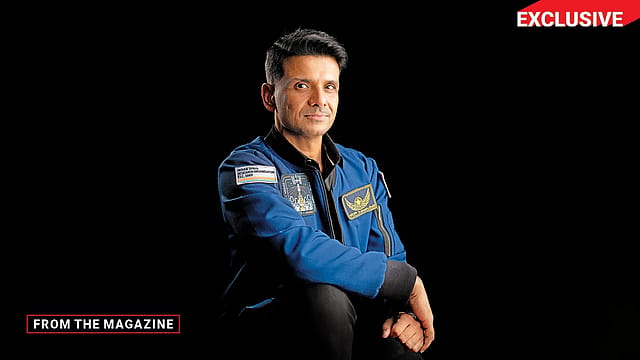
ALMOST A YEAR AGO, ON A THURSDAY LIKE NO OTHER, Earth filled Shubhanshu Shukla’s vision. He was on the International Space Station (ISS), after hours of piloting the SpaceX Dragon spacecraft, and an even longer period of rigorous training as part of Axiom Mission 4. The newly arrived contingent of four, including Shukla, was led to the Cupola, the observatory module of the ISS and asked to close their eyes. Earth came into view, the “blue marble”, in its sheer expanse.
Shukla became the 634th human in orbit, when he crossed the Karman Line which marks the edge of space. But he was the first Indian to soak in this sight. He is only the second from the country to have made the journey to space—more than four decades after Rakesh Sharma. The ISS had not been around during Sharma’s space odyssey, having been established only in 1998. So, Shukla became the first Indian to step into the ISS. “This is the beginning of India’s human space programme. I would like you, my fellow countrymen, to be part of this journey,” Shukla had said in a message from the ISS.
His return from the ISS, 18 days later, did not mark the end. The 40-year-old Shukla is adding new milestones to the journey. June 25, the first anniversary of his momentous journey, will see the launch of The Second Orbit: Belief of A Man… Dream of 1.4 Billion Hearts (Vintage Books), his first book and a memoir of the journey. He has spent a lot of time over the past year sharing his experience of being space-borne. “There was a lot of excitement about the mission,” he tells Open. “But I very quickly realised that it will not be possible for me to reach every corner and every classroom. It is a huge country. And I thought that this book would be a good way of providing access to space for everyone.”
We are meeting in Delhi, days before the launch of The Second Orbit, just as the first copy arrives from the press. At first meeting, he might surprise those who have built a hero-like impression of the astronaut who took India to the ISS. In reality, Shukla looks diminutive, albeit very fit. He browses the copy, equal parts thrilled and tranquil—fitting for a man trained to keep his composure. If space travel involves one of the most intensive training regimens on the planet, writing a book is no less demanding. “Space training is different compared to aviation training, but it is also similar in a lot of aspects. I learnt a lot of new things—it was challenging, but still something familiar.” Writing was completely different. “Interestingly, I realised that one key trait, for space training as well as writing, is discipline. It is something you pursue every day and that was helpful to me while writing the book,” he says.
Shukla hopes to keep writing, and getting better at it. “It is a once-in-a-lifetime experience, of getting to travel outside the planet but you never really sit down and think about it. There is no time—you’re always busy doing something,” he says. “When I started writing this book, I sat down and started contemplating, remembering what all has happened. It was very good, personally, to relive those moments and putting them in words. It was not easy to write a book, but it was a very memorable experience for me.”
Following a foreword by Rakesh Sharma,The Second Orbit begins with a letter from 14-year-old Shukla to his future self. Born in 1985 and growing up in Lucknow, the youngest of three children, space was not on his radar but the skies certainly were. Between trying to come first in class and getting his hair to behave, Shukla found his desire to fly after visiting an air show and watching fighter planes in action.
After graduating from the National Defence Academy (NDA) in 2005, Shukla made his way to the Indian Air Force Academy; in 2024, he was promoted to his current rank of Group Captain. His training proved useful when he was shortlisted in 2019 for ISRO’s Gaganyaan programme. Before his participation in Axiom Mission 4 was announced in 2024, Shukla had spent time in preparation—training in Russia, at ISRO’s Astronaut Training Facility in Bengaluru, and getting a Masters degree in aerospace engineering from the Indian Institute of Science (he had previously studied computer science from Jawaharlal Nehru University). His many experiences loom in the background of The Second Orbit, which focuses on Axiom Mission 4, from his time training at NASA’s Johnson Space Center in Houston to the journey back and forth the ISS with his crewmates—commander Peggy Whitson and mission specialists Sławosz Uznanski-Wisniewski and Tibor Kapu.
The gravest discomforts—and space travel abounds in those— fall away at the prospect of stepping into the great beyond. Nothing can be adequate preparation for the emotional aspects, yet it is impossible to undertake this journey without preparation— for the technical details as well as the physiological impact. As Shukla writes in the book, “Astronaut training essentially prepares you to be comfortable with the uncomfortable.” Repetition and discipline become keys but don’t mitigate the unease when one must check into work every day in space. “Your body experiences and goes through a lot of pains in the initial days adjusting to this new environment,” he says. “But it is definitely a place that changes the way you think, because you see things which you have never seen, you see the perspective that you have never had.”
Earth is bigger than what we imagine, yet hardly the biggest in the solar system. There are bigger solar systems in the Milky Way and bigger galaxies beyond. And here we are: specks in this vast universe. “In a sense, the importance we attach to ourselves loses its meaning,” he says, describing the feeling as a “transformative experience”. Another lesson that he hopes to impart on others: “We are together on this planet. We are not different people, different places, different countries—what we do here today affects everyone.”

The joy and learnings of space mingled with a yearning for home—for his family, his wife Kamna and their young son, as much as the minute aspects of everyday life. “I’m not a very big foodie. But being in space for a few days, your taste buds get subdued. You don’t really taste the food that well,” he says. “I missed food—the spices, and just Indian food.” It hadn’t helped that their food kit, chosen after days of serious food tasting (one session involved tasting 100 items) did not arrive in the ISS. Sriracha sauce offered small comforts in the standard-issue meals Shukla ended up eating. These are minor gripes. There is peace in the experience and fun too—in accomplishing an experiment or in conjuring up games. “I really enjoyed it every single day I was up there,” he says.
The Second Orbit is packed with science and information. Shukla makes the jargon relatable with anecdotes and personal experiences, but the technical details are hardly a soft serve. The book is a primer for space travel, and its author wouldn’t have it any other way. Since his return, Shukla has been a busy man. He looks forward to being at home, in Bengaluru where he has lived since 2017, with his family and friends, and finding time to read (he is currently reading The Beginning of Infinity by David Deutsch) and play sports. More often than not, however, he is navigating a packed schedule, from addressing public gatherings to interacting with children on what it takes to prepare for it—endless training, adult diapers, anti-gravity and all.
Despite his celebrity status, and the crowds milling about him in the hope of selfies, hubris does not characterise Shukla. Yet, he is attentive to the fact that he is a role model in a country where many have dreamt of being astronauts but rarely known the road to realising it. Shukla notes that he never imagined becoming an astronaut in his “wildest dreams” when he was young. “The ecosystem did not ensure, or give any confidence to me, that there is a possibility of doing this,” he says. Interacting with astronauts from other countries, he says, reveals that many felt inspired to make space their professional pursuit after they met an astronaut. “These have a very lasting impression and you never know who would get excited and decide to pursue this,” he says. “If we can get the kids of our country to believe that these things are possible, that would be a very big win for me.”
Even as science illuminates new parts of the universe, encountering an astronaut provokes fantastical questions. Shukla is game for all sorts of queries—from whether sci-fi films do justice to the real experience (Christopher Nolan’s Interstellar and the Matt Damon-starrer The Martian come close) to the possibility of extraterrestrial life. “The sheer scale of the universe is so big that to think we would be the only ones out there would be too arrogant.” The probability of intelligent life is not to be dismissed nor the idea that one day all of humanity might journey across the stars. But for the moment, Shukla is keen on taking the next step to the future. His 2025 mission has offered crucial learning as India prepares for Gaganyaan, its first human spaceflight programme led by ISRO. During the conversation, Shukla mentions a popular saying among astronauts: “You are ready for a space flight when you finish one.” Is Shukla ready to take off again? “Absolutely,” he answers in a heartbeat, before adding. “I would really like to see our own mission taking off from India. It would be a bonus if I got to fly.”