Sankar (1933-2026): The Lord of Chowringhee
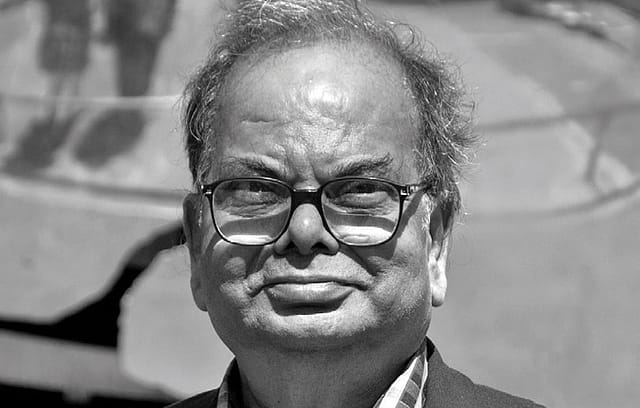
Mani Sankar Mukherjee, famous by his pen name Sankar, was decidedly the most popular among storytellers in Bengal. He died in a Kolkata hospital on February 20 at 92.
Sankar’s long journey as a novelist took off with a hit. After being rendered jobless as a typist after the sudden death of his em-ployer, the last British barrister of Calcutta High Court, the 28-year-old literary aspirant published his first book, Koto Ajanare (The Great Unknown). A story of the common man visiting courts for legal redress and the court insid-ers who people the judiciary, Koto Ajanare, published in 1959, proved astonishingly quick in drawing housewives’ attention in the pre-television era. Never too technical, the stories skirted legal and procedural intrica-cies but the young novelist never erred in identifying his read-ers. A decade after its publication, till my college days were over, Koto Ajanare never dropped out of the list of bestsellers.
If Koto Ajanare is a dirge to an institution, the court of law, created by the former masters, Chowringhee, the crowning plume on Sankar’s literary career, is a blazing symbol of hope. Calcutta (now Kolkata) after Bengal’s partition in 1947, had become anaemic. The novel put the city on a global map, with characters as oddly named as Cony, the dancer, or Marco Polo, the monster of a manager of the Shahjahan Hotel. The book otherwise pivots on Satyasundar (Sata) Bose, the debonair and tragic front desk manager of the hotel.
Chowringhee’s popularity has been undaunted by the ups and downs of reader taste. Still, the film version in the late 1960s, with superstar Uttam Kumar playing Sata, gave it a new dose of mortality. In the new millennium, Chowringhee’s global journey began with Penguin publishing its English edition, translated by Arunava Sinha. Subsequently, the book was translated into several other languages, including Italian. Sinha says the author has a magical style, “the author’s own magic realism,” which has given its characters and events a very long lease of life.
However, I got curious about Sankar as many of Satyajit Ray’s razor-sharp films on contemporary city life were released. Sankar, the writer for two of these films, Seemaboddho (Company Limited) and Jana Aranya (The Middleman) became my friend at once. Seemaboddho is about an ambitious company executive who is faced with the discovery of quality problems in an export consignment. Since that could ruin the chances of his promotion, besides causing losses to the company, he strikes upon an ingenious solution to the problem. He stage-manages a labour strike, a legally accept-able excuse for delay in export delivery.
A few days later, when I met Sankar, I asked him if such corporate shenanigans were commonplace. He smiled and said what was indeed rare was its absence.
Ray had high regard for Sankar’s ability to read the minds of people in business. It proved prophetic in Jana Aranya. Its story rests on the middle class hero Somnath’s ethical dilemma. As the first step in a career in business, he has to find a woman in the evening for the man who promised him a contract. It is a quest reminescent of Vittorio De Sica’s famous film Bicycle Thieves (1948). Sankar told me that his intimacy with common people and knowledge of Calcutta’s localities enabled him to give a realistic touch to this chase.
Sankar spent most of his working years as an executive at RPSG Group. Stories were in his heart and business in his blood. He also admired people and institutions with an ability to attract many men and women. In his later years, when he turned to working on Bengal’s modern spiritual icons, like Ramakrishna and Vivekananda, he kept his narrative free from hyper-religiosity and peppered it with his familiar humour. The title of his short biography of Ramakrishna is Mr Chatterjee and Mrs Chatterjee, the saint having been born as Gadadhar Chatterjee.