S Janaki (1938–2026): A Voice for Every Face
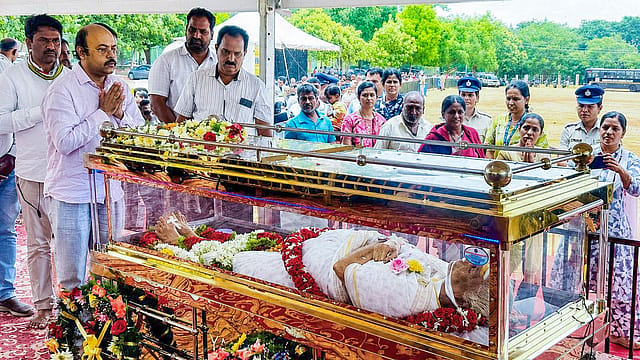
The playback singer S Janaki died Saturday at Apollo BGS Hospitals in Mysuru, after suffering multiple cardiac arrests. She was 88. On Sunday morning, admirers said their final goodbyes at Maharaja College Grounds before her body was taken to a farmhouse at Kaniyanahundi for the last rites with full state honours. Her first public performance had taken place in Mysuru in 1952 and she chose the same city for her final concert in 2017.
Janaki is reported to have sung more than 48,000 songs, winning four National Awards in three languages over three decades, 11 Kerala State Film Awards, six from Tamil Nadu and 10 Nandi film awards.
Sistla Sreeramamurthy Janaki was born on 23 April 1938 in Pallapatla, near Repalle in Guntur district. Her father was an Ayurvedic doctor and schoolteacher. Part of her childhood was spent in Sircilla, in what is now Telangana. She received brief instruction from the nadaswaram vidwan Paidiswamy but had no sustained formal training in classical music. The radio became another kind of education, and Lata Mangeshkar’s voice was a formative influence.

Zeroing In on ECI
09 Oct 2026 - Vol 05 | Issue 41
Constitutional legitimacy versus political opportunism
At AVM Studios, R Sudarsanam hired her as a singer. Her first recording was for the Tamil film Vidhiyin Vilayattu in 1957, but the film was never released. The Telugu MLA, recorded soon afterwards, became her first released film. By the end of that year she had recorded in at least five languages.
Five years later came the recording that established her in Tamil cinema. In Singaravelane Deva from Konjum Salangai, Shantha, played by Savitri, falters and says that her music is nothing before the hero’s nadaswaram. When Janaki resumes, she does not try to defeat the instrument on its own terms. Karukurichi Arunachalam’s pipe is broad and reedy, and her answer is a bright filament. She lengthens the final vowel of deva, bending the phrase. The words invoke Murugan, but Savitri sings them towards Gemini Ganesan. In the long swara passage the notes tighten and accelerate, yet every syllable remains separately struck, creating the illusion that a human voice can sing at the speed of a wind instrument.
Arunachalam’s nadaswaram had been recorded in Madras. Janaki’s voice was recorded at Raman Studio in Bombay, and the two tracks were mixed. The encounter between voice and instrument never occurred in a room. It exists only on tape.
Playback singing is acting without a body. The singer must become, in a few minutes, someone she may never have met. Janaki’s distinction was not simply that she could make her voice beautiful, it was that she could make it particular. Child, grandmother, drunk, ghost, village flirt, exhausted wife—age and circumstance entered the line with her.
By the time Ilaiyaraaja made his debut with Annakili in 1976, Janaki had already been singing for 19 years. He had encountered her work during his years assisting GK Venkatesh and gave her three songs in his first film. Over the next two decades they made hundreds together across the four southern languages. Senthoora Poove in Bharathiraja’s 16 Vayathinile brought her the first of her four National Awards in 1977. Bharathiraja died on 10 June this year, a month before her.
Ilaiyaraaja did not use her merely because she could negotiate difficult lines. In their best work, the voice itself became part of the composition. The village address of Machanai Paartheengala, the audible breath of Ponmeni Uruguthe and the passage between speech and melody in Kanmani Anbodu Kadhalan are acts of characterisation. Ilaiyaraaja later said that when he wanted a particular expression, Janaki would keep refining the line until she had surpassed even his expectations.
In Kaatril Endhan Geetham from Johnny, Archana, a professional singer, performs in a near-empty hall during heavy rain, hoping that the fugitive Johnny will hear her and return. Based on Keeravani, the melody keeps inclining towards resolutio and Janaki makes a public performance sound like a private message.
One melody offers another measure of her contribution. Ilaiyaraaja first used it for his Tamil duet with Janaki, Sangathil Paadatha Kavithai in Auto Raja. At Balu Mahendra’s request it became her Malayalam solo Thumbi Vaa in Olangal, and later Aakasam Eenatido in the Telugu Nireekshana. The melodic contour remains recognisable, but the prosody, the screen situation and the relation to the listener change.
Kannada received a flood of Janaki songs through GK Venkatesh, Rajan–Nagendra, Hamsalekha and others. Asked to name her most difficult song, Janaki picked Shiva Shiva Ennada Naaligeyeke from the Kannada film Hemavathi, a composition that moves between Todi and Abhogi and ends in a rapid swara sequence. In Malayalam, composers from MS Baburaj and Salil Chowdhury to Shyam and Raveendran found a more intimate grain in her voice. In Telugu, K Viswanath repeatedly called on her dramatic intelligence—Govullu Tellana from Saptapadi brought her a Nandi award.
Janaki’s Telugu work also carried Tyagaraja’s kritis and Annamacharya’s sankirtanas into popular cinema. The film versions were not always concert renditions; they quoted, spliced or repurposed. In Sankarabharanam, Janaki sings the pallavi and anupallavi of Tyagaraja’s Samajavaragamana, while SP Balasubrahmanyam carries Veturi’s romantic charanams. Marugelara O Raghava in Saptapadi turns a devotee’s appeal to Rama into a woman’s concealed desire. Viswanath used it again in Subhalekha. With Ilaiyaraaja she sang Bala Kanakamaya Chela in Sagara Sangamam. Annamacharya appears elsewhere in her film work: Vinnapalu Vinavale in Subhalekha, and Muddugare Yashoda in Padamati Sandhya Ragam.
Janaki began singing in Hindi early, for dubbed versions of southern productions. In the 1960 Hindi dub Ramayan, she shared songs with Mohammed Rafi and Mahendra Kapoor. Her work in mainstream Hindi cinema broadened in the mid-1980s, when Bappi Lahiri gave her a sustained run. He duetted with her on Yaar Bina Chain Kahan Re from Saaheb and paired her with Kishore Kumar in films such as Dharm Adhikari. Laxmikant–Pyarelal made use of both ends of her range—the extrovert Bol Baby Bol in Meri Jung and the inward Surdas bhajan Prabhu More Avagun Chit Na Dharo, adapted for Sur Sangam by Vasant Dev. Hindi cinema, however, was never the centre of her career.
In 2013, the Government of India offered Janaki the Padma Bhushan and she declined it. The award had come too late in her five-and-a-half-decade career, she said. She was not opposed to recognition itself; she asked the government to show greater consideration to artists from southern India and said that her own contribution merited the Bharat Ratna. It was a reckoning with how unevenly cultural honour is bestowed across the country.
In Mysuru in October 2017, Janaki told an audience that she wanted to stop while she was still singing well and make room for younger artists. Amma Poovinum, the Malayalam lullaby from 10 Kalpanakal, had been intended as her final playback recording. But in 2018 she was coaxed back to sing Un Usuru Kaathula for Pannadi.
In April this year, shortly after her eighty-eighth birthday, an album of four songs composed and written in Hindi by Janaki was announced. Shweta Mohan had visited her and listened as she played around 25 rough tape recordings made two or three decades earlier, many in collaboration with PB Sreenivas. Mohan chose four, and Janaki taught them to her line by line. At the end of a life spent lending her voice to other women, she entrusted her own compositions to another’s voice.
Her only son, Murali Krishna, died in Mysuru in January after a prolonged illness. Janaki continued to live in Bogadi with her family.
In the 2018 film ’96, Trisha plays Janaki Devi—Jaanu—an ardent admirer of S Janaki who repeatedly sings her songs. The filmmakers shot a scene in which Jaanu and Ram, played by Vijay Sethupathi, stop outside the singer’s Chennai home during a midnight walk. The real Janaki arrives, invites them inside, and the borrowed voice finally meets the borrowed face. The scene was cut. Janaki is absent from the film’s theatrical version and everywhere in it nevertheless. That was playback’s paradox: the face received the light while the voice disappeared.