Remains of the Long Partition
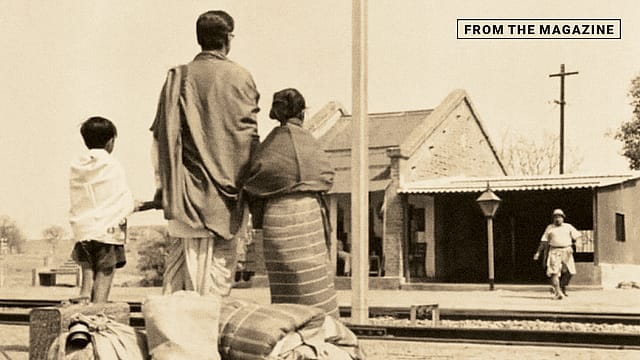
THERE IS A PECULIAR CRUELTY IN HOW Partition has been remembered. Punjab bled and was heard. Bengal bled slower, longer, and largely in silence. Ask any reasonably literate Indian to name a Partition novel, and the odds are overwhelming that Punjab will answer first. Khushwant Singh’s Train to Pakistan (1956), Bhisham Sahni’s Tamas (1974), Saadat Hasan Manto’s unbearable little parables of Toba Tek Singh and the mad asylum that outlived the sane world around it—these are the texts through which the subcontinent has been taught to grieve. Ask the same question about Bengal, and the silence that follows is not merely an absence of recall. It is the symptom of a historiographical and cultural asymmetry eight decades in the making.
Political change in West Bengal, too, is slow and takes decades to unfold. However, is there reason to hope the latest change in the state can correct the narrative, even if that correction can never be material? In any case, this is definitely Bengal’s last-chance saloon.
Punjab Speaks, Bengal Doesn’t
The scholarly record on this imbalance is substantial enough to not be a matter of impression. Urvashi Butalia’s The Other Side of Silence (1998) and Gyanendra Pandey’s Remembering Partition (2001) built, deliberately or not, a canon around the Punjab experience as a single, catastrophic, months-long cataclysm with a clean before-and-after, tailormade for narrative compression into novel or film. Bengal offered no such compression. Partition scholars have increasingly recognised what Joya Chatterji, in a consequential intervention, named the “long partition”—a displacement that did not conclude in 1947 but continued in waves through 1950, 1964, 1971, and beyond (The Spoils of Partition, 2007). A slow bleeding does not make for a bestseller. It makes for statistics, and statistics rarely travel.
That’s not to say Bengal produced no literature of its own suffering. It produced a great deal.Each film in Ritwik Ghatak’s trilogy of displacement (Meghe Dhaka Tara,1960;Komal Gandhar,1961;Subarnarekha, released in 1965), is an unresolved elegy for a homeland the filmmaker himself never stopped mourning. Jyotirmoyee Devi’s Epar Ganga Opar Ganga (1967) is an unflinching account of the plight of women. Sunil Gangopadhyay’s refugee fiction, most notably Purbo- Pashchim (1989), traced the class humiliations of displacement with an eye for the small, corrosive cruelties that grand historical narratives tend to omit. More recently, the Dalit testimonies of Manoranjan Byapari and Adhir Biswas have complicated the bhadralok-centred memory that had dominated even Bengal’s own partial telling of itself, insisting that the refugee experience was never a single, undifferentiated grief but one sharply stratified by caste and class from the moment the first colony was settled. And yet none of this achieved the canonical, cross-national recognition of the Punjabi counterparts.
Why?
Partly because Bengal’s story lacked a single unifying atrocity around which a national conversation could organise itself. There is no equivalent of the Punjab trains arriving full of corpses, an image that became the metonymy of Partition. Partly, too, because Bengal’s story bifurcated after 1971 into a second Partition-shaped event—the Bangladesh war—that both extended and diluted the memory of the first, folding 1947 into a longer, messier continuum that resists the clean narrative arc a national audience wants from its historical trauma.

And partly, one suspects, because Bengal’s literary establishment was itself dominated by the bhadralok classes who had generally weathered displacement with greater resource and resilience than the Namasudra and Rajbanshi cultivators who filled the squatter colonies. That meant the community that suffered Partition’s harshest material consequences was, for decades, the least equipped to write its own account of them.
Memories of before and regrets of after lived on, in miniature, in Bengali literature and cinema, but never assumed the dimension and depth necessary for a prolonged and persistent national reckoning.
A City Undone
If the literature never quite closed this gap, the material history is unambiguous, and it begins not in 1947 but decades earlier. Calcutta’s decline as the subcontinent’s premier city predates Partition by 36 years—the 1911 transfer of the imperial capital to Delhi was, as Bengali contemporaries understood immediately, a calculated diminishment of a city whose Swadeshi-era politics had grown too troublesome for the Raj. World War II compounded this: Calcutta became a frontline logistics city for the Burma campaign, its economy destabilised by wartime requisitioning, its streets by early 1943 filling with the rural destitute fleeing a famine that would eventually claim some three million lives. Janam Mukherjee’s Hungry Bengal (2015) makes the case, empirically, that the famine cannot be separated from what followed it. At “the frayed end of each and every lead” into the violence of 1946, the trail led back to hunger. The older argument, however, has not been wholly invalidated by the newer academic drive to connect 1943 with 1946. While hunger might be the universal casus belli, the bloodbath of 1946 would not have happened without the Muslim League.
Nevertheless, what happened on August 16, 1946—Direct Action Day, or the Great Calcutta Killing—was, in one historian’s careful phrasing, something “exceeding anything the city of Calcutta has ever seen.” Suranjan Das, the subject’s foundational scholar, has insisted the1946 violence was categorically distinct from Bengal’s earlier communal disturbances: organised, urban, mass-participatory in a way that earlier riots, largely agrarian and class-inflected, had never been (Communal Riots in Bengal: 1905-47, 1991). Estimates of the dead over three days range from 4,000 to 10,000; besides, 100,000 were left homeless. And this was merely the overture.
What followed across 1947 was not a single rupture but a slow demographic catastrophe. On the one hand, the city that absorbed the famine dead on its pavements in 1943 was the same city, three years later and scarcely recovered, that absorbed the Partition dead and displaced in its streets. On the other, Calcutta’s own Muslim population, nearly a third as late as 1941, fell to under 15 per cent within a decade. This, too, was a transformation of the city’s composition that occurred with none of the singular drama of a train massacre, and precisely for that reason has never entered the national imagination with equivalent force.
The bottom line: how could the city, also the main urban centre of the province, articulate its own story as it turned into hell on earth? It was told by others, not merely poverty photojournalists, and told unfairly.
Political Uses of Refugees
What the city could not absorb gracefully, it absorbed anyway— in camps that were“cramped spaces”of“unhygienic sanitary facilities”, never conceived as permanent, and therefore permanently inadequate. When the state’s temporary camps failed the displaced, they built their own city within the city. These squatter colonies spread along the marshy fringes of the metropolitan railway tracks, numbering in the hundreds by the 1970s, home possibly to a quarter of Calcutta’s population within a generation.
And it is here that Bengal’s Partition story takes its second great, undertold turn: the political capture of the refugee. Prafulla Chakrabarti’s The Marginal Men (1990), with the unambiguous subtitle ‘The Refugees and the Left Political Syndrome in West Bengal’, remains the essential text on how this occurred. The Communist Party of India (CPI), and later the CPM, organised the colonies with genuine effectiveness, giving displaced Hindus from East Bengal a political home, land defence committees, and eventually electoral weight.However, this was at the cost of ever forcing a public reckoning with what had actually been lost. The refugee became a vote bank before she became a citizen with an acknowledged grievance.
Congress, which had governed at the moment of Partition and borne the first responsibility for rehabilitation, had already forfeited the refugee’s trust through the camps; the Left inherited that disillusioned constituency and, over three decades of uninterrupted rule, converted political loyalty into permanence without ever using it for narrative repair.
The Left compelled the East Bengali Hindu to forget without forgiving.
The community that would eventually migrate a third time—this time politically, from the Left to BJP, the party now in power both in the state and at the Centre—is instructive precisely because of who it is. The Matua sect, descendants of Harichand Thakur’s 19th-century Namasudra reform movement in today’s Bangladesh and concentrated around the Thakurbari shrine at Thakurnagar in North 24 Parganas, constitute about a fifth of West Bengal’s Scheduled Caste population and hold decisive weight across a cluster of constituencies in Nadia and the two 24 Parganas. Theirs was the entire arc of Partition victimhood: dispossessed in 1946 and 1947, warehoused in camps, absorbed into Left patronage networks for two generations, and only in the last decade drawn towards a party promising, through the Citizenship Amendment Act, what neither Congress nor CPM had offered—an explicit legislative naming of the persecution that had driven their grandparents across the border. That the community’s own leaders have since found the law’s implementation bureaucratically punishing, its documentary demands apparently ill-suited to people who fled as destitute refugees decades ago, is a separate and serious criticism, and does not erase the significance of the naming itself.
The story of what had happened to these millions of people— the murders, the abandoned homes in Barisal and Faridpur and Mymensingh, the specific violence of August 1946 that set the entire chain in motion—was never made central to how India, or even Bengal itself, told its founding story. It was managed, not mourned.
The Last Window
This is the context in which the current political moment deserves to be read.Not, primarily, as a matter of the citizenship law’s practical mechanics, which have proven fraught for the community it purports to serve, but as the first instance since 1947 of an Indian government explicitly naming, in statute, the specific religious persecution that drove Bengal’s Hindu refugees across the border. Whatever else may be said of the timing and the electoral calculation behind it, the symbolic act of a national government formally acknowledging that this happened, that it was wrong, and that the descendants of those who fled deserve to be recognised as what they always were, arrived at a moment of historical urgency. The generation that actually crossed the border in 1947, 1950 and 1964 is now all but gone. What remains is the second and third generations, for whom the story survives as inherited grief rather than lived memory. And inherited grief, unlike lived memory, either calcifies into permanent silence or is belatedly spoken, if at all.
None of this can undo what was actually lost. No parliamentary Act, however generously framed, returns the dead of the Maidan rally or the ancestral house in East Bengal or the 78 years in which Bengal’s Partition sat in the shadow of Punjab’s more legible tragedy. Partition Horrors Remembrance Day, first observed in 2021, seeks to memorialise a shared catastrophe of the subcontinent. It is also meant to bring people together and find them closure (‘The Right to Remember’, Open, August 30, 2021). But restitution is beyond acts of memorialisation.
Moreover, there is a form of justice that operates independently of restitution. It is the simple, overdue act of correcting the record, of insisting that a story be told with the same seriousness as its counterpart. Bengal has never lacked the material for that story. It has lacked, until perhaps now, a political opportunity to insist that the rest of the country listen. Whether this moment is used honestly, or merely instrumentally, will determine whether Bengal’s Partition finally enters the national memory it has always deserved; or remains, as it has for 79 years, the quieter half of a shared catastrophe.