Prime Messaging: Narendra Modi revalidated a hopeful vision of the future
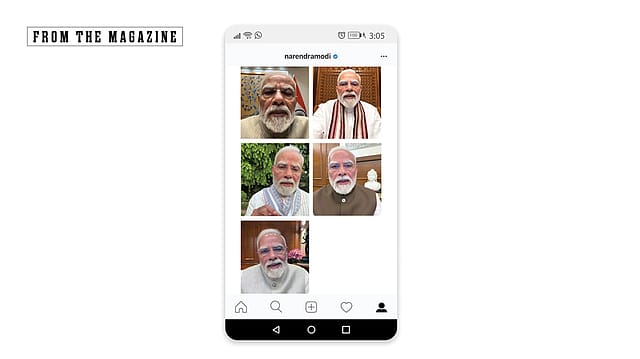
IN THE LAST of his five recent “selfie videos” on Instagram, Prime Minister Narendra Modi rounded off a series of messages that began with a promise to legislate tough laws to deal with organised gangs and individuals responsible for examination question paper leaks. Responding to abusive videos posted by protesters at Delhi’s Jantar Mantar, Modi struck a conciliatory note even as he refused to dismiss the outrage among his legion of supporters. The foul language was a “cultural shock,” he said, and it is hard to imagine “our daughters” could use such words. But hounding the offenders and dragging them to courts was not a solution.
“If you punish them, make them do the rounds of courts, this will not change the circumstances. I want to forgive them; I want society to accept my view. These kids are ours. It is our job to show them the way. I tell these children, ‘come let’s work together for the nation.’ The country is moving ahead and so should you. I live for you,” Modi said in the video shot in tight close-up. The post received 13.1 million views, most within a day of the prime minister’s outreach on Gen Z’s preferred social media platform. Some commentators questioned the use of ‘forgive’ as patronising, but the broader public opinion, going by likes and shares, understood what Modi was driving at.
A day before, a video noted that amendments to the Public Examinations (Prevention of Unfair Means) Act were passed by Parliament after two days of detailed debate. “Gangs that play with the future of kids will not be spared. Anti-cheating laws have been passed and are a big step towards a reliable exam system. Let us work for the goal of Viksit Bharat (Developed India),” he said in a video that garnered 8.1 million views. In another video released a few days earlier, Modi had promised fast-track courts to try paper leak cases and the setting up of a committee headed by Infosys cofounder Nandan Nilekani on examination reforms. “Those who played with the future of children are rotting in jail. Fast-track courts are being set up and the Nilekani committee will give suggestions on the maximum use of technology for making examinations clean and transparent,” Modi said. The video received 14.2 million views.

The first two videos Modi posted— one that acknowledged the gravity of the National Eligibility cum Entrance Test (NEET) paper leaks and the subsequent one thanking viewers for their response—set the tone for the five video posts. In his initial post close to midnight on July 23, Modi said several measures had been taken in the two-and-a-half months since the NEET leaks came to light. The government used every resource at its command, he said, to bring the guilty to book and to ensure a re-test was held without delay. He pledged tough legislation to deter future leaks. The video was followed by another the next night in which he thanked viewers for their responses. The two videos received 20.9 and 16.4 million views. Modi signed off saying the affection between him and those who heard his message would only deepen in the course of time.
The July 23 late-night video came just a couple of days after Central Delhi turned into a war zone, with protesters who responded to the Cockroach Janta Party’s (CJP) call for a march on Parliament clashing violently with Delhi Police and Central security forces. Although hundreds of students and young people had indeed rallied to the CJP call, the incidents revealed the involvement of criminal elements and politicised activists from Left student organisations, such as the All India Students’ Association (AISA), the Students’ Federation of India (SFI), and the All India Students’ Federation (AISF), which have a track record of violent confrontation with police. But Modi did not discuss the composition of the mob, recognising the discontent and anger in a young and restless cohort. He understood the Jantar Mantar protest had stirred a wider audience.
The genuine sense of hurt over the paper leaks, the political storm in Parliament, and the perception that the CJP protest had tapped into frustration over the lack of employment and the dissatisfaction of many with their circumstances needed a convincing response. Modi stepped around point-scoring between rightwing and anti-Bharatiya Janata Party (BJP) swarms on social media. He recognised the core sentiment at work and addressed it directly. The July 23 video, consciously reflecting proximity and an informal touch, was a light touch even as the prime minister conveyed an important message. The video crossed 303 million views in 24 hours, a record on Instagram. Modi gained a significant number of followers organically without the assist of artificial boosts. With the video delivering and the gamble to go on Instagram paying off, the subsequent videos followed. On each occasion there was a rise in the number of followers. The prime minister is no stranger to social media, having understood its potential in the early days of Twitter. His selfie after casting his vote in the 2014 Lok Sabha polls was extensively shared across all media even though Twitter did not at the time display an impressions matrix. His assessment that the Gen Z medium was the best way to communicate with a generation immersed in Reels has paid off.
Like bad news, challenges come all at once. The CJP protest march was timed to coincide with the convening of the Monsoon Session of Parliament. The events of July 20 led to Congress leading the stalling of Parliament over the demand that Home Minister Amit Shah respond to allegations of police highhandedness. Congress leader Rahul Gandhi’s claim that Shah ordered “firing” on protesters is not borne out by facts but did disrupt Lok Sabha and Rajya Sabha—a tactic intended to prevent the Modi government from moving on its plans to pass the constitutional amendment for delimitation of Lok Sabha seats linked to a rollout of women’s reservation in Parliament and state legislatures. The shock defeat of the BJP nominee in the Bankipur Assembly bypoll in Bihar— the seat hitherto held by party president Nitin Nabin—added to the perception that the ruling dispensation’s problems are mounting. The setback in Bankipur is a good example of a perfect storm as a poor choice of candidate after the Nitish Kumar transition, the X factor of Jan Suraaj Party leader Prashant Kishor, and low voting coalesced. But the result underlined the risks of taking voters for granted.
While BJP has been at the receiving end, the emergence of CJP or the success of political entrepreneurs like Kishor is not great news for opposition parties either. Kishor received the support of all voter sections, including the Rashtriya Janata Dal’s (RJD) Yadav base, which perhaps felt he was best placed to defeat BJP. Meanwhile, Rahul Gandhi’s efforts to retool Mandal politics by seeking caste counts in every sphere of public life and ill-advised ventures like participation in a ‘skit’ parodying the theft of donations at the Ram temple limit his politics. The rejection of both the Dravidian parties in Tamil Nadu is evidence that they were seen as discredited versions of one another.
In the circumstances, BJP’s primary task is to prevent unmapped political forces from exploiting a vacuum and retain control of the narrative as it mostly has since 2014. Modi’s messaging is intended to stem the loss of confidence and forcefully convey that BJP works for the good of sarv samaj (all of society) and that this lies at the core of the Viksit Bharat articulation.
The prime minister has the opportunity to administer correctives and undo the damage caused by self-goals like Bankipur through a purposeful rejig of the Union Council of Ministers that conveys his readiness to pick the best minds while showing the door to underperformers. BJP’s parliamentary managers will need to look beyond current animosities to reach an understanding with the opposition so that Parliament functions. This is not an impossible task as the government displayed common sense in concluding a truce with CJP. A government has several levers by which outcomes can be achieved. The Modi government’s parliamentary strategy is helmed by the home minister and Shah has displayed pragmatism in diffusing situations and ending deadlocks. The current logjam is demanding but not one that cannot be resolved.
Getting key legislation like delimitation and important amendments to the Foreign Contribution (Regulation) Act (FCRA) passed is central to the Modi government’s political goals and complement Modi’s broader messaging. The prime minister’s adroit use of Instagram shows he has understood the shift in public sentiment and has adopted new mediums while not losing sight of the larger purpose of his political mission.