Portrait of CJP Protest
THE NEWS ARRIVED and Jantar Mantar erupted in jubilation but of a different kind—the sort that would have been difficult to imagine at a political protest in India a decade ago. Some hugged. Some shouted. Some danced. Many others reached for their phones to record the moment of victory. News that Union Education Minister Dharmendra Pradhan had resigned travelled through the crowd, and for a moment, the protest site turned into something between a political gathering and a college festival.
There were cheers for the cockroaches.
“Cockroaches won, democracy won,” the Cockroach Janta Party (CJP), which was spearheading the protest, posted on social media. At Jantar Mantar, the news was greeted as a victory by a movement that had begun, improbably enough, on the internet and had grown into a sustained campaign over alleged examination irregularities and paper leaks.
“It was as if we just won the World Cup,” says Rahul, a 20-year-old college student. “Our perseverance finally paid off.”
The celebrations were loud and distinctly young. The protest had serious demands. The mood, however, was rarely solemn for very long.
Even hours after the announcement, with CJP calling off the protest, the fervour didn’t die down. Occasional shouting and cheering would break the silence, but what was ever-constant was making reels and clicking photographs. Some acted out memes for the cameras. Some carried placards that made people chuckle—“Simon, come back.” Others were serious, displaying the names of the National Eligibility-cum-Entrance Test (NEET) aspirants who had committed suicide.
The language of the internet had crossed over to the street, bringing with it its peculiar mix of irony, exaggeration and an inability to remain serious for more than a few minutes at a stretch. The result was a protest that could effortlessly switch between anger and laughter.
CJP first made its presence felt as a satirical social-media movement. Its campaign was built around the demand that Pradhan resign over alleged failures linked to the examination system, including those surrounding the NEET-UG paper leak. By June, the movement had moved from the screen to the street, attracting students in fair numbers as well as parents and young professionals to Jantar Mantar.
They called them cockroaches, insects ordinarily associated with disgust but also survival—a popular trope holds that they could survive a nuclear holocaust. The movement embraced both the insult and the endurance and made it part of its identity.
The protest’s visual language was therefore unlike that of the great political agitations of the earlier generation. There were no white caps associated with the Anna Hazare movement. There were no candle light vigils or silent marches. Instead, there were phones held high, posters designed to be photographed and circulated and slogans written to leave an impression on the mind.

One placard read: “We asked for ‘Make in India’, you gave us ‘Leak in India’.” Other slogans demanded that Pradhan resign and that the National Testing Agency (NTA) be shut down. The political message was clear, but the method of delivering it often came wrapped in humour.
“We need to have some fun,” says Sunidhi, a 19-year-old college student, “after all we are the youth.” Yet she adds that the Gen Z crowd, which mostly comprised the protesters, has proven that it is not a laidback generation but stands up for what it believes is right.
“Watching Gen Z take charge during the protest was inspiring,” Sunidhi says.
Being the most-present and most-outspoken, Gen Z became the language of the protest. Just like their world, which revolved round constantly changing online references to cringe humour and senseless ‘67s’, it took over Jantar Mantar and protest sites across the country as well as the internet that was flooded with videos since July 20.
July 18 became one of the defining moments when activist Sonam Wangchuk, who had been on a hunger strike for 20 days, was removed from the protest site ahead of the ‘Chalo Sansad’ march. That was when the protest intensified, turning peace and calm to chaos as the demonstrators and police clashed.
“When they removed Sonam sir, we knew our protest was not meaningless,” says 34-year-old self-employed Mosheen. “That’s when I saw the change in the mood of the protest: from fun to anger.”
As expected, the incident caught the attention of the country as well as some foreign media outlets. “The memes were not memes anymore; they became provocative.”
Videos of the police clash seemed to have taken over everyone’s social media feeds. But if there is one generation to make clashes with the police fun, it is Gen Z. Some recorded videos of them being chased down by the police, running and laughing with the background music of the popular mobile game Subway Surfers. Some in Bihar went to the police asking if they had brought tear gas shells. When the police said no, they retorted with “vyavastha sahi nai hai (the arrangement is not good)”.
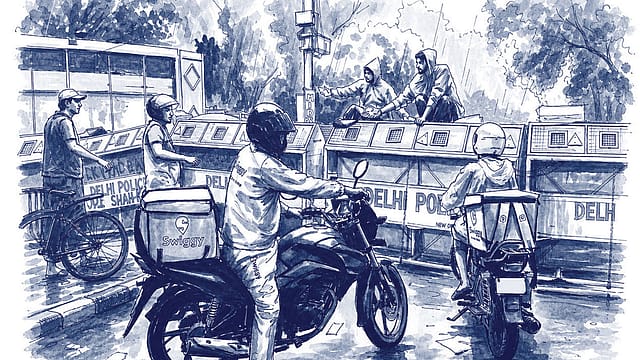
And how do you keep such a big protest up and running, people fed and comfortable? Strangers. There were many who could not join the protest but that did not stop them from “doing their part”, becoming the language of solidarity during the protest. Medical tents were set up and volunteers rushed to help anyone in need. Delhiites sent food, medicines, snacks and necessary amenities for those at the protest. Food delivery orders showed up marked “For the brothers and sisters at the protest”. A 21-year-old carried snacks, medicines, mosquito nets, and drinking water to donate, travelling with heavy bags on his shoulders.
Having these amenities may not be new to a protest but getting orders delivered was something rare for such demonstrations. Besides, several restaurants offered food to the protesters while a popular coffee chain’s outlet on Janpath provided shelter to the protesters and offered free water refills.
“We felt so supported by all our friends and strangers all over Delhi who helped us in their capacity,” says Anushka, a 22-year-old college student, who frequently took part in the protest. “This showed that our protest was not just for the sake of it but people actually cared. Not everyone can afford to join physically.”
ALL THIS CULMINATED on July 25 when Pradhan resigned. The moment they had been waiting for. CJP called off the protest, stating that all its demands had been accepted. While this was official, some protesters were apprehensive, demanding more action.
People like Shatruta, a 37-year-old researcher, said that the NTA, which conducts entrance examinations, needs to be scrapped, while Rohit, a 36-year-old nurse, wanted the protest to continue so that others could be held accountable.
Nevertheless, the scenes that followed Pradhan’s resignation were perhaps the clearest expression of the movement’s character. There was no attempt to behave like a traditional political organisation or pretend to remain silent and applaud in a restrained manner. The mood was closer to the sudden release of pressure after a long examination. For a movement that had spent weeks talking about tests, that was perhaps fitting.
A serious protest can ask people to pay attention. A funny protest can make them stop scrolling.