Pahalgam in Memory
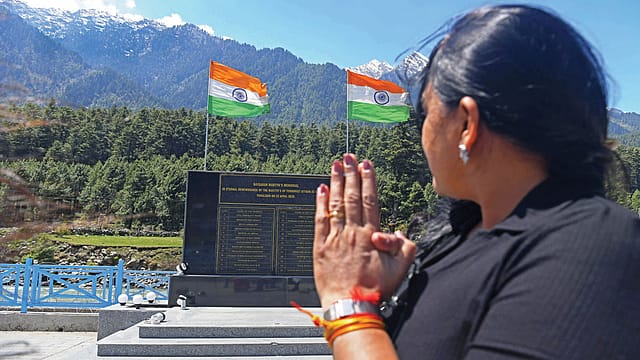
THE COLD-BLOODED murder of 26 unsuspecting civilians at Pahalgam, Jammu and Kashmir (J&K), on April 22 last year in a terrorist strike was another grim reminder of the peril faced by India from Pakistan. A fortnight later, the response sent a clear message to Islamabad that India would ratchet up the military dial in case of any misadventure. The damage visited upon Pakistan—the targeting of its 11 air bases, including ones at Rawalpindi and Sargodha— was an unequivocal signal of India’s resolve. It also restored deterrence against Pakistan for the time being.
The last point holds the key to stability in the region. But unlike classical notions of deterrence that are considered lasting in nature, India has to periodically demonstrate its resolve to Pakistan. Under Narendra Modi, this has been refined over the past decade. When terrorists attacked an Army base in J&K’s Uri in September 2016, 19 Indian soldiers died. In response, India launched cross-border raids (“surgical strikes”) that dismantled terrorist infrastructure just across the Line of Control (LoC). Then, again, on February 14, 2019, a Pakistani proxy carried out a suicide bombing, targeting a convoy of CRPF troopers at Lethpora in Pulwama district of J&K. Forty CRPF men died in that terrorist atrocity. India responded by using airpower against a target in Pakistan proper, for the first time since 1971.
The response to the atrocity at Pahalgam was a full-fledged military operation—a limited war—under the nuclear shadow. It destroyed the myth that India could not launch conventional military operations under a nuclear overhang. It was the first time in the 21st century that two nuclear-armed states came to blows with each other without conventional operations escalating to the nuclear level. From the time of Uri to Pahalgam, scores of Western nuclear ‘experts’ went to great length to spell the dangers inherent in any Indian response to Pakistan. India’s superior control over the ‘escalation ladder’ has led to question marks over theories of nuclear conflict.
India’s ability to successfully wage a limited war against Pakistan rested—in no small measure—on the availability of standalone precision strike weapons such as various types of missiles that it could launch from well within its territory.
This was the result of rapid learning since the time of the Uri cross-border strikes. India’s leadership realised that it needed a response package that would be more than just a symbolic strike at Pakistan. Restoring deterrence is a hard task especially against a recalcitrant power like Pakistan. At the same time, escalation control is essential if matters are not to get out of hand. The assessment of those risks and responses requires political leadership that is confident and one that has the appetite to do what is necessary. The availability of a number of weapon platforms and devices since 2016 greatly aided India in this respect. India’s strikes at the Nur Khan Airbase in Rawalpindi along with multiple other targets between May 7 and 10, 2025, caught Pakistan unaware. Islamabad did not anticipate the extent of India’s response. The result is that from Uri (2016) to Pahalgam (2025), India’s envelope of options and its operations have increased far more than what Pakistan—and to be fair—many of India’s former rulers could ever imagine.
Behind this success of India’s response to Pakistan lies a long history of strategic failures at political and diplomatic levels. It would, however, be wrong to blame India’s armed forces and other parts of its response apparatus. The failure, primarily, lay at the political level. In the first instance, it was a case of imbibing the tough lessons imparted by a very difficult geostrategic environment. The December 13, 2001, terrorist attack on Parliament led India to mobilise its Army. The stand-off continued for six months but went nowhere as the then government realised it had no viable options to punish Pakistan.

Over the next 12-odd years, this absence of options was converted into something of received wisdom that India had to live with a neighbour which would pursue atavistic political goals come what may. The extent of what India could hope for was some sort of limit on terrorist attacks on Indian soil. That was the farthest extent to which Indian policymakers were willing to go. This lack of appetite was also the product, in part, of domestic politics of appeasement transferred to the international level. Western academics, and their Indian followers, provided the intellectual gloss to this outlook: India had failed to deter Pakistan from repeatedly launching terrorist attacks on Indian soil and asymmetric warfare in J&K. This was the closest that Pakistan came to establishing compellence against India, something that should have been ruled out just by the sheer military mismatch between the two countries. But then history is replete with instances that have led to strange outcomes.
In this worldview, the answer to the problem did not lie in the vain quest for military options but the pursuit of diplomacy. This was the basis for the so-called Aman ki Asha class of activities that ranged from Track II diplomacy to routine sermons by superannuated diplomats that “geography cannot be wished away” and, in an earlier age, candlelight marches to the border with Pakistan at Wagah in Punjab. Repeated assaults by Pakistan, including the massacre of 175 persons in the 2008 Mumbai attack, did not shake the politicians and diplomats who pursued this course of action out of their stupor.
Pahalgam has decisively changed all that and rendered this past history into embarrassing memories. If anything, Indian policymakers now realise that maintaining deterrence with Pakistan is not a one-off activity and has to extend beyond military means. The decision to hold the Indus Waters Treaty of 1960 in abeyance holds great potential even as India constructs dams, irrigation and water storage infrastructure for the river waters that were unjustly apportioned to Pakistan under the treaty. Used properly, it can check Islamabad’s worst instincts, almost like a tap that can be turned off to quench its thirst for terrorism against India.
What changed matters for India is the combination of political will and the availability of military means that were not available a quarter century ago. Both ingredients are important if Pakistan has to be kept at bay. For the moment, India possesses both. It could do with more military hardware for it faces more than one external threat. The spread of global disorder requires that India equip itself adequately. But that is another story.
In Arms and Influence, his 1966 classic, the Nobel Prize-winning economist Thomas Schelling noted the paradoxes of deterrence. He stated that, “It is a paradox of deterrence that in threatening to hurt someone if he misbehaves, it need not make a critical difference how much it would hurt you too—if you can make him believe the threat.” A more accurate summation of India’s strategic failures between 2004 and 2014 could not be found. Not only were our politicians and diplomats fearful of Pakistan’s ability to inflict unacceptable harm but were utterly incapable of warning Islamabad in any way. It took Modi, a politician of a different cast, to re-orient India’s responses to Pakistani misadventures. So far, it has worked well.