Openomics 2026: The Long-Term Moderniser
INDIA-WATCHERS, PARTICULARLY THOSE BLESSED WITH a sense of the past, will no doubt have observed the shrinking longevity of the public discourse centred on the annual Union Budget.
During the high noon of the post-Independence socialist raj, the Budget was an occasion for intense public anxiety and business nervousness. Since the overriding philosophy of governance was state control and regulation, both the Centre’s outlay and its tax proposals were the subject of hard political bargaining in which the voice of those who most contributed to the exchequer mattered the least.
The Budget was also a festive occasion for professional speculators. Since taxes on consumer goods—particularly needlessly dubbed luxuries—fluctuated annually depending on the quantum of the fiscal black hole, the weeks before the Budget would witness systematic hoarding of items such as cooking oil, cigarettes and items the bush telegraph suggested were targets of the finance minister’s roving hands. The political leaders spewed venom against the so-called profiteers, black marketers and even those who acquired skills in adulteration. Jawaharlal Nehru even threatened to hang these enemies of the people from the nearest available lamppost. It is a different matter that there is no record of any public execution of those suspected of economic crimes. However, the evil Sethjis depicted in the Bollywood films of that era weren’t the only ones that made a killing from tax fluctuations of the Budget. Bazar gossip indicated that otherwise well-paid executives of what used to be called ‘mercantile’ firms did rather well by negotiating private understandings with the bigger players of the wholesale market. In a shortage market, what really mattered was allotments.
This cosy world came to an end, first, after Manmohan Singh’s 1991 Budget and, finally, after Arun Jaitley both devalued and redefined the finance minister’s job with the introduction of the Goods and Services Tax (GST) in 2017. The ‘one nation, one tax’ approach successfully negated the discretionary element of the Budget. With the principle of ‘pooled sovereignty’ determining taxes on goods and services, the concurrence of the states is necessary for modifications in tax rates. The changes are dictated by the GST Council, not the finance minister’s Budget speech. Consequently, unlike the bad old days of the controlled economy, public discussions of the Budget have sharply lessened in both duration and importance.
This year, the focus on Nirmala Sitharaman’s ninth consecutive Union Budget was even more fleeting. Just a day after its very subdued presentation on a Sunday morning, the entire attention of the country shifted, predictably, to US President Donald Trump and the long-awaited trade ‘deal’ of India with the US. Given the way the media news cycle operates, the Budget was overtaken by tariffs. At a more basic level, the anger of speculative market traders over a marginal increase in a transaction tax was subsumed by the relief and euphoria over the resumption of a near-normal trade relationship with the US. Of course, the exuberance could well be irrational since Trump’s unpredictability is among the most important market risks that global capitalism has factored in.
Whether India’s finance minister formulated her Budget with an anticipation of the lowering of US tariffs isn’t known. However, judging from the approach that was underlined with remarkable lucidity in this year’s Economic Survey, global uncertainties have tempered the Narendra Modi government’s flirtations with populism. Like each year, the approach of summer will coincide with Assembly elections in Tamil Nadu, Kerala, Puducherry, Assam and, of course, West Bengal. In the three southern states, expectations from the Centre have always been marked by realism. The southern conflict with Delhi is not over economics and states such as Tamil Nadu, Karnataka, Andhra Pradesh, and Telangana have done rather well from the growing maturity of Indian capitalism. Assam—where the Bharatiya Janata Party (BJP) is in power—has also seen mega-investments in infrastructure that in turn has made it an attractive destination for business.
The real problem of managing expectations has been in West Bengal which has experienced sustained economic decline and even deindustrialisation since its people began experimenting with Left radicalism after 1967. The termination of Left rule after nearly three decades in 2011 hasn’t made any difference for a variety of reasons. First, the politically inspired banishment of the Tata Motors manufacturing unit from Singur in 2008 sent a clear message to India Inc that West Bengal was unsuitable for any meaningful investment. Second, the volatile political culture of the state—despite 15 years of apparent stability—has been compounded by entrenched networks of corruption and extortion. Finally, the mindset of the political class in Bengal is still frozen in the time of the licence-permit-quota raj. There is still an expectation that the state will be the engine of investment and change. The challenges of market capitalism are only too often presented as Delhi’s wilful discrimination of Bengal.
West Bengal may be the last relic of the old order—Uttar Pradesh has changed quite dramatically, and Bihar is tentatively grasping new opportunities—but its alienation is important in documenting the shift in the Budget culture. Many commentators suggested that Sitharaman’s Budget presentation was dreadfully boring and, consequently, failed to map the future direction of the Indian economy. This is a backhanded compliment to the finance minister, and an important indicator of where India has moved.
For its growth and vibrancy, capitalism depends substantially on macro-economic stability. There are natural challenges that confront entrepreneurs. Among the most important of these is the ever-changing frontiers of technology, of which AI is presently the most formidable. Finally, the national economy demands geopolitical predictability at the global level. At one time it seemed that the rules-based World Trade Organization (WTO) was going to set the norms of international trade and investment. However, after the disruptions to the global supply chain resulting from the Covid-19 pandemic and the political interventions of Trump in his second innings, the emerging new normal has been unsettled. The global movement of peoples which at one time had the blessings of the European Union (EU) has been disturbed following a nativistic backlash in its member states. The US, which once prided itself as the world’s melting pot of peoples, has also witnessed a fierce reaction from those who see American nationhood in civilisational terms.
In the last decade of the previous century and following at least 15 years of internal debate and political acrimoniousness, India took the long overdue decision to finally integrate its economy into the world market economy. What China had done in 1978, after the death of Mao Zedong in 1976, was belatedly emulated by India at least two decades later, and with considerably less purposefulness because democracy invariably slows down the pace of change. At the same time, perhaps owing to the presence of governments with conflicting pulls and pressures and a misplaced faith in the popularity of statism, India’s transition to a market economy has been hesitant. Not until Narendra Modi demonstrated to a sceptical political class in 2014 that there existed a sufficient body of Indians exasperated with a rotten status quo and impatient to make the country truly world-class, did the wheels of reform start rolling with sufficient speed to make a difference.
The Indian reforms process started acquiring greater momentum after 2014 for several reasons.

First, the authority of Prime Minister Modi within BJP and the government was undisputed and unchallenged. How big a blessing this has been can only be gauged by comparing the India of today with the India that existed between 1989 and 2014. Three consecutive election victories and a commanding hold over state governments have given Modi the requisite authority and credibility to steer a new course for India.
Second, unlike earlier governments that were unable to make a complete emotional break with gradualism, Modi was determined to take India out of the orbit of Third Worldism. The realisation of the dream of becoming Vishwaguru may still be a work in progress. However, what is important is that the glorification of poverty and the disdain of economic prosperity and entrepreneurship that had bogged India down were finally and quite unceremoniously discarded.
Third, the foreign policy of India has been quietly tweaked to further India’s economic interests and enhance national security. For the first two terms the Modi government shied away from continuing with the UPA government’s policy of negotiating Free Trade Agreements (FTAs). This was not due to some narrow interpretation of swadeshi, as some imagined. The delay was determined by a desire to give domestic industry a chance to ready itself to face competition and avail of overseas opportunities. It would, however, be fair to say that Trump’s America First approach removed all pre-existing hesitation over FTAs. A more outward-looking entrepreneurial culture was necessitated by sheer pragmatism. Maybe it was the Indian success in negotiating FTAs with Australia, New Zealand, the EU, and the UK that facilitated the ‘deal’ with the US. The 18 per cent tariff rate set by the US is still quite high, but India has not yielded to Washington’s demand that it compromise its flexible energy security approach or fully open up to American agricultural produce.
Finally, what has distinguished the Modi government from its predecessors is its unwavering commitment to the longer term. Every government in an India that is dominated by competitive politics must make shoddy short-term compromises for its survival. Modi, however, has tried to keep these few and far between. It is important, for example, that there have been large doses of continuity in the personnel entrusted with key responsibilities. In the past 15 years, only Arun Jaitley and after his death, Nirmala Sitharaman, have been finance minister. Likewise, the external affairs portfolio has been held by, first, Sushma Swaraj, and since 2019 by S Jaishankar. Ajit Doval has been National Security Advisor since 2014.
THE CONTINUITY OF decision-making has been accompanied by a genuine attempt to improve the ease of doing business, improve living standards and enhance domestic consumption. The present Budget of Sitharaman is politically unglamorous if judged by the yardstick of populism. However, in terms of strengthening the foundations of the Indian economy and creating an ecosystem that will make India a natural home for innovative technology, it comes out tops. A casual reading of this year’s Economic Survey will confirm that the low glamour quotient is deliberate.
To assess the Budget as a standalone statement of the government’s economic policy—as Budgets of an earlier era were—would miss the wood for the trees. It must be read with last year’s significant income tax cuts that have resulted in low-income families with non-agricultural incomes with larger disposable income. A double-income family, for example, can now avail of a tax-free income of around `26.7 lakh. Along with the rationalisation of income tax, the GST modifications of last year have helped bring down the prices of consumer goods.
Despite these measures, there remained a certain hesitation on the part of both the private sector and foreign investors to sink their money in India’s future. The FDI inflow for the past two years suggested a big scope for improvement, despite the policy changes that have made doing business quite attractive in India. The multiplier effects of Apple’s experience with iPhones in India and the willingness of the EU to climb down a few notches from its dogmatic environmentalism should begin to make a big difference. Coming in the wake of a settlement with the US—a move that will bring cheer to the textile, auto ancillary and pharma sectors—there will now be a greater inclination on the part of Indian business to resume its voyage in a domestic vessel rather than look to an uncertain future in either Dubai or Portugal built on portfolio investments.
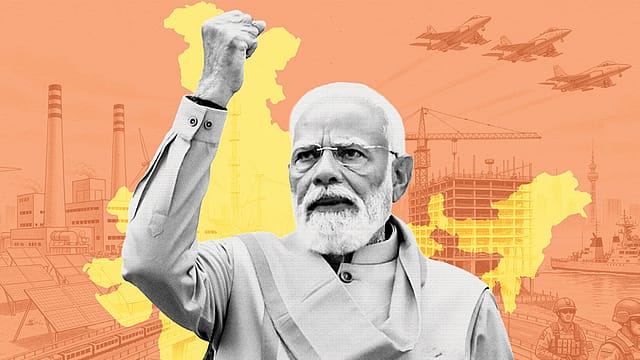
Modi was gung-ho in his speech to his MPs after both the Budget and the US trade deal. The expression ‘turning point’ has often been used rashly, more as an expression of faith rather than an assessment of reality. This time it has a fighting chance of being different. Sitharaman’s Budget may well be an important building block in the eventual creation of Viksit Bharat.