Openomics 2026: The Call of Kartavya
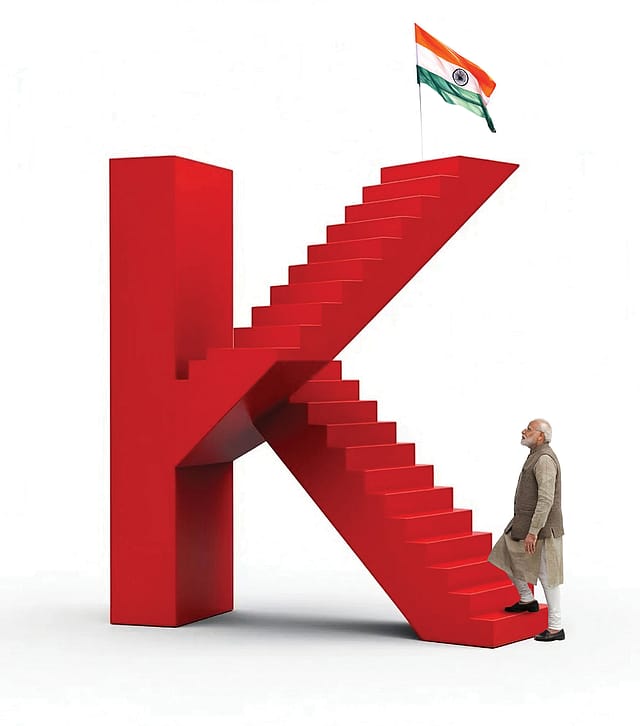
THE 2 0 2 6 - 2 7 Union Budget-making exercise gathered momentum as a tumultuous 2025 drew to a close and the central theme that would run through Finance Minister Nirmala Sitharaman’s speech in Parliament on February 1 became crystal clear. Irrespective of the India-European Union (EU) free trade agreement (FTA), then in the final stages of negotiation, or a possible breakthrough in the stalemated trade talks with the US, atmanirbharta or self-reliance would be the guiding mantra. If there was one lesson to be learnt in an uncertain world where international rules of trade and commerce had been upended, it was that there is no substitute to building indigenous capacities and resilience to shield India from global shocks.
Framing the theme of atmanirbharta would be the notion of kartavya or duty, to be read as a charter outlining foundational principles of governance intended to bind the government and citizens in a compact. In her speech, Sitharaman set out three kartavyas or duties that will define the Modi government’s actions: Accelerating and sustaining economic growth, fulfilling popular aspirations and ensuring equitable progress for households, communities and regions. “The threefold approach requires a supportive ecosystem… to sustain momentum of structural reforms [by being] adaptive and forward looking, [building] a robust and resilient financial sector to mobilise savings and manage risks. Third [developing] cutting-edge tech, including AI, to serve as force multipliers for better governance,” the minister told Lok Sabha.
The concept of kartavya in Indian thought is imbued with a higher meaning than mere ‘duty’, read as a prosaic description of individual or societal responsibilities. It occurs most famously in the Bhagavad Gita in the form of Lord Krishna’s exposition of Arjuna’s obligations and is often seen as “selfless action” to further the good of society and humankind. The detached and altruistic aspects of kartavya can seem out of place in politics where pursuit of power and office are legitimate objectives and the means employed can be rough and ready. Politics, by common reckoning, is not for shrinking violets. The idea of public service as kartavya is, however, a thread that runs through Prime Minister Narendra Modi’s thoughts. In September, 2016, the New Delhi Municipal Council (NDMC) renamed the Race Course Road where the prime minister’s residence is located as Lok Kalyan Marg, and six years later the redeveloped Rajpath, the historic avenue connecting India Gate to the Rashtrapati Bhavan, was named Kartavya Path. The nomenclature can come across as didactic or moralising but it is not superficial. The break from the imperial connotation of ‘Rajpath’ or the colonial legacy of a road named after a horse racing club was a public statement but also marked a more substantive shift in the political imagination.
The preamble to the finance minister’s speech establishes the centrality of self-reliance as she observes, “Keeping atmanirbharta as a lodestar, we have built domestic manufacturing capacity, energy security and reduced critical import dependencies.” The imperative for the pivot comes a couple of lines later when she says, “Today, we face an external environment in which trade and multilateralism are imperilled and access to resources and supply chains are disrupted.”
The reference can be read in the context of the continuing effects of the Russian invasion of Ukraine that is now in its fifth year as also the tempests set off by US President Donald Trump’s weaponisation of tariffs and American withdrawal from international institutions. The actions of the Trump administration include a welcome intervention—despite the inevitable grandstanding—in the Middle East and the abduction of Venezuelan leader Nicolás Maduro that is widely regarded as an overreach. The wider implications of Trump’s troubled relations with NATO allies and partners like Japan and Korea sent all nations scurrying to secure supply chains and trade partners. The breakthrough in the India-US trade deal came just a day after the Budget was presented and provided immediate relief to exporters engaged in sectors such as textiles, fisheries, leather and food items, all directly hit by a cumulative 50 per cent tariff on Indian goods. It also shored up the rupee that was caught in a Catch-22 cycle where the exit of FPIs (foreign portfolio investors) led to a slide in the currency value which in turn triggered fresh withdrawals. Uncertainty about the future of India-US relations was certainly playing on the minds of both short-term and long-term foreign investors. But the Budget planners did not know which way the coin would fall and they proceeded on what they felt needed to be done anyway.

The three kartavyas are directional pathways that prescribe the ambit of government action. These guiderails and specificities of atmanirbharta are spelt out in considerable detail and are an effort to infuse capital in particular sectors, particularly those that are labour intensive; bring about skill and infrastructure upgrades; and cut away at regulations and rules that generate friction in the economy and retard enterprise. The interventions promote innovation and knowledge accretion, such as the `10,000 crore funding over five years for the domestic production of biologics and biosimilars, medicines, and medical formulations made from living cells and organisms. New pharma education and research institutes and drugs control to match international standards recognise emerging trends and look to provide momentum to India’s already robust pharma sector. The need to be future-ready is evident in the plan for dedicated “rare earth corridors” in Odisha, Kerala, Andhra Pradesh, and Tamil Nadu and complement India’s participation in international discussions like the inaugural Critical Minerals Ministerial hosted by the US government in Washington on February 4.
In keeping with the conclusion of the Economic Survey that argues that manufacturing capacity is a key requirement for a nation aspiring to be a developed economy and is the hallmark of countries with strong currencies, the Budget pitches for strong capital goods capability as a determinant of productivity and quality. It proposes facilities to design, test and manufacture precision tooling components and moots a plan to boost production of advanced construction and infrastructure equipment such as tunnel boring machines that are currently imported. Modernisation of traditional textile sectors—much in need of fresh capital—by provision of machinery, technology, certification, and a national handloom and handicraft mission marry competitiveness with job creation.
The Modi government has worked on reducing tax filing and regulation burdens, but the need to keep up with global standards while also getting rid of a backlog of decades continues to be a work in progress. A committee to incorporate income computation and disclosure standards, a rationalisaton of accountant definitions that will have a bearing on safe harbour rules, changes in taxation of buyback routes to curb misuse, reduction of tax deducted at source (TDS) for alcoholic liquor, scrap and minerals, and new set-off rules all reflect minute attention to detail and an understanding that seemingly small changes, taken together, have a much larger impact that will unfold over time.
“MAT is proposed to be made final tax. So, there will be no further credit accumulation from 1st April 2026. In line with this change, the rate of final tax is being reduced to 14 per cent from the current MAT rate of 15 per cent. The brought forward MAT credit of taxpayers accumulated till 31st March 2026, will continue to be available to them for set-off as above,” the finance minister said.
The clean-up of the detritus in the taxation system has been described by Sitharaman as a “weeding out” of long-running customs duty exemptions on items manufactured in India or where imports are negligible. It is evident that the thought driving these changes is to make the economy efficient and resilient and align it to modern needs. The limit for duty-free imports for specific inputs in processing seafood products for export is proposed to be reduced from 3 per cent to 1 per cent, basic custom duty exemption for capital goods for making lithium-Ion cells is to be extended as also for goods imported for nuclear power projects irrespective of capacity. Similar exemptions are proposed for capital goods needed to process critical minerals and for components required for manufacturing civilian, training and other aircraft.
The measures reflect the working of minds keenly aware of the nitty-gritty of taxation and linkages with productivity and competitiveness. There are welcome measures to reduce duties on goods imported for personal use and relief to patients of diseases like cancer. There is an overarching recognition to overhaul India’s customs processes to minimise intervention and quicken movement of goods that will lend greater certainty to trade. The thinking is to make Indian regulation rules-compliant and efficient to better benefit from global opportunities. The Budget’s rationale works in both directions—internal strengthening which is not a rejection of globalisation.
SOON AFTER HE became prime minister, Modi announced that the onerous practice of “attestation” for documents submitted for job applications, passports and college admissions would be done away with in favour of self-attestation. The measure made life easier for an untold number of people, many who would have found it difficult to get hold of an official to attest their papers. The system, not surprisingly, bred corruption as agents promised to procure the required attestations even as applicants could never be sure of the genuineness of the stamp and the signatory. The philosophy has since evolved towards reducing the arbitrary powers of officialdom which have not vanished but stand reduced as happened with the introduction of the “faceless” system of tax assessments that broke the chartered accountant-tax official nexus. The paragraphs relating to “Trust-based systems” propose to enhance duty deferral periods for certain authorised economic operators (AEOs) and encourage certification. “Regular importers with trusted longstanding supply chains will be recognized in the risk system, so that the need for verification of their cargo every time can be minimized. Export cargo using electronic sealing will be provided through clearance from the factory premises to the ship,” the Budget speech states. There is a promise to transform the customs warehousing framework into an operator-centric system with self-declarations, electronic tracking and risk-based audit. The objective is to prune “officer-dependent” approvals and make transactions faster. The best global examples like Singapore, the US and Hong Kong have mastered the system a long time ago and India’s container processing time has been unacceptably lengthy.
The use of non-intrusive scanning with advanced imaging and AI technology and online clearances aim to bring about a sea-change in procedures and tie in with the atmanirbhar principle which the Budget suggests should not be confused with opacity or complacence. The proposal to make fish catches by an Indian vessel within the exclusive economic zone (EEZ) duty-free can be seen in the context of the Tamil Nadu election where fishing communities matter. But the move, along with treating the landing of such fish at a foreign port as “export” goods, is expected to benefit the trade in all coastal areas. Denoting penalties as fees is not just a play on words. It promises a genuine effort to decriminalise offences where fees, even higher rates, can substitute for jail terms and litigation. The proposal to relook duty-free allowances will bring a smile to the faces of an increasing number of Indians travelling abroad and the finance minister ended her speech by promising to recognise a genuine bid to settle dues. “There are honest taxpayers who are willing to settle disputes by paying all their dues. But they get deterred due to negative connotation associated with penalty. They will now be able close cases by paying an additional amount in lieu of penalty,” she said.
IN THE BOOK Modi’s Mission, author Berjis Desai, a former journalist and lawyer, writes that dal, large jowar and bajra rotis with a pinch of salt, roasted on a wood and cow dung fire, were standard fare at home during Modi’s childhood. The accompanying chilli paste was an “antidote” to appetite. “Modi thus grew up in a household that was in that twilight zone between poor and lower middle class. Not starving but barely surviving,” the book states. Modi’s spiritual bent, writes Desai, was evident from his early years when he was drawn, under the influence of his mother, to visiting temples in Vadnagar where he grew up. He enjoyed roaming around the ruins of Buddhist monasteries and visited the Sun temple at Modhera and was greatly moved by the biography of Swami Vivekananda. Sometime after appearing for his senior secondary examinations in 1967, Modi decided to leave home and did so permanently the next year. “He clinically severed all family ties save and except with his mother and has never felt a twinge of regret in doing so,” the book notes. After becoming prime minister, Modi met his mother regularly and she also visited the prime minister’s residence. It would seem her passing on December 30, 2022, ended a worldly tie that meant a lot to Modi.
In the years that immediately followed his departure from Vadnagar, Modi travelled in the Himalayan region, sometimes with sadhus of different persuasions. “Cooking for them and carrying their belongings, he hoped to receive some grace and insight,” Desai writes. Modi developed an intense faith in the “Divine Mother” and later when he gave up the idea of becoming a monk and became a Rashtriya Swayamsevak Sangh pracharak (volunteer), he made notes in Gujarati in a dairy and his prayers seek the power to distinguish right from wrong. His travels took him to famous temples like the Kamakhya shrine in Assam to the Vivekananda Centre in the Kumaon foothills to a second-century temple of Durga in the village of Kesar Devi. “In many ways this period of two years was perhaps the most crucial in preparing Narendra Modi for his ultimate mission,” feels Desai. Modi’s decision to spend the night in meditation in a cave at Kedarnath after he led the Bharatiya Janata Party (BJP) to a second consecutive Lok Sabha majority in 2019 was not optics. His spiritual and intellectual journeys are the key to understanding Modi’s belief and practice of what he sees as kartavya towards society and the nation.