Openomics 2026: Prudence In the Time of Populism
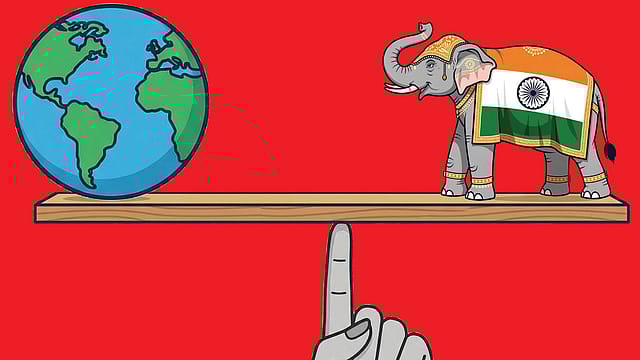
TWO DAYS BEFORE Nirmala Sitharaman presented her ninth consecutive Budget as finance minister of India, global gold and silver markets suffered a historic turmoil. After a record-breaking rally in prices into the New Year, there was a tumultuous fall shortly after the announcement by US President Donald Trump that Kevin Warsh would be the next chairman of the American central bank. Uncertainty and upheaval have been the defining features of global politics and economics in Trump’s second term. This was India’s first Union Budget since Trump’s April 2025 tariffs rocked the world. In a world where moderation is not necessarily seen as a virtue, there may have been expectations of a big-bang Budget. In the end, the Budget made no sound at all. It was status quoist in a time of dramatic change. And that may not be a bad thing.
Some part of the explanation for that may lie in two landmark events, one just before the Budget and one the day after. The Free Trade Agreement of India and the European Union signed during the course of the Republic Day visit of the two EU chiefs (António Costa and Ursula von der Leyen) freed trade between the world’s second-largest economic entity and the world’s fourth-largest economy. For India, which was under pressure after the imposition of punitive US tariffs, greater access to European markets was a big boost. In particular, the labour-intensive sectors like textiles would be the biggest gainers.
And then, the day after the Budget, Trump announced that a trade deal had been agreed with Prime Minister Narendra Modi. Not quite a free trade deal—American tariffs on India will be 18 per cent. But after several months of suffering a 50 per cent rate, this is an excellent outcome. It puts India in a better position than China and even ASEAN countries with respect to the US market. With two big boosts to growth and economic sentiment either side of the Budget, it isn’t surprising that the Budget stuck to a conservative course.
But there are other reasons for the Budget’s business-as-usual approach. For one, it is futile to try and anticipate what comes next in Donald Trump’s world. Who would have thought that in the 10 months since April 2025, there would not only be tariff/trade wars with rivals (US-China) but that it would extend, more brutally to friends/allies. That India found itself on the hard end of the bargain with 50 per cent tariffs, higher than China’s 30 per cent, was unimaginable and unpredictable. That Trump would turn on his NATO allies and go to the brink on the issue of Greenland may not have been even within the range of astrology predictions. The abduction of Nicolás Maduro in oil-rich Venezuela, the near war with Iran (it is still simmering), the list goes on.
In a world which is apparently de-globalising, there are still many interdependencies. Everything affects everything, more quickly than you would imagine. Consider that Trump’s nominee for the US Federal Reserve Kevin Warsh will not assume office until May. It is just his reputation as an inflation-hawk which wreaked considerable havoc, erasing $3 trillion in a day. How do the dots connect: If America’s central bank is hawkish, the dollar will strengthen. That reduces demand for commodities like gold and silver (prices go up in other currencies) and also builds confidence in the US dollar as a global store of value and reserve currency. That also dampens the demand for gold and silver as safe-haven investments. The earlier, record-breaking rally of precious metals was for the opposite reason: because markets believed that Donald Trump was intent on weakening the dollar, increasing safe-haven demand. Normally, these cycles play out over time. In the age of Trump, they can change every week. Oil markets, for example, are sensitive to what happens in Venezuela and Iran. India is a net importer of commodities, so volatility is particularly unwelcome.
In any case, the government cannot react to every upheaval. It is better to stick to first principles. A sound macroeconomy is less likely to be troubled by external shocks. Hence, the government’s continued commitment to fiscal discipline. India’s growth is driven primarily by internal engines. On its part, the government continued to increase its capital expenditure on infrastructure from around `11 lakh crore to `12 lakh crore. That would cushion some of the adverse impact on growth from events beyond India’s control. The government had announced a strategy of self-reliance or atmanirbharta in 2020, well before it became the dominant global strategy in 2025. The Budget reinforced some aspects of that. The support to Rare Earth Corridors in Odisha, Andhra Pradesh, Tamil Nadu and Kerala which will see the mining and processing of strategic rare earths and manufacture of end products like magnets, are a critical initiative at a time when mineral supply chains are being weaponised. On critical minerals, the decision to allow duty-free import of capital equipment required to process such minerals is also a well thought out strategic move.
The government’s focus on boosting electronics has already reaped dividends. From being an importer of all electronics, India is now an exporter. The decision to double the incentives under the electronics components scheme and to launch a second edition of the Indian Semiconductor Mission are signs of further capitalising on the good work done.
It is likely that the government used its experience of navigating the Covid pandemic to stay calm and focused during Trump’s tumult. At that time, the unpredictability and uncertainty of a once-in-a-century pandemic was much higherthannow. Indeed, manypoliciesand decisions had to be modified and changed at frequent intervals in order to best protect lives and livelihoods. But even at that time, the government stuck to first principles. It did a responsible fiscal loosening but not of the excess kind that inflicted inflation in many other countries (including the developed countries). It was in the challenge of Covid that the government pivoted to strategic self-reliance. No outcome in a pandemic is good, given the lives lost, but on the economic management front, India did well, better than most other countries by being prudent and sticking to first principles without panic.
There is one big agenda that remains to be completed by the Modi government: deregulation. There are two committees tasked with the recommendations, one headed by ex-Cabinet Secretary Rajiv Gauba and the other by incumbent Cabinet Secretary TV Somanathan. The outcome of their efforts will determine whether India continues to grow at 7 per cent per annum or whether it raises its trajectory to 8 per cent-plus. But those aren’t tasks for the Budget.
As India evolves and matures as an economy, the annual Budget should become more routine and less of an event. Too much change, whether in policy or tax rates or import duties is not a good thing. Interestingly, the finance minister announced a tax holiday until 2047 for cloud-service providers who will use data centres in India. That’s the kind of long horizon in policy making which will attract investment.
In a world characterised by excess and volatility, prudence and stability still have great value. When there is a raging storm, it is best to hold one’s ground.