Openomics 2026: It’S the Stability, Stupid!
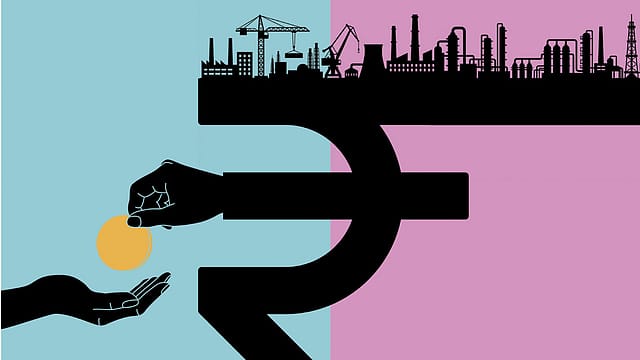
CALL IT ALCHEMY. The 2026-27 Union Budget has mastered the impossible trinity of India’s political economy. The highest outlay ever on capital expenditure at ₹12.2 lakh crore (4.4 per cent of GDP), a reduction in the fiscal deficit, and the large outlay on welfare schemes is a pointer to that magic. Keeping this tripod of expenditures in equilibrium was considered impossible at one time.
These facts are well known. But when seen together with the recommendations of the Sixteenth Finance Commission, they point to a far more ambitious and vital effort: limiting the threats to political stability in India in the years to come even as India pushes the frontiers of economic growth.
In the Indian context it is not difficult to understand why high growth can be politically destabilising. This is due to strains that emerge in the process both at the national and regional political levels—the top level of politics—as well at the level of individuals, the micro level of politics. At the top level, because of the extreme competitiveness of politics in India, any party able to push economic growth, fuels envy among its rivals. This is a condition specific to India. In India the usual mode of winning political power is by some sort of welfarism.
Survival Instinct
22 May 2026 - Vol 04 | Issue 72
India navigates global economic turmoil with austerity and smart diplomacy
Loosely speaking, welfarism entails ever higher and unretractable expenditures on social-sector schemes. This approach leads to a trade-off between winning political power and finding enough fiscal space for investment that can generate growth. For the better part of the last 55 years, from the garibi hatao of Indira Gandhi to MGNREGA during the (United Progressive Alliance) UPA era, growth suffered due to this approach to politics except for a small period when other enabling conditions promoted growth.
This feature of India’s political economy is now being undone. The historically high capital expenditure seen in the past six years is a testament to this ‘iron law’ being broken down. But that is only a partial truth as welfare expenditures have continued to gallop ahead. The trick, if there is one, lies in making the most of economic growth and the sustained increase in revenue that accompanies the growth process. This is intimately linked to the other side of the politics equation, the one at the micro level, the level of individuals.
It is no secret that India is a highly unequal country. Whether one measures inequality in terms of income—the share of the top 10 per cent in national income compared to that of the bottom 50 per cent—or in terms of wealth for the same split, inequality has gone up. These claims, made most famously in the World Inequality Database over years, have been disputed. But there is no denying that these inequalities have gone up. But interestingly, inequality in household consumption expenditure, captured by the Gini Index, has gone down from 28.8 in 2011-12 to 25.5 in 2022-23. This was reported by the World Bank. But the Bank was careful to note that wealth inequality remained high.
This reduction in consumption inequality has been made possible by a number of interventions by the government, ranging from free foodgrains, cash transfers to various sections, and provision of other public goods. If one excludes the multiple schemes to provide public goods, the money spent on cash transfers (through PM-Kisan), PM Garib Kalyan Anna Yojana (PM-GKAY), the newly minted VB-G-RAM-G, and a part of the MGNREGA that will continue this year—the programme component part of the scheme—totals to ₹4.16 lakh crore. This expenditure imparts political stability in a diverse, continent-sized country. To see this expenditure only from the perspective of welfare is misleading. It is worth asking why India alone among countries in the Indian subcontinent, nowadays somewhat erroneously called “South Asia”, remains an oasis of stability while other countries are in choppy waters. These phenomenal expenditures secure growth from political instability.
In this context, it is interesting to compare the expenditure on PM-GKAY that has totalled to a neat pile of ₹16.14 lakh crore from 2020-21 to 2026-27 (estimated) with the outlay for capital expenditure. Capital expenditure for 2026-27 has been budgeted at ₹12.2 lakh crore. The entire bill on foodgrains for seven years could have more than amply funded one year worth of capital expenditure.
Can this be described as a trade-off? In a purely economic sense, this is true. But in political terms, there is no trade-off. This is not about the politics of welfarism but about the political stability in India. One can always turn the question on its head and ask why this should be considered important for political stability now and not in earlier years and decades. The answer lies in the very different economic outcomes and the political processes seen in the two periods. In earlier decades, welfare expenditures came at the cost of investment and growth; not any more. Now, a key concern is ensuring stability, a condition for continuing growth.
Maintaining political stability at the macro, or top, level requires expenditures of a different kind. At this level, dangers to stability take a different colour. In recent years, claims have been made that states that contribute more to the country’s revenue are treated “unfairly” as they get fewer resources compared to poorer states. Similar claims have been made with respect to population and demography where southern states have done better as compared to the teeming states of the North. In these claims and counter-claims, attempts have been made to sow divisions on a North versus South basis. This is a potential flashpoint, one that can harm India’s unity.
At this macro level, maintaining political stability also requires devoting extensive resources spread over not just one Budget but over many years. Here, the story can be seen neatly through the devolution scheme of the Sixteenth Finance Commission. The report of the commission was released on the day the Budget was presented. These recommendations will, over time, defang the threat posed by fomenting the North versus South division.
The commission in its recommendations on sharing of tax resources between states has given a weight of 10 per cent for a state’s contribution to GDP. Together with another 10 per cent for demographic performance, the two criteria favour the “progressive” states in southern India. Traditionally, the commissions have attached much greater weight to “equity” criteria— such as the distance between states with high per capita income and those with lower per capita income—over “efficiency” as could be expected in a developing country with a large number of poor. But the strong emphasis on efficiency sends a very different message at this particular point in India’s economic and political evolution: the relative balance between equity and efficiency can be changed if necessary in the national interest.
The Fifteenth Finance Commission that made proposals for the 2020-21 to 2025-26 period gave a weight of 45 per cent for the income distance criterion. The Sixteenth Finance Commission reduced this to 42.5 per cent. The “tax effort” criteria was given a weight of 2.5 per cent by the Fifteenth Finance Commission but has been raised substantially by its successor. These have not been at the cost of equity but the message is clear: performance matters too.
In the “arc of instability” in ‘South Asia’ from the delta of the Ganges to that of the Indus, India alone remains sandwiched as an island of stability. Nepal and Sri Lanka, too, have seen revolts against established authority, toppling ruling parties. In the wider world as well economic uncertainties have led to populist backlashes, in the Americas as well as Europe. These storms could have hit India. It is not that efforts have not been made to sow unrest in India and they continue to be made. Old fault lines, cynically exploited for political purposes, are sought to be used for far more dangerous ends. What helps India maintain calm is the judicious distribution of resources and opportunities for everyone. The 2026-27 Budget and the Sixteenth Finance Commission’s recommendations are steps in that direction.