Openomics 2026: How To Take It Forward
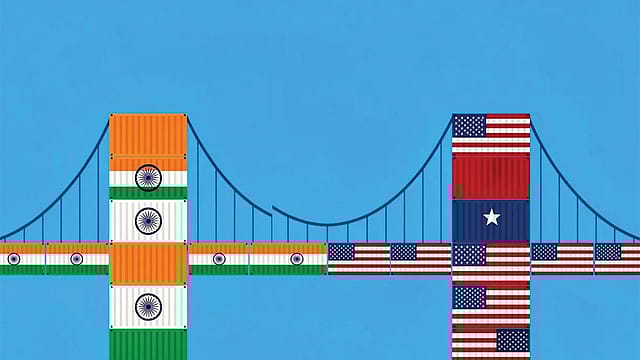
THE IN-PRINCIPLE AGREEMENT between India and the US on a trade deal has helped soothe nerves on both sides, even in the absence of signatures on the dotted line. The political understanding reached by the leadership in New Delhi and Washington represents a significant political and economic win. This comes after a period of sustained, and in some cases widening daylight, between the two capitals, not only on trade but also over the contentious issue of crediting the US president for halting the India–Pakistan conflict in May last year, which had imparted a noticeably divergent tone to bilateral engagement.
Against this backdrop, the agreement on a specific tariff percentage for Indian exports to the US, arguably the most contentious element of the negotiations, provides much-needed scaffolding to guide the tiered discussions that lie ahead. This broad understanding now paves the way for the detailed legwork required to implement the core tenets of the agreement.
With rapidly shifting geopolitical dynamics globally and within the bilateral context of the two countries, time was of the essence. Under Donald Trump’s second presidency, the US has continued to move aggressively to address trade deficits and what it perceives as economic disadvantages vis-à-vis partners, friends and allies alike. Steps taken by Washington over the past six months have ensured that the administration’s initially stated promises are being implemented in a serious and unprecedentedly mercantilist manner.
Tariffs have been central to this reformulation of US trade policy, fundamentally altering how countries respond to their bilateral, multilateral, and sectoral priorities. The combined economic and political power asymmetry between Washington and most other capitals has meant that few countries have been able to blunt the weaponisation of tariffs by the US. China remains, perhaps, the only country to have retaliated meaningfully against US tariffs, leveraging its economic weight and strategic standing vis-à-vis Washington.
India may not have possessed the economic heft to push back against Washington in the manner that China has, but it arguably never intended to do so. This marks a clear contrast between India’s response to Trump-era tariffs during the president’s first term and his second. In the first term, like many countries, India responded by imposing retaliatory tariffs on the US. The second term, however, has unfolded under markedly different conditions that necessitated a recalibrated response from New Delhi.
Foremost among these has been a dramatically transformed Trump administration and a more belligerent approach to reducing Washington’s bilateral trade deficits. Domestically, the selection of a loyal cabinet and the sidelining of dissent within the bureaucratic and political establishment in Washington have ensured that the traditional checks exerted by the judiciary and the legislature, most notably the Supreme Court and the US Congress, on executive decision-making remain limited. Under these circumstances, entering a retaliatory spiral with Donald Trump was never a credible strategy for India in pursuit of favourable negotiations with the US. Moreover, the asymmetry between the two economies, India’s appreciation of the US as a long-term partner in defence and technology, and the need for sustained US political support to maintain a favourable balance of power in the Indo-Pacific collectively shaped and restrained Delhi’s response.
A second, equally important factor has been India’s own steady economic rise, which a confrontational approach, particularly with the world’s largest economy, could easily jeopardise. Several labour-intensive Indian sectors are deeply tied to exports to the US, including textiles, gems and jewellery, and auto components. With US–India bilateral trade approaching $130 billion, a strategy premised on rapidly diversifying the bulk of Indian exports away from the American market was simply not feasible. That said, the broader lesson of not placing all eggs in one basket has emerged as a common strategic takeaway for countries jolted by Trump’s tariff policies. While such diversification may gradually shape India’s trade strategy, it is likely to remain a function of time and incremental changes in domestic manufacturing capacity rather than an immediate pivot away from the US economy.
Although the US–India trade deal was fundamentally an economic exercise, it accumulated significant geopolitical moss amid rapidly escalating externalities, both in India’s immediate neighbourhood and across the globe. In South Asia, swift shifts in the US-Pakistan relationship emerged as an unwelcome liability for Delhi, driven in part by Trump’s personal proclivity for headline-grabbing diplomacy. Separately, the imposition of an additional 25 per cent punitive tariff on India for purchasing Russian oil reflected growing domestic pressure within the US Congress on the Trump presidency to bring the Russia–Ukraine war to an end. In both instances, the resulting strain on India-US relations had little to do with bilateral frictions and was instead driven by external contingencies. That very condition, however, also created a latent off-ramp for the administration when a politically opportune moment with India presented itself.
Ultimately, the agreement was the product of calibrated steps taken by both sides. There are indications that India may have diversified a portion of its oil imports away from Russia. Yet, differences persist in the language employed by Trump and Modi in their respective social media statements, particularly on the issue of Russian oil as well as in Trump’s unilateral claim that India will purchase $500 billion worth of US goods, notably without a specified timeline. Reconciling expectations in Washington with political will in Delhi, and translating intent into execution on these fronts, may prove to be the central challenge for the renewed India-US compact going forward.
Even so, the trade agreement marks one of the most anticipated developments not only in bilateral ties but also in how both countries manage their wider external relationships. In the short and long terms, this could quickly galvanise partnerships in the Indo-Pacific, in the area of critical minerals, connectivity, and India’s role in contributing to global development and peace. In that sense, the much-touted “mother-of-all deals” may well have nudged the ‘daddy’ of all deals into motion.