Openomics 2026: A Winning Deal With Trump
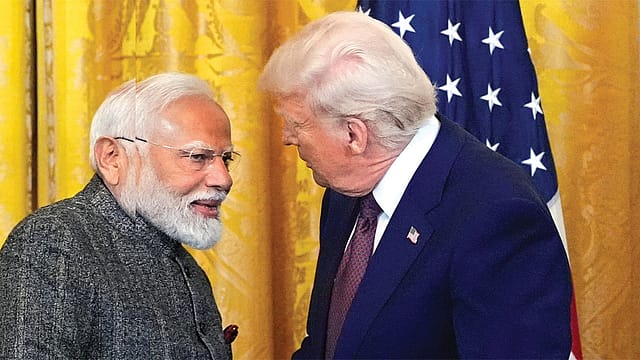
NERVES WERE TAUT AHEAD OF US PRESIDENT Donald Trump’s phone conversation with Prime Minister Narendra Modi on February 2 as Indian officials hoped the two leaders would turn the page on almost a year of strained relations and missed opportunities. The conversation, which lasted half-an-hour, saw Modi skilfully close the gap over the trade deal even as the leaders discussed the Ukraine war. Then a long-awaited moment arrived when Trump agreed to effectively reduce duties on Indian exports to the US from 50 per cent, as had been the case since August 2025, to a moderate 18 per cent, signalling a much-needed reset in India-US ties.
Negotiators had wrapped up discussions over the India-US bilateral trade agreement (BTA) for a while now and what was awaited was the political green light. Although it will take time to fully restore relations, Trump’s post on Truth Social referring to Modi as “one of my greatest friends” and a “powerful and respected leader of his country” indicated an upward tick. The US leader’s claims about India deciding to stop buying Russian oil and instead sourcing crude from Venezuela will need closer examination but tariff reduction is now a fact. “Out of friendship and respect for Prime Minister Modi and, as per his request, effective immediately, we agreed to a Trade Deal between the United States and India whereby the US will charge a reduced reciprocal tariff, lowering it from 25% to 18%,” he said. He then rounded off by observing that “PM Modi and I are two people who GET THINGS DONE, something that cannot be said for most…” As events unfolded in the past month, it is indeed evident that Modi got the deal over the line.
Trump’s commitment to furthering India-US trade is shared by the Modi government even if the projected figures are open to discussion. Throughout a tumultuous time that saw Trump administration figures like Secretary of Commerce Howard Lutnick and trade advisor Peter Navarro regularly directing abrasive and dismissive comments at India, contact between the two sides never dried up. Almost in parallel with the politicking on public display, negotiators kept at their briefs, looking to iron out details and maintain a “positive” engagement, preparing for the moment when politics “normalised” and a regular dialogue was restored. Modi’s decision not to respond to the mix of allegations and threats was deliberate. He did counter Trump’s July 31, 2025 angry “dead economy” remarks about India—asserting at a rally in Bengaluru on August 10 that India is the world’s fastest growing economy and would soon be the third-largest—but avoided slanging matches. He had made his position clear a few days before the Bengaluru speech when he said, “The interest of farmers is our top priority. India will never compromise with the interests of its farmers, livestock holders and fishermen. And I know that I will have to pay a huge price for this personally, but I am ready.”
A little more than five months later, after the phone conversation between Modi and Trump and both sides announced that a trade deal had been finalised, India had held its ground and agriculture, dairy and GM foods remained off the table as Indian negotiators did not budge from the “red lines” set for them. “I want to reiterate that India’s primary concerns in food and agriculture have been fully kept in mind. Opportunities for MSMEs, skilled labour and industries will grow,” Commerce Minister Piyush Goyal told Lok Sabha on February 4. As the details of the BTA are revealed, a quota and price line for some products is likely to become apparent—just as in the case of products like apples, wine, and autos in the India-European Union (EU) trade deal—but sectors identified as sensitive will not be opened to regular US imports. This means cereals, maize, soybean, and GM foods are outside the pact.
The phone call and Trump’s announcement took political pundits by surprise but there were a few straws in the wind. On January 29, after a meeting with External Affairs Minister S Jaishankar, new US Ambassador to India Sergio Gor posted on X: “Always a pleasure to spend time with @DrSJaishankar. We had a highly substantive discussion that covered everything from defense, trade, critical minerals, and working towards our common interests. Stay tuned for much more!” On February 2, after the Trump-Modi phone call, Gor again hinted in a “watch-this-space” tweet: “President Trump just spoke with Prime Minister Modi. STAY TUNED…” A few hours later he welcomed Trump’s trade deal announcement. Even prior to his arrival in India in the new year, Gor had been active in Washington, using access to Trump’s high table to ease the tensions in India-US ties and removing misgivings in the relations between the leaders that had steadily grown since the middle of 2025.

The end of the India-US impasse less than a week after the conclusion of the India-EU Free Trade Agreement (FTA) seems more than a coincidence and India’s success in accessing new markets might have helped move things along. At the same time work on the India-US pact had not stopped even as arguments that nothing was to be gained by holding out gained salience in Washington. There had been rising domestic criticism in the US that the Europeans had proved to be quick movers and clinching the trade pact with India was in America’s interests. The developments have placed India in the unique position of having arrived at trade agreements with both the EU and the US at a time when the transatlantic allies are barely on talking terms. The reasons, point out sources familiar with the developments, lie in India’s determined pursuit of “strategic autonomy” that visualises every relationship in its own right. The clarity in directions and Modi’s preparedness to soak up pressure empowered Indian negotiators to present their case with conviction, ruling out what could not be placed on the table while also offering unprecedented opportunities for American businesses. In the past, Manmohan Singh as prime minister had dug in his heels over a nuclear deal with the US in the face of opposition from his own Congress and its allies. But his political goal was in alignment with Washington. In the months and weeks after Trump slapped penalty tariffs, claiming India was “aiding” Russia’s war against Ukraine, the Modi government stood at cross purposes with the US. “There was clarity that the so-called oil purchase tariff was arbitrary and unfair and would need to be withdrawn,” said a source.
In July 2025, anticipating that India and the US were close to concluding the trade deal, Congress leader Rahul Gandhi had lashed out at the government, saying Modi would “surrender” to the Trump administration. Responding to Goyal’s statement that protecting Indian interests is more important that any deadline, Rahul Gandhi said, “Piyush Goyal can beat his chest all he wants, mark my words, Modi will meekly bow to the Trump tariff deadline.” Not only was the purported deadline never met, Trump went on impose the oil-related tariff, taking the overall rate on Indian exports to a record high of 50 per cent. Thereafter the Modi government waited it out and held firm till Trump’s post on February 2. Since the decision to withdraw and reduce tariffs was to be an American decision, it was only appropriate that the US president made the announcement. This did not, however, prevent the Congress leader from repeating his charge, this time embellishing his allegations by claiming that a case against the Adani industrial group in the US and the Epstein files’ revelations were an added reason for succumbing to US pressure.
The government’s response was swift and Goyal was unusually harsh in accusing Rahul Gandhi of being perennially opposed to India’s progress. “Why does he feel irritated by lakhs and crores of rupees of investment that we are engaged in attracting? Rahul Gandhi ko kya mirchi lagti hai? (Does Rahul feel envious?),” Goyal asked at a press conference on February 3. The minister’s remarks were directed not only at the Congress leader but he also painted I.N.D.I.A. parties Dravida Munnetra Kazhagam (DMK), Trinamool Congress (TMC), and the communists with the same brush, saying their support for the Congress position made them accomplices in peddling anti-India narratives. “The failed, disparate, disgruntled leaders of Congress and their friends in DMK, Trinamool, and communist parties who have failed the nation will be punished by the people for their anti-national thinking,” he said. The broadside against the entire I.N.D.I.A. bloc was clearly deliberate since the Bharatiya Janata Party (BJP) is ranged against these parties in the elections in Tamil Nadu, Kerala, and West Bengal due in a couple of months. BJP intends to present the deals with the US and the EU as major achievements and evidence its policies will deliver growth and prosperity.
THE JUNE 17, 2025 phone conversation between Modi—who was in Canada at the time attending a G7 meeting—and Trump was terse as the prime minister explained that India has not, and will not, accept any third-party mediation in ties with Pakistan and that the May 7-10 conflict ended after the Pakistani military sought a ceasefire. Trump is understood to have heard Modi without saying much. Indian Foreign Secretary Vikram Misri thereafter read out a statement on the phone call that left no room for ambiguity. “Prime Minister Modi clearly conveyed to President Trump that at no point during this entire sequence of events was there any discussion, at any level, on an India-US Trade Deal, or any proposal for a mediation by the US between India and Pakistan. The discussion to cease military action took place directly between India and Pakistan through the existing channels of communication between the two armed forces, and it was initiated at Pakistan’s request. Prime Minister Modi firmly stated that India does not and will never accept mediation. There is complete political consensus in India on this matter,” Misri said. Not only was Trump’s claims to have used trade as leverage to end the fighting denied, so was his assertion of mediating an end to the hostilities. This amounted to India’s refusal to endorse Trump’s adding the resolution of the India-Pakistan clash to his claim to a Nobel Peace prize. On the other hand, Pakistan had no such qualms in humouring Trump and its army chief Asim Munir, who had wrangled a promotion to ‘Field Marshal’ for himself, gained access to the White House. A September 2025 photograph of the military officer and Pakistani Prime Minister Shehbaz Sharif presenting a box of rocks, supposedly rare minerals, to Trump was the high point of the newfound camaraderie. Yet the mineral deposits in Pakistan are primarily located in Balochistan which has been rocked by a separatist insurgency, making plans for commercial extraction highly speculative. On the other hand, India-US relations have now turned full circle and even if it takes time for suspicion and doubt to abate, the BTA is evidence of a normalisation in ties.
The fine print of Trump’s statement that India has committed to purchasing $500 billion of US goods is that this is to be spread over five years and is seen as a “best endeavour” objective. In other words, it is not that the deal would be off if these purchases were not concluded. The deal’s terms will become clearer once the two sides issue a joint statement but India is expected to step up purchase of high-value chips, such as those made by Nvidia, aircraft and auto parts, oil and LNG once the deal is operationalised. Going by last year’s trade figures, about $25 billion of Indian exports, such as pharma products and mobiles, do not attract any duty and the same is the case with another $4 billion covering some minerals and agricultural products. Some $12-14 billion of Indian exports attract provisions of US Section 132 that governs tariff rate quotas and products like steel, aluminium and auto parts will continue to be subject to a 50 per cent tariff. Around $30 billion of exports to the US, such as marine products, rubber, chemicals and textiles, will be governed by the reduced 18 per cent reciprocal tariff Trump announced. Another $10 billion of exports will gain duty-free access.
On the Indian side, discussions with US officials indicate price-linked quotas like those worked out with the EU might apply to fruits, almonds and cashews alongside walnuts with shells. On the purchase of Russian oil, it would seem the US statements that India had agreed to halt such imports may not be seriously contested in public but Indian officials noted that the commodity will be procured from any “non-sanctioned” entity. As regards Trump’s statement that India is ready to buy oil from Venezuela, this was the case earlier too and imports were halted after the US imposed sanctions on such purchases. India can revert to buying Venezuelan oil again but most reports indicate that it may be a while before the crude is available. In his comments on February 4, US trade representative Jamieson Greer, while saying that duties on a vast array of agricultural goods will go down to zero, admitted that India—like the US—has protection in some “key areas” which will continue to be controlled. It is evident that cereals, maize, soybean, GM foods and most dairy products are outside the scope of the trade pact.
The deal will have implications for India’s geopolitical calculations. For one, the ebullience in Pakistan’s civilian and military leadership over apparently outflanking India, which could spill into renewed adventurism in Jammu & Kashmir and elsewhere, will receive a reality check. Pakistan may not find it as easy to take advantage of differences between India and itself. In the context of ties with China, the development could result in Beijing taking concrete steps to make the current thaw in relations more meaningful. China has tended to see relations with India through the US prism. Closer India-US relations have often prompted the Chinese leadership to seek improved ties with India. Although Trump’s policies and actions have made foreign policy predictions a hazardous pursuit, India’s success in sealing trade pacts with the EU as well as the US is not good news for China. The trade deals increase India’s global standing and Modi’s ability to hold firm on India’s core interests offer a negotiating model to other nations who have been at the receiving end of Trump’s tariffs.