Openomics 2026: A Fine Balance
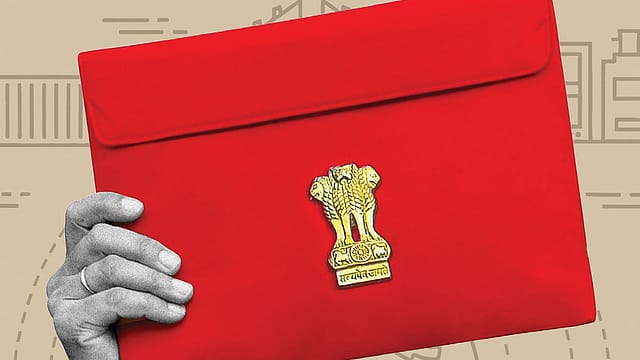
WHEN FINANCE Minister Nirmala Sitharaman rose in Parliament on the morning of February 1 to present her ninth consecutive Union Budget—a record in Indian history—she faced a landscape of contradictions. India’s economy is projected to grow at 7.4 per cent this year, making it the fastest-growing major economy on the planet. Yet, the rupee has slumped to historic lows, foreign investors have fled Indian equities in record numbers, and a punishing 50 per cent tariff wall imposed by Washington has cast a long shadow over the country’s export ambitions.
The Budget she delivered was neither a populist giveaway nor a dramatic pivot. It was, instead, a document of measured continuity—an attempt to navigate between the Scylla of global trade disruption and the Charybdis of domestic political expectations. In doing so, Sitharaman has offered a revealing glimpse into the pressures of governance: balancing the imperatives of long-term structural investment against the immediate demands of a restive middle class and the capricious winds of great-power rivalry.
The challenges confronting India as it entered 2026 were formidable on multiple fronts. Globally, the trade architecture that had sustained decades of export-led growth across Asia lies in tatters. President Trump’s decision last August to impose sweeping tariffs on Indian goods—initially 25 per cent, then doubled to 50 per cent over India’s continued purchases of Russian oil— has placed New Delhi in an unenviable position. The tariffs, among the highest imposed on any American trading partner, threaten an estimated $48 billion in exports and have already decimated sectors like textiles, gems, jewellery, and leather goods that employ millions of Indians in labour-intensive manufacturing.
Unlike China, which has reached a temporary tariff truce or European nations that secured their own arrangements with Washington, India spent much of 2025 locked in prolonged negotiations on multiple fronts. The diplomatic chill was palpable. When Prime Minister Narendra Modi met Trump in February 2025 and pledged to double bilateral trade to $500 billion by 2030, few could have predicted that within months, Indian exports would face duties that dwarf even those imposed on Beijing. Relief has come only recently: days before the Budget, India and the European Union concluded a landmark free trade agreement—hailed by both sides as the “mother of all deals”—creating a free trade zone of two billion people. And just a day after Sitharaman’s speech, Trump announced a separate deal with Modi, reducing US tariffs from 50 per cent to 18 per cent in exchange for Indian commitments. The full details of both agreements remain to be finalised, but they signal a potential turning point in India’s trade fortunes.
On the domestic front, the picture is equally complex. India’s growth story remains intact—real GDP expanded at a six-quarter high in the second quarter of fiscal 2026, unemployment has fallen to historic lows, and inflation has cooled to levels well within the central bank’s comfort zone. This macroeconomic success has translated into prosperity that is broadbased and, yet, in several dimensions, falls short of the population’s rising aspirations. Youth unemployment remains a challenge. Housing costs continue to climb. Healthcare expenses are a rising burden, with out-of-pocket spending accounting for nearly half of all medical expenditure. Structurally, the economy’s transition away from low-productivity agriculture to manufacturing and services has taken place at a far slower pace than hoped. Private investment remains weak.
It was against this backdrop that Sitharaman unveiled her 85-minute Budget speech, choosing fiscal discipline and spending targeted towards growth over electoral sweeteners. The headline figures tell a story of cautious optimism: capital expenditure will rise to `12.2 lakh crore, an increase of roughly one lakh crore over last year. The fiscal deficit is projected at 4.3 per cent of GDP, continuing a gradual consolidation from the pandemic-era peaks.
The Budget proposes seven high-speed rail corridors connecting major urban centres, including routes from Mumbai to Pune, Delhi to Varanasi, and Hyderabad to Bengaluru. Twenty new national waterways will link mineral-rich regions to industrial hubs. A dedicated SME Growth Fund of ₹10,000 crore aims to nurture “future champion” enterprises that can scale from local to global markets. The Self-Reliant India Fund, which provides equity support to micro, small, and medium enterprises, receives an additional ₹2,000 crore.
FOR A GOVERNMENT facing steep external tariffs, the emphasis on manufacturing self-sufficiency is neither surprising nor unreasonable. India Semiconductor Mission 2.0 has been launched to accelerate the country’s nascent chip ecosystem. A Bio-Pharma SHAKTI initiative seeks to position India as a global leader in pharmaceutical innovation. New schemes target everything from rare earth minerals to electronic components, textiles to high-tech tools—all part of a broader vision to reduce critical import dependencies and build domestic manufacturing capacity.
Perhaps the most revealing aspect of Budget 2026 lies not in what it includes, but in what it consciously omits. There are no new income-tax cuts for the salaried class. There is no increase to the PM-KISAN scheme that provides direct cash transfers to farmers. There is no dramatic expansion of welfare programmes designed to generate pre-election enthusiasm. Instead, Sitharaman has doubled down on the supply-side investments that will boost infrastructure, manufacturing, and build domestic capacity (broadly envisaged).
Amidst these initiatives lies a significant missed opportunity. While the Budget tinkers at the margins of customs policy—exempting duties on certain capital goods for lithium-ion batteries, solar glass, and aircraft components—it fails to address a structural weakness that has long hobbled Indian manufacturing: the country’s persistently high tariffs on raw materials and intermediate goods. India’s average tariff rate of about 18 per cent is nearly double that of Vietnam (9.6 per cent) and China (7.5 per cent), the very competitors it hopes to displace in global supply chains. Various industry bodies have repeatedly warned that India’s “inverted duty structures”, where components are taxed higher than finished products, erode domestic competitiveness rather than enhance it. Indian manufacturers of mobile phones, electronics, textiles, and chemicals all face input costs that are higher than those of their regional rivals. A bolder Budget might have moved towards zero duties on industrial raw materials and a low standard duty on finished goods, as many economists have urged.
THE AGRICULTURAL SECTOR, which employs nearly half of India’s workforce, receives targeted interventions rather than blanket subsidies. A multilingual AI-based platform called Bharat-VISTAAR will provide customised advisory support to farmers in their own languages. Schemes promoting high-value crops—coconut, cashew, cocoa, sandalwood, almonds, walnuts—reflect an attempt to move Indian agriculture up the value chain. A credit-linked subsidy programme aims to modernise livestock enterprises and expand veterinary infrastructure.
Critics will note, perhaps fairly, that the Budget offers little immediate relief to households squeezed by rising costs. The middle class, which had come to expect annual tax sweeteners, will find the unchanged income-tax slabs disappointing. The only meaningful concession comes in the form of compliance simplification: extended deadlines for revised tax returns, reduced rates on overseas travel remittances, and streamlined procedures for obtaining lower withholding tax certificates. These are useful reforms, but they are not the stuff of dinner-table celebrations.
Yet, there is a coherent logic to the government’s approach, even if it is politically unrewarding in the short term. With the rupee under pressure and foreign capital departing, fiscal profligacy could only accelerate the currency’s decline and stoke imported inflation. With global trade conditions deteriorating, investments in domestic manufacturing and infrastructure create alternative growth engines that reduce dependence on fickle export markets. With employment improving and inflation contained, the government has calculated that it can afford to prioritise long-term structural reforms over immediate consumption stimulus.
Budget 2026 represents a serious attempt to build the productive capacity that will determine India’s economic fortunes over the next decade. The targeted incentives for electronics, pharmaceuticals, clean-technology components, and other strategic industries reveal a state increasingly comfortable with industrial policy. The investments in infrastructure and human capital address genuine constraints on growth. The fiscal restraint preserves policy space for future contingencies.
Budgets, however, have inherent limitations. They are well-suited to announcing schemes and allocating resources; they are far less effective at dismantling the entrenched institutional obstacles that have long constrained Indian competitiveness. Becoming a developed economy is not merely a matter of sustained growth; it requires institutional evolution—faster courts, more capable municipalities, more flexible labour markets, a state that delivers services as reliably as it collects taxes. No single Budget can accomplish all of that.
But what Sitharaman has done is lay the groundwork. At a time when global geopolitical tensions are at a peak, when India’s economic relationship with the US has frayed, when global capital has turned sceptical, and when domestic expectations have run high, she has chosen the path of steady stewardship over spectacular gesture—and in doing so, has kept India’s options open for the harder work ahead.
For now, the middle class will have to content itself with compliance reforms rather than tax cuts. The rupee will find its own level as the newly announced trade deals with Europe and the United States take shape—though their full impact will depend on details yet to be finalized. And India will keep building—railways and waterways, factories and data centers, skills and institutions—betting on the long game. With the world’s largest youth population, a deepening domestic market, a democracy that remains vibrant, and a trade landscape that finally appears to be shifting in its favor, India has reason to believe that patient investment will eventually yield its rewards. The geo-political and geo-economic storms of the present will pass; what will endure is what India chooses to build while they rage.