Open Minds 2026: Public Square
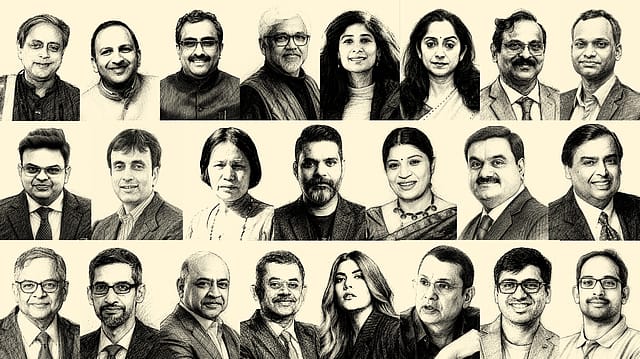
If you imagine the world as a giant convention, then the main topic on the agenda today, both on stage and the sidelines, is generative AI, a technology that did not exist a decade back, and until five years ago was still being tested. Once it came into the public domain however, it became clear that humanity would change. But how exactly is the unanswered question. Entire sectors will become redundant, with AI agents replacing human employees. But there will also be massive productivity leaps. When the internet first arrived, it too was known to be world-changing, but no one could have predicted social media as the biggest cultural, commercial and even political force in the world. AI will unleash something similar but only time will tell what it is.
Amitav Ghosh, 69, Author: The Climate Prophet
Over four decades, Amitav Ghosh has remade the landscape of Indian English literature with his sumptuous stories. His more recent books, however, have come to be anchored in a central concern: the global climate crisis. In works such as The Great Derangement: Climate Change and the Unthinkable (2016) and The Nutmeg’s Curse (2021), Ghosh explores the links between environmental degradation, history, trade, and colonialism. His literary stature ensures that people take notice. A case in point was Kerala Chief Minister VD Satheesan recently citing The Nutmeg’s Curse as the inspiration behind a proposal to build an International Maritime Museum in the state. Ghosh’s latest novel, Ghost-Eye, released this year to great fanfare, is also a story of climate activism.
During the launch, the author spoke to Open about the challenges of climate change, biodiversity loss, and species extinction. “They stem from a completely mechanistic reading of the world—where you assume that the world is yours to exploit and you know everything about it. But it is profoundly not the case,” he said. As the impact of climate change becomes increasingly visible, Ghosh’s words have become his weapon. Always a novelist of ideas who has grappled with history from the Opium Wars to the Marichjhapi massacre, Ghosh’s intellectual activism now addresses the 21st century’s biggest global crisis.
V Narayanan, 62, Chairman, ISRO: Space Savant

IN THE LAST decade, ISRO has carried out a number of important missions, often at a fraction of the cost others have spent. These have placed India in a very tiny group of countries with cutting-edge space capabilities. V Narayanan, a veteran ISRO scientist who specialises in the propulsion of rockets and spacecraft, has been a critical figure in ISRO’s rise. Now, under his chairmanship, the space agency is working towards its next big milestone—the Gaganyaan Mission that hopes to send humans to space by next year. As of now, there are doubts whether the deadline will be met. But there is a reason why ISRO is taking such a cautious approach. Human safety, after all, is paramount. When the mission eventually takes place, it will be a huge moment in the country’s space programme, one that Narayanan will have played an important role in.
Mohanasankar Sivaprakasam, Engineer: The Brain Mapper
When he returned to India in 2008, Mohanasankar Sivaprakasam did so with the goal of developing indigenous medical technologies. This would lead to the Healthcare Technology Innovation Centre at IIT Madras which has incubated multiple healthtech startups and played a pioneering role in developing many affordable medical products and devices. He also set up the Sudha Gopalakrishnan Brain Centre, today considered one of the world’s leading centres for human brain imaging. The centre, of which Sivaprakasam is the director, is helping tackle the absence of high-resolution images of human brains across ages and diseases. MRIs can give images at the millimetre or centimetre level. But Sivaprakasam and his team want to push this further to the cellular and molecular level, using which doctors and scientists will be able to tell not just what damage may have occurred to a brain but also what is happening and could happen. Their first set of detailed human brain maps, released last year, is said to have advanced the field tenfold. Many more maps are being worked on, and the insights will not just advance neuroscience but help develop technologies to fight brain diseases.
The Arc of the Argument: Where the Nation Is the Conversation
Shashi Tharoor, 70, Author and MP: Word Leader
A relentless writer and orator, Shashi Tharoor can be liked or disliked but never ignored, thanks to his intellectual stamina. In recent years, he has written books on a range of subjects and people, including BR Ambedkar and Sree Narayana Guru—in the case of the latter, it was a rare attempt by a major scholar. He is not often liked especially because he and his party are not on the same page, be it on international outreach to argue India’s cause or about the situation in Jammu & Kashmir, which he feels is progressing towards normality.
That Tharoor, who has immense potential for reviving the fortunes of his party which is a pale shadow of what it was, is underutilised is public knowledge. Which is why, be it on global developments or local politics, he talks his mind, and at times, to provoke. At the same time, he instinctively knows the difference between a seminar hall and a TV debate. The 70-year-old former UN under-secretary general and alumnus of the Fletcher School of Law and Diplomacy has a knack for continuing to ignite debates in a way very few do in India.
Neelkanth Mishra, Economist: The Optimist
RECENTLY APPOINTED INDIA’S Executive Director at the World Bank, Neelkanth Mishra is widely regarded as one of India’s most prominent economists and public policy wonks. An alumnus of IIT Kanpur and chief economist at Axis Bank, he has held many key government posts, from being a part-time member of the Economic Advisory Council to the Prime Minister and part-time chairperson of the Unique Identification Authority of India to being an advisor to several important government committees and institutions. His appointment to the World Bank comes at a time when India wants to have more influence in shaping global conversations around development financing and economic growth initiatives. In a key post in one of the world’s most important financial institutions, Mishra will be in a position to do just that.
Pratap Bhanu Mehta, 59, Public Intellectual: Conscience Keeper
EVEN GEN Z, whose collective affinity for deep political analyses can often be compared to that of vampires for garlic, is familiar with Pratap Bhanu Mehta’s name. At a time when the public attention span for such topics is perceived to be shrinking, Mehta attracts readers to his essays on constitutional morality or when he rues that “the media landscapes of most democracies have become, in effect, more reminiscent of the propaganda apparatuses of authoritarian states than of free societies”.
His columns are consumed not exactly for second-hand use in any shrill debate but for learning how we have changed as a nation and a world, buffeted by political winds from afar and within. Mehta is hated in equal measure as he is loved when he champions dissent without pulling punches. When he invoked Czeslaw Milosz to highlight self-deception recently, it generated public opinion in favour and against. What is remarkable is that the 59-year-old questions authority not often as though it is his right but as his responsibility as a public intellectual.
Ram Madhav, 61, Author, The Hindu Conservative
Few straddle politics, intelligentsia, and public policy in India as much as Ram Madhav. With roots going back to the intellectual wing of the Rashtriya Swayamsevak Sangh (RSS), he became co-opted into active politics in the Bharatiya Janata Party (BJP). He was the party’s national general secretary once it came to power. Madhav is credited with being one of the architects who brought the Northeast into the party’s fold.
He then had a long break from active politics when he returned to RSS as a member of its executive council, and then two years ago, returned to BJP as the in-charge for the Jammu & Kashmir Assembly election. A columnist and regular writer of books that address political, social, and cultural issues that India grapples with, his think-tank India Foundation is a forum whose debates and discussions craft a direction for the government.
Gita Gopinath, 54, Economist: The Realist
SHE MAKES NEWS not only by offering commentaries on oil shocks, inflation, currency markets and the like but also by congratulating the Indian women’s team on their victories, posing with an Indian beauty pageant winner, and dining at her favourite Mumbai restaurant. An Indian-origin economist with many firsts to her credit, Gita Gopinath, currently the Gregory and Ania Coffey Professor of Economics at Harvard University, made a name for herself by becoming the first deputy managing director of the International Monetary Fund (IMF), having earlier served as its chief economist. Her pronouncements on the Indian economy and policy decisions continue to be treated with great interest by the media and experts. Gopinath has praised the Centre’s fuel-price strategy amid the Middle East crisis and called for strengthening its reform agenda and contribution to AI. Kolkata-born Gopinath, an alumna of the Delhi School of Economics, the University of Washington, and Princeton University, seldom shies away from stating inconvenient truths about the global economy.
Shamika Ravi, 50, Economist: The Explainer
It was when Covid began to spread in India that Shamika Ravi first came into the national limelight. Her daily updates and data-driven insights about the spread and nature of the pandemic provided a measure of comprehension beyond the mounting panic. Since then, Ravi has continued to be a voice in the economic conversation of India, with her columns and public appearances. An economics doctorate from New York University, the public role she essays is of someone making complex economic issues facing the country understandable to a wider audience. For instance, in a podcast she questioned the anxiety over the rupee potentially touching 100 against the dollar, arguing it was just another number whereas the real issues to address were elsewhere, such as inflation. As a member of the Economic Advisory Council to the Prime Minister, she also gives inputs that drive policies.
Ruchir Sharma, 52, Author and Commentator: The Smart Interpreter
MAKING PREDICTIONS ISN’T easy but the intelligent interpreter weds forecasting to structural analysis and empirical warnings. If the analyst is Ruchir Sharma, the investment banker and author whose critique of the US economy and the current state of capitalism goes hand-in-hand with his long-term optimism about India though he never shies away from underscoring policy flaws, then such warnings don’t go unnoticed. The author of Democracy on the Road (2019), an exploration of Indian politics and electoral history, based, literally, on road journeys and, more recently, of What Went Wrong with Capitalism (2024), has highlighted the shifting balance between growth, inflation and politics— and offered investors a pragmatic playbook for the uneven recovery of 2026. Sharma has also recently discussed India’s strengths and vulnerabilities—fast nominal GDP growth versus low R&D and productivity challenges. As chairman of Rockefeller International and founder of Breakout Capital, Sharma combines public commentary with institutional leadership. His argument that while the India story is largely sound, the economy will keep performing below its potential without structural reforms and serious deregulation, along with his firsthand insight into Indian politics, makes him one of the sharpest interpreters of the nation in business.
Wealth of Ideas: Powering India Inc
Mukesh Ambani, 69, Chairman, Reliance Industries: Owning the Future
Jio has just filed for an IPO and it is expected to be the largest one India has ever seen. This was a company whose bricks were carefully laid a decade-and-a-half ago by Mukesh Ambani. First, the telecom network patiently took root and now it has become an umbrella for all things digital, from e-commerce to finance to streaming services. He is now positioning it for the AI era. Simultaneously, he has also made ready the next generation to take over from him by carving out the group’s responsibilities between his children. If Reliance, already the biggest company in India, has today metamorphosed from a traditional petrochemicals business to an entity at the cusp of new technologies, then it is Ambani’s vision at play. If his father Dhirubhai Ambani was the original entrepreneur, the son has not just been an empire builder but an architect for the future. He is also India’s wealthiest man.
Gautam Adani, 64, Chairman, Adani Group: Growth Multiplier
If the Adani footprint is now found everywhere in the Indian business ecosystem, it is because of Gautam Adani’s vision and ambition. Ports, energy, defence, logistics, transport, media, FMCG— wherever an opportunity of sufficient scale opens up because of the India story, Adani is present. The Navi Mumbai International Airport, for instance, built by the group, has recently opened while a mega redevelopment project of Dharavi is on the anvil. As the world changes because of AI, Adani is creating the infrastructure, like data centres driven by green energy, which will underpin it in India. The theme of his message to shareholders in the annual report was: Accelerating Infrastructure, Leveraging Intelligence, and his belief was that the group was helping build “the physical and digital nervous system of an emerging global superpower”.
N Chandrasekaran, 63, Chairman, Tata Sons: Safe Hands
TATA CONSULTANCY SERVICES (TCS) is the crown jewel of the Tata Group, driving a substantial percentage of its profits. And N Chandrasekaran had a stellar role in turning it into a cash cow, the reason why he was chosen to be chairman of the group when it was in crisis in 2017. He steadied the ship, but TCS is increasingly threatened by AI. How Chandrasekaran is managing the upheaval can be seen in his annual general body meeting address, where he said in three years the company would have as many AI agents as human employees. Besides this, the Tatas under him are doubling down on the business of AI infrastructure. A mega data centre is going to be developed in India in partnership with OpenAI. There are projects related to AI chip making. Chandrasekaran’s steady hand is guiding the group into a world of tomorrow, where old businesses like steel and cars are expanding along with cutting-edge technology-driven ventures.
Indian Genes: Global Footprint
Arvind Krishna, 63, IBM CEO: Quantum Leap
IBM was once known as the Big Blue but by 2020 when Arvind Krishna took over, it was a company grappling with a loss of direction. Krishna has changed that, hiving off old businesses like IT services and keeping the mothership laser focused on AI and cloud computing. Krishna was the right person to do it because even before being made CEO, he pulled off the biggest acquisition of IBM, Red Hat, for $34 billion. Once he led the company, he doubled down on it. And the results have shown in stock price doubling in the last five years after remaining flat for a decade. In recent times, the IITian who has been with IBM since 1990 has been making the company a leader in quantum computing, which is still in a nascent testing stage. If successful, that could revolutionise technology, much like AI has done. India is also strong on Krishna’s plans for IBM with the company promising to skill five million Indian youths in AI, quantum computing and cybersecurity.
Sundar Pichai, 54, Google CEO: India on His Mind
IF CEOS IN a time of upheaval can make or break a company, then no one is in any doubt as to what Sundar Pichai has done. When ChatGPT first hit the market, many predicted the death of Search, Google’s primary revenue driver. Pichai not only pivoted the company to be a major force in every aspect of AI, from Search to images and videos to cloud to mobile operating systems. Gemini, its AI model, has more than 900 million active users, more than double from the previous year. AI Search is growing exponentially. In fact, when Apple failed in creating its own AI, it finally had to rely on Google to get it right. At its annual conference this year, Pichai revealed how Google is even scaling custom silicon chips. Of the total $180 to $190 billion in capital expenditure, these TPUs would form a big component. In India, Pichai is now a frequent visitor. He announced a Google AI Hub to be set up in Visakhapatnam that would have gigawatt compute and make India also home to mega data centres.
Kunal Shah, 47, Global Head of WhatsApp: Message Maven
Indians have risen to lead giant US tech companies but when Meta announced that Kunal Shah would be the global head of WhatsApp, it was a testament to not executive competence but entrepreneurial drive. Shah, just a regular graduate who dropped out of a management course, had his first major success with Freecharge, a co-founded digital wallet venture that was sold to Snapdeal in 2015 for ₹2,800 crore. Three years later, he went on to found something even more successful. CRED, a members-only financial service to bring rewards to credit card holders, was valued at ₹43,000 crore when Meta took a minority stake in CRED. Along with it, they made Shah lead WhatsApp to monetise the messaging platform that has three billion users. So far, they have had limited success and Shah, who will move to Meta’s headquarters in Menlo Park, California, is expected to make this happen with his experience in the domain and proven successes at building businesses.
Jay Shah, 37, ICC Chairman: Game Changer
JAY SHAH MAY have moved from being secretary of the Board of Control for Cricket in India (BCCI) to chairman of the International Cricket Council (ICC), but if the cricket administration of India has seen numerous notable achievements in recent years, then no one really doubts whose imprint it is. Just this year, India won the T20 World Cup for the second time running, and the tournament raked in more views and revenue than ever before. Shah is credited with bringing parity of pay between the national women’s and men’s cricket teams. And when the Indian women’s team won the ODI World Cup in 2025, some credit must also go to this new focus. One of Shah’s major achievement is bringing cricket into the Olympics for its 2028 edition. The coffers of BCCI and ICC have also never been fuller because of the optimisation of revenues through record-breaking commercial deals. Shah has made both the Indian team stronger and world cricket richer through his administrative prowess.
Uday Shankar, 64, Vice Chairman, JioStar: Media Savvy
He has been in key leadership positions in news and entertainment in the past two decades, redefining both mediums with surprising finesse. Media leader Uday Shankar has mentored leaders across platforms as diverse as Netflix, ICC, Google and Reliance, and has shown agility in identifying the possibilities in digital media. Few have as informed a view of the ever-evolving media scene as Shankar does, and as vice chairman of JioStar, and cofounder and director of Bodhi Tree Systems, not only is he guiding the future of one of India’s largest media and entertainment companies but also paying it forward. He has taken astonishing risks throughout his career, whether it was launching Satyameva Jayate, a primetime show on social issues on Star TV, or launching one of India’s first streaming platforms for live sport, TV and film in Hotstar. As the head of several industry organisations, Shankar has played a vital role in defining media discourse in India. So how does he envision the future of AI: “AI will both disrupt and create new opportunities. AI slop is going to be a menace but it will also put additional premium on quality content and platforms. But AI will equally enable superior creativity and will also allow better efficiency and economies of production. That may be a huge advantage for countries like India to compete in global markets.” Streaming, he says, will continue to be mainstream. Sadly, though, he believes the crisis of credibility and profitability for news in India and globally will deepen. “It’s a fundamental crisis,” he adds, “and this year, the slide will only accelerate.”
Cyriac Abby Philips, 43, Hepatologist: Medical Rationalist
As a well-known hepatologist in Kerala who also does medical research frequently, publishing papers in journals, one would think Dr Cyriac Abby Philips would not have the time to don more hats. But he is now arguably the strongest voice for evidence-based medicine in India. On social media, going by the nomenclature of The Liver Doc, he has developed a huge following. Caustic and combative, he pulls no punches in speaking against what he terms superstition masquerading as science, and under that umbrella falls every branch not following the rigour of modern medicine’s processes. He has had FIRs filed against him by proponents of alternative medicine, has jousted with celebrities when they lent their voice to these treatments, and riled up huge swathes of online trolls. But he has refused to bend or be broken. He recently authored a book on his experiences and insights as a doctor, once again making the case for why, in medicine, the only thing that should matter is science.
Pawan Kumar Chandana, 35 and Naga Bharath Daka, 36, Co-Founders, Skyroot Aerospace: Reaching for the Sky
WHEN PAWAN KUMAR CHANDANA, then a scientist at ISRO, decided to leave the agency to form a space-tech company with Naga Bharath Daka, another ISRO scientist, the decision was fraught with risk. Their company Skyroot Aerospace was going to build rockets to target the market for launching small satellites. At that time, private rocket development in India was still at a nascent stage and the ecosystem for space startups was limited. That changed in 2021 when India opened up the space sector to private players. The company achieved a major breakthrough in 2022 when it developed its own suborbital rocket, a first for an Indian company. Now, it is weeks away from launching an orbital rocket, Vikram-1, another first for an Indian company. After a few more tests, the company plans to begin using it for commercial launches by next year. Another indicator of its success is its growing valuation. After a recent round of funding, the firm became the first space-tech unicorn with a valuation reaching $1.1 billion. As has become evident for some time, the next leap in space exploration will be defined by not just countries but also private players. For India to become an important space power, it is vital that the likes of Skyroot Aerospace keep growing.
Yanung Jamoh Lego, 63, Herbalist: Healing Touch
With more than 1.9 million followers on Instagram, including influencers, physicians, celebrities and others, Yanung Jamoh Lego is an unlikely social media phenomenon. Her account, comprising over a hundred short videos, offers a glimpse into the work that has earned her a reputation as a healer and herbalist. When conferring the Padma Shri on her, the government noted that she had helped heal more than 10,000 people who had given up hope of recovery. Lego is no snake-oil merchant trading in desperation. Born in Sika Tode village in Arunachal Pradesh, she holds a Master’s degree in agriculture from Assam Agricultural University and served for 35 years in the state’s agriculture department. Parallel to her career ran another interest—under the guidance of her father, a traditional healer, she immersed herself in the study of indigenous healing practices. Through her organisation Indigenous Herbal Heritage, she has trained more than one lakh people, planted thousands of medicinal plants, and preserved traditional knowledge. Those who seek her help are treated at little or no cost.
Purnima Devi Barman, 46, Conservationist: Force of Nature
BY 2007, THE Greater Adjutant Stork, the large and distinctive bird known in Assam as hargila, looked to be in a perilous state. Once found abundantly across Asia, its vanishing habitats and indiscriminate hunting had brought its numbers down to just around 450. In Assam, the bird was looked at as a nuisance and harbinger of bad luck. Today, however, its numbers have soared to over 1,800 in Assam alone, and its status has improved from ‘endangered’ to ‘near threatened’. Much of this is due to the efforts of Purnima Devi Barman and the unique conservation model she has pioneered, one that blends wildlife protection with women’s empowerment. Barman created an all-female conservation group called Hargila Army, which rescues injured birds and educates locals about the need to conserve it. They in turn benefit from sustainable business involving hargila-themed textile merchandise. The model ensured women became the bird’s biggest champions and the perception of the bird has changed in Assam. Her unique conservation model has brought her many laurels, from the Whitley Gold Award in 2024 and her inclusion in TIME’s Women of the Year in 2025 to the recent National Geographic Wayfinder Award.