Open Green Shift 2026: Mapping a Sustainable Future
INDIA NEEDS TO cut its pollution levels by roughly 60 per cent just to meet its clean air standards—that is a number that came up more than once through the evening as more than 20 speakers gathered in New Delhi, on July 23, for The Green Shift 2026 hosted by Open and the RP-Sanjiv Goenka Group, to talk about energy, air, fashion, food, and pretty much everything else caught up in the question whether India’s growth story and its climate deadline could coexist.
Opening the summit, Open Editor S Prasannarajan set the tone. “We are all environmentalists today,” he said, arguing that sustainability had stopped being a fringe concern and become the language everyone speaks now, whether they mean it or not. “What we need is not environmental absolutism,” he said. “What we need is environmental empathy... When a president says, “Drill, baby, drill,” it doesn’t sound funny. It sounds insensitive,” he added. Does India have a plan to grow without wrecking the planet it is growing on, or just a plan to talk about one?

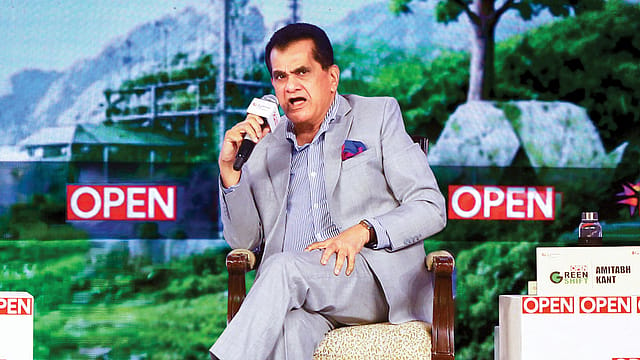
That question found its answer later in the evening when Amitabh Kant took the stage and opened with a number. The former G20 Sherpa and NITI Aayog CEO said that to meet the prime minister’s target of a fully developed India by 2047, GDP needs to grow roughly nine-fold, manufacturing sixteen-fold, and urbanisation twenty-two-fold, with some 500 million people expected to move from villages to cities over the next three-and-a-half decades. That is most of India rebuilding itself in real time, not a line item in a policy document. He was equally blunt about the world’s biggest polluters. A small number of companies, he argued, account for a hugely disproportionate share of global emissions and get away with it because nobody tracks the number the way markets track earnings. Put it on the balance sheet, he said, and let the stock price do the punishing.
Delhi’s own numbers tell a more complicated story than Kant’s global arithmetic. Anumita Roychowdhury, Executive Director of CSE, told the panel ‘Can India Breathe Better?’ that the city’s pollution has actually fallen nearly 40 per cent over eight to nine years, which was a genuinely good thing. The catch is that the city still larger than just seasonal, and the toll on the health and wellbeing of Indians is immense. The problems are not singular, nor can they be fixed by simple changes either. Dr Anant Mohan, Head of Pulmonology at AIIMS, and environmentalist Sumaira Abdulali between them underscored just how varied the damage is, from lung disease to noise. The seasonality of Delhi’s pollution should not change how seriously people take it either, and for Mohan, an air purifier alone isn’t enough to fix the problem. He pushed back on the idea that a few clear-sky days mean the danger has passed. “A few better days doesn’t change the fact that exposure and its health effects are a continuous, ongoing process, not an occasional one,” he said. “You cannot stay indoors and air-purified all the time; over a day, whether exposure is one hour or 10, both intensity and duration of exposure matter.”
“There is substantial evidence,” Mohan said, “on almost every organ” being affected, directly or indirectly; eyes and skin first, then the heart, kidneys and, over time, cognition. He was candid about the limits of the science too, proving a direct causal link between pollution and any one disease is hard, he admitted, but “this now has been established by various studies,” even where the exact mechanism is difficult to pin down in an individual case. He also flagged something that does not make headlines: smaller, lesser-known Tier 2 cities, not just the big industrial or metropolitan hubs, often post pollution numbers just as alarming, for a mix of local reasons—dust, open burning, construction, etc that nobody is really tracking.
Abdulali brought a new angle to the same conversation: noise. She has worked on it since 2002 and remembers exactly how that started. “Everybody used to laugh,” she recalled. Not anymore, arguably, though the fight took its time. “Technically, noise pollution is legally classified as part of air pollution under the Environment Protection Act, and it’s just as destructive, overlapping with health effects like hearing loss and reduced ability to concentrate,” she said. Unlike Delhi’s smog, the damage from noise is ever-present, and it rarely gets the attention it calls for. “Internationally, it’s now recognised that noise pollution can affect lifespan, and every living organism is affected by it, even a caterpillar’s heartbeat rises with noise,” she said. India is one of the world’s worst offenders by global data, she pointed out, partly because noise here doubles as self-expression, which makes it that much harder to even discuss as a health issue.
Perhaps the most striking number of the panel came from Kavita Vij, Director of Programmatic Advancement at the Energy Policy Institute at the University of Chicago. Air pollution, she said, cuts “3.5 years of life” off the average Indian lifespan, more in the worst-affected areas, closer to two years in others. Her team is working to fix those numbers while bolstering the economy alongside it, not instead of it. “We’ve built partnerships with pollution control boards and industries, including working on emissions trading, a cap-and-trade system that incentivises industries to cut emissions, because staying under the cap avoids penalties and the risk of being shut down,” she said. “This lets economic growth continue while reducing emissions,” she explained. Her team’s first such market launched in Surat around 2014 and has since added an effluent market alongside it, with more than 100 industries now connected to the exchange in its first phase. What India needs, Vij argued, is accountability and transparency with high-emission companies and industries, to put limits on the amount of pollution.
A panel on youth activism dug into pressuring industries into strategic, long-term change rather than one-off fixes. “We were born with a publishable platform, a share button,” said environmentalist and sustainability consultant Abhiir Bhalla, “that earlier generations simply didn’t have easy access to.” He called it a double-edged sword: it accelerates awareness but also complicates it, flooding movements with noise alongside momentum. A “hook," he argued, is essential to activism, something that gets people to leap from awareness to actual action, and finding it starts with figuring out what people value most: their health, their convenience, or their finances. He was not romanticising his own generation’s motives either. “We’re a fairly selfish generation, myself included, we tend to ask ‘What’s in it for me?’ before we act on anything,” he said. His own hook “was learning how air pollution was adversely affecting my health and everyone else’s around me. That’s when I really woke up and became interested in the subject.” By 16 he was likely the youngest person involved with a Delhi pollution initiative that went on to run for three-to-four years. He also argued that focusing on communal spaces, places where a wide range of people will actually listen, is vital, which is why he and his team took the fight to the city’s Metro stations to “disrupt positively,” pulling commuters away from their phones with mock demonstrations, “everything from why should I buy bamboo straws as an Instagram trend to more nuanced questions, like how do I get a subsidy for an EV,” as he put it. “That’s the real difference in youth activism,” he said. “We go out and get what we want, rather than waiting for it.”
Between the individual and the government sat a third answer: the community.Dr Payal Kanodia, promoter of M3M and Chairperson and Trustee of the M3M Foundation, argued that lasting environmental change doesn’t actually start in rooms like the one they were all sitting in. “Climate resilience is not built in conference rooms, it is cultivated in villages where people choose to protect what they have planted," she said. For Kanodia, the answer lies less in individual habit than in collective mindset, a sense of shared duty toward the land people actually live and work on. "Lasting environmental change begins when stewardship becomes a shared responsibility," she said.
Fashion designer Rina Dhaka in her turn spoke about a smaller, individual version of that same idea. She wore it, literally, to the ‘Making the Conscious Choice’ panel, a piece from her own line made from cotton grown and woven without a trace of chemicals for nine years running, courtesy a family member in Rajasthan who has been quietly perfecting chemical-free looms. The fabric outlasts polyester, she said, and carries the feel of the earth it came from. Her own sustainable instincts, she added, go back further, to years spent reworking factory leftovers, embroidering discarded sequins together or turning offcuts into fresh detailing instead of throwing them out. It wasn’t originally meant as a statement, she said, it was just the only way to make a small production unit work. It left her convinced that constraint and good design were never really opposites. Men, she added, have been quietly better at this than women for years, wearing the same suit to a dozen events without a second thought, something she said women could stand to learn from.
Chef Manish Mehrotra took the same idea to the kitchen. Asked about farm-to-table dining in India, he said, “There is not a single restaurant in India which is farm to fork in a genuine manner,” pointing out that using three vegetables from one farm doesn’t make an entire menu farm-sourced. His actual advice was less glamorous, run kitchens on three rules—reuse, replace, refuse—cook shorter menus properly instead of two hundred badly, and stop assuming imported produce beats whatever is already growing here. He put in a good word for lauki too, calling it one of the most versatile vegetables, even though it rarely gets treated that way. He was particularly unimpressed by ingredients that show up with a rebrand attached, pumpkin sold back to Indian kitchens as “butternut squash” being his favourite target, and argued a good recipe can make an unfashionable vegetable desirable again without reaching for an imported one instead.
Ricky Kej mentioned the smallest change of the day and talked about it like it was nothing. The musician and UN Goodwill Ambassador sold every car he owned, a BMW Z4, a Mercedes SLK, a Porsche Boxster among them, back in 2013 and never bought another, relying on public transport ever since, even from the airport. He gets his own carbon footprint audited every quarter now, the way some people check a bank balance, and offsets what is left through tree plantation and renewable investment. He took a swing at fast fashion too, much like Dhaka and Mehrotra had earlier in the evening, arguing that the most expensive clothes anyone buys are the ones worn only once.
The Green Shift summit covered a lot of ground—growth targets, pollution numbers, personal habits—each moving at its own pace but pointed towards the same goal. Prasannarajan had said as much before a single statistic had come up: “To remain green, is to remain human.”