On his 76th birthday, PM Modi inaugurates SEMICON India 2026: Why India’s chip ambitions matter
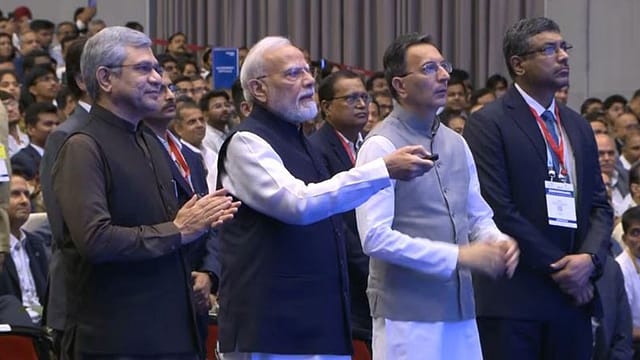
What do you get a Prime Minister on his birthday when the country wants to build a semiconductor industry from the ground up? For Narendra Modi, the answer on September 17 is a walk through a vast exhibition floor filled with the technology that could shape India's next industrial chapter.
PM Modi, who turns 76 today, visited the SEMICON India 2026 exhibition at Yashobhoomi in New Delhi and interacted with participants before inaugurating the fifth edition of the event. Born on September 17, 1950, PM Modi's birthday coincides this year with the opening day of India's biggest semiconductor industry gathering.

Zeroing In on ECI
09 Oct 2026 - Vol 05 | Issue 41
Constitutional legitimacy versus political opportunism
And the symbolism is hard to miss. India is trying to move from being one of the world's biggest consumers of electronic products to becoming a significant part of the global semiconductor supply chain.
Why is PM Modi at SEMICON India 2026 on his birthday?
The timing puts two major stories on the same calendar date: PM Modi's birthday and India's semiconductor push.
SEMICON India 2026 is being held from September 17 to 19 at Yashobhoomi, with the government presenting it as a platform for industry engagement, policy discussions, investment and international partnerships. The event is being organised by the India Semiconductor Mission, the Ministry of Electronics and Information Technology (MeitY) and SEMI, the global industry association.
This year's theme is "Silicon to Systems: Building the Ecosystem" — a phrase that captures the larger ambition. India does not simply want semiconductor factories. It wants the companies, designers, suppliers, engineers, equipment makers and electronics manufacturers that can make those factories part of a much bigger ecosystem.
What is SEMICON India 2026 showcasing?
Look beyond the chips themselves and the scale becomes clearer.
According to the government's announcement, SEMICON India 2026 brings together more than 600 exhibitors, including around 300 international companies, across a 15,000-square-metre exhibition area. More than 150 speakers are expected, while six country pavilions and 12 state government pavilions are part of the exhibition.
The event also has dedicated spaces for startups, students and workforce development.
That matters because semiconductor manufacturing is not a single factory story. A chip passes through multiple stages — from materials and wafer manufacturing to design, fabrication, packaging, testing and eventually its integration into electronic products.
SEMICON India 2026 is designed to show that entire journey.
From sand to silicon: What does India’s new semiconductor showcase mean?
One of the central attractions is the "Sand to Silicon to Systems" Value Chain Experience. The idea is simple enough to understand: show visitors how the semiconductor ecosystem moves from materials and manufacturing to advanced packaging, design, electronics and systems.
It also reflects a change in how India is talking about its semiconductor ambitions. The objective is no longer simply to attract a few giant fabrication plants. The government wants India to participate across more stages of the value chain — including chip design, equipment, packaging, electronics manufacturing and talent.
That is why the word "ecosystem" appears so prominently at this year's event.
Which global semiconductor companies are at SEMICON India 2026?
The guest list tells another part of the story. MeitY says companies participating in the exhibition and strategic discussions include global semiconductor and technology players such as ASML, Applied Materials, Teradyne, Infineon, Ebara, Jabil, IBM Research, NXP, Merck KGaA, Rapidus, Lam Research, Advantest and Tokyo Electron.
Indian companies including Tata Electronics, Micron, CG Power and Uno Minda are also part of the wider industry gathering.
For India, the presence of such companies is important because semiconductor manufacturing depends on an interconnected network of equipment suppliers, materials companies, designers, manufacturers and customers. The government's pitch is that India can become a trusted location within that network.
How far has India’s semiconductor mission progressed?
This is where the story moves from exhibition displays to actual manufacturing. According to MeitY, the government has approved 12 semiconductor projects under the Semicon India programme. Three units approved under the first phase have commenced commercial production, marking a shift from announcements and construction to actual output.
The Union Cabinet has also approved Semicon 2.0, the next phase of the programme, structured around six core pillars.
The broader aim is to deepen India's semiconductor capabilities rather than simply count the number of factories being built.
Why are startups and engineers such a big part of SEMICON India?
Because a semiconductor ecosystem cannot run on factories alone. India will need engineers, chip designers, researchers, technicians and specialised workers to sustain the industry over the long term.
MeitY says electronic design automation tools have been extended to more than 400 academic institutions and 105 startups, while 24 startups have secured approvals under the Design Linked Incentive scheme.
The exhibition's Startup Pavilion will feature around 40 startups, while the Workforce Development Pavilion will focus on skills, talent and career opportunities in microelectronics.
In other words, the government's semiconductor bet is also a bet on India's engineering and technology workforce.
Why does semiconductor manufacturing matter so much to India?
Think about almost any modern product you use. Your phone has chips, so does your car, computers, medical equipment, telecommunications systems and an expanding range of industrial machines. That makes semiconductors far more than a technology-sector story. They are increasingly tied to manufacturing, national economic resilience and global supply chains.
The disruption caused by the global chip shortage showed countries just how vulnerable they could be when critical components come from a limited number of manufacturing hubs.
India's response has been to try to build domestic capacity while positioning itself as an alternative and complementary destination for global semiconductor companies.
What does SEMICON India 2026 mean for India’s global chip ambitions?
For now, SEMICON India 2026 is as much about building confidence as it is about displaying technology.
Global companies are looking at India's manufacturing plans. Indian companies are looking for technology partnerships and supply-chain connections. States are competing to attract investment. Startups are looking for opportunities. And policymakers are trying to create the infrastructure and skills needed to keep the ecosystem growing.
PM Modi's birthday visit puts all of that under one spotlight.
At 76, the Prime Minister is spending his birthday at an event built around an industry that India hopes will define a very different economic future.
The bigger question is no longer simply whether India wants to make semiconductors. It is whether India can build everything around them, from sand to silicon to systems, and turn that ambition into a globally competitive ecosystem.
(With inputs from ANI)