Odisha: The Ore and More
FOR DECADES, ODISHA’S economy has been defined by what lies beneath its soil—iron ore, bauxite, chromite. The state has been a backbone of India’s mineral sector, feeding steel plants and export markets alike. But to see Odisha today only through this lens is to miss a quieter change.
“Odisha is not really an agrarian state in the traditional sense,” says Hemant Sharma, additional chief secretary in the Industries Department. “We are heavily industrialised because of our mineral wealth, and we are a coastal state. That combination is quite unique.” The state remains among the largest producers of iron ore, chromite and bauxite, and is also emerging as a significant player in rare earth minerals. But Sharma is quick to point out the gap. “What we have lacked is a strong base of small and medium industries.”
That gap is now a policy focus. The state is trying to push industry beyond large plants and into districts through a plan to ensure at least one MSME is opened in each district, and by also providing land, water, and clearances. The idea is simple: spread industry, don’t cluster it.
On the ground, this shift shows up in different ways.
Take Ori Food and Beverages. It is not a flashy company. It doesn’t sell products under its own name in most cases. Instead, it makes products for others, which is a quiet but critical part of the manufacturing chain. “We started with TOMCO, and then in 1993 we began manufacturing Wheel detergent with Hindustan Lever,” says Susovan Mohanty, its director. That early association built both scale and credibility.
Today, the company produces around 1,60,000 tonnes of detergent a year, including brands like Surf Excel and Wheel.
Its food division is expanding too, making nutritional products like Horlicks and now moving into confectionery and biscuits. The logic, Mohanty says, lies partly in geography. “For food products, raw materials like maida are easily available here. And for products with longer shelf life, ports help us export.”
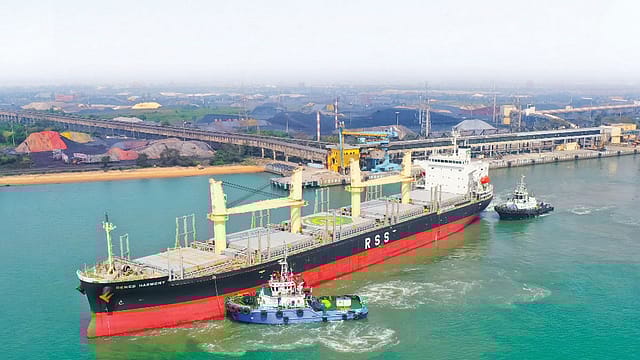
Those ports have long handled Odisha’s mineral exports, especially the Paradip Port, which is trying to reposition itself beyond a bulk cargo hub. “It is the true gateway of the east coast,” says T Venu Gopal, vice chairperson, Paradip Port Authority, pointing to the mineral-rich hinterland it serves. The port is targeting transporting 160 million tonnes of cargo this year, a sign of both scale and ambition. But Gopal frames it as part of a larger system. “Public and private sectors are all working together. We are all part of one engine for the country,” he says. Even softer metrics find a place in this narrative. Despite being a cargo-heavy port, Paradip has ranked first under the Swachh Bharat Abhiyan—something Gopal links to the broader push led by Narendra Modi.

The roles of such ports in Odisha are also widening. For companies like Ori Food, they are not just exit points for raw materials, but gateways for finished goods.
If Ori Food represents one end of the spectrum, Pragati Milk shows what a strong local player can look like. The company, led by its Managing Director Pradosh Kumar Rout, has built a dominant position in the state’s dairy market. Rout puts the company’s market share in the state at 60 to 70 per cent.
His explanation is straightforward. “We price well, we provide timely service, and we make sure our suppliers are paid on fixed dates—2nd, 12th and 22nd of every month,” he says. This consistency matters in a sector where delays can strain relationships. The company also invests in its manufacturing—what Rout calls a “state-of-the-art facility”—and regular quality checks. The result is a brand that retailers trust enough to pay for in advance.
These are not isolated examples. They point to a broader pattern: Odisha’s industrial story is slowly filling out. It is no longer just large, capital-heavy plants. There is a growing layer of mid-sized and smaller enterprises, each responding to different opportunities—raw material availability, local demand, or logistics.
But industry alone doesn’t complete the picture. The other half lies in skills.
“We are training not just for Odisha, but with a global perspective,” says Bhupendra Singh Poonia, secretary, Skill Development. His department’s programmes reflect a shift in thinking. Training is not just about getting someone a job nearby; it is about preparing them for wherever the job may be. That includes language training in order to meet international standards.
The scale is growing. There are more than 80 training centres, with around 35,000 students. The courses are not designed in isolation. “We ask industries what kind of skills they need, and we train accordingly,” Poonia says. The demand is spread across manufacturing and services sectors, from apparel and textiles to electronics assembly.
One of the more visible symbols of this shift is the World Skill Center in Bhubaneswar. Conceived as a high-end training hub, it reflects the state’s attempt to move beyond basic skilling into specialised, industry-linked training. The focus here is not just on numbers, but on quality—training aligned with global standards, exposure to international practices, and an effort to make vocational education aspirational rather than a fallback.
But not all of those trained stay in Odisha. Around 30 to 40 per cent find work outside the state, Poonia states. That is not seen as a failure. The idea, he says, is to give people options—local, national and global. At the same time, there is an effort to reduce distress migration by ensuring that staying back is also viable.
This link between industry and skills is becoming more visible in investment decisions.
When Supreme Industries set up operations in Odisha in 2023, it was not starting from scratch in terms of workforce. “Many of our plants outside the state already have employees from Odisha,” says Ramshankar Khatua, manager of one of the plants. “Setting up here was, in a way, bringing the workplace closer to them.”
THE COMPANY, WHICH has more than 30 plants across India and manufactures over a thousand types of products, found the state supportive. Khatua points to the role of local industry departments in helping them set up. He also sees room to expand further.
Demand is not a problem. As infrastructure grows and housing schemes like Pradhan Mantri Awas Yojana and Antyodaya Gruha Yojana expand, the need for products like PVC pipes and water tanks rises. For a plastics manufacturer, that is a steady market.
Put together, these threads suggest a state in transition. The old strengths of minerals, heavy industry, ports are still there. But they are being complemented by newer elements: contract manufacturing, local brands, skill training systems.
There are still gaps. The push to build MSMEs across districts will take time. Training does not always translate neatly into jobs. And moving from raw materials to higher-value manufacturing is never straightforward.
But there is also a sense of direction.
“More than just creating jobs, we are focusing on training and skill mapping,” Sharma says. It is a line that captures the shift. The question is no longer only how many industries come in, but how well the workforce fits them.
The change in Odisha does not come from one big moment. It shows up in pieces. A manufacturer scaling up quietly. A dairy brand tightening how it works with suppliers. A company setting up closer to the workers it already employs. Training centres trying to keep pace with what industry actually needs.
In the background, the old structures still hold—minerals, large plants, ports moving cargo in and out. But alongside them, something else is taking shape. Not a break from the past, but a slow shift in how the state uses it—less about just extracting, more about building on top of it.
Somewhere in that mix—between policy, industry and people—a different kind of industrial state is taking shape. Not one that abandons its old strengths, but one that tries to build on them, and perhaps, over time, move beyond them.