NEET Passes the Test, New Avatar Next Year
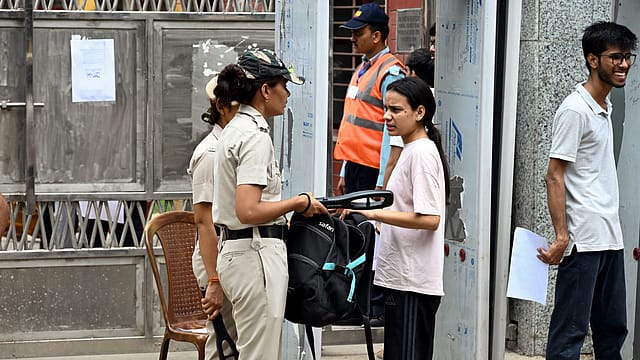
The re-test for the National Eligibility cum Entrance Test (NEET) examination, the last one to be held in a paper format, passed uneventfully on Sunday even as a surge of cyber attacks targeting the National Testing Agency (NTA) portal and hundreds of fake claims of “leaked” questions sought to create fresh controversy even as more than 22 lakh medical aspirants appeared for the exam for around 1.25 lakh undergraduate seats.
The extraordinary decision to quarantine examiners and translators and a suspension of the Telegram platform were crucial decisions. The first ensured there would be no leak as happened with the May 3 examination where a translator gifted with a phenomenal memory was the source of a “paperless” theft of the NEET questions. The Telegram’s editing tool that allows a post-dated edit to appear as part of the original was potentially a powerful tool of misinformation.

The Health and Wellness Issue
25 Sep 2026 - Vol 05 | Issue 39
Political Agendas
There is, however, an opinion that is unhappy the test passed smoothly. A large number of social media handles, many of them politically aligned, tried to raise issues relating to students who could not take the examination as they were late or in some instances carried the wrong admission card. This is never easy for those who suffer but presumably such instances can occur in any exam, whether college and professional entrance tests or recruitment to central and state government jobs. One worthy suggested an examinee must be allowed to enter the exam hall at any time before the end of the test. Obviously, the sanctity of a test or the need to keep a test venue free of disruptions is not a factor for consideration.
There slackness on part of the NTA that led to the leak requires stringent action though the organisation’s leadership has changed. But once the leak was discovered there was no alternative but to cancel the test. It would have been completely unfair to allow the perpetrators and students who benefitted unfairly to get away. Hard as it was, honest aspirants had to be assured that the examination would be a credible test of their skills. The exam will move to a computer-based format from next year and is to be held in multiple shifts to accommodate the large number of test-takers.
Political Supervision
The key learning from the episode is that the bureaucracy needs to be carefully monitored and made accountable. The presence of education minster Dharmendra Pradhan – under fire for the leaks – in the control room on Sunday injected a sense of urgency into the proceedings. The transport of question papers by air force planes and security provided by central para-military forces all came to a head on exam day. There is no substitute to a hands-on approach to matters of such crucial importance. An exam of the scale and importance as NEET has many moving parts and the political executive needs to ensure the highest degree of accountability.
The successful re-test was important also because ever since NEET has been instituted, it had been under persistent attacks that almost always lead to India’s private education lobby that has been writhing ever since the dismantling of the “capitation” or paid admissions that were such a lucrative part of the business. All manner of arguments – that state board students are disadvantaged vis a vis central boards or language barriers affect students from some states – are advanced to try and undermine NEET. The fact that a very large number of test takers enroll in special classes and coaching institutes is conveniently forgotten.
UPA’s Failed Legislations
While public memory is supposedly short, it would need severe amnesia to forget that the Congress-led United Progressive Alliance government introduced five bills to reform higher education in its second term in office. Not one was passed. An important reason being the determined opposition from MPs from states with a large number of private medical colleges. In fact, politicians run many of them and MPs from Andhra Pradesh, Maharashtra and Karnataka played a leading role in scuttling the legislations. Many of these MPs were from the Congress party or from UPA constituents.
These bills were: National Commission for Higher Education and Research Bill, National Accreditation and Regulatory Authority for Higher Education Bill, Educational Tribunals Bill, Prohibition of Unfair Practices in Technical. Medical Educational Institutions and Universities Bill and Foreign Educational Institutions (Regulation of Entry and Operation) Bill. The legislations had several problems. They aimed to create a massive, overbearing bureaucracy that would have burdened India’s education sector with more compliances and a maze of rules.
Protecting Admission Quotas
This was certainly a bother of UPA MPs who had stakes in private colleges. But their primary concern was a likely dilution in their autonomy to discard merit and create various “quotas” for students willing to pay more. The plain fact is that prior to a national-level exam, the myriad tests conducted by government and private colleges forced students to run from one exam center to another while allowing private colleges to fiddle with admissions.