Native Intelligence
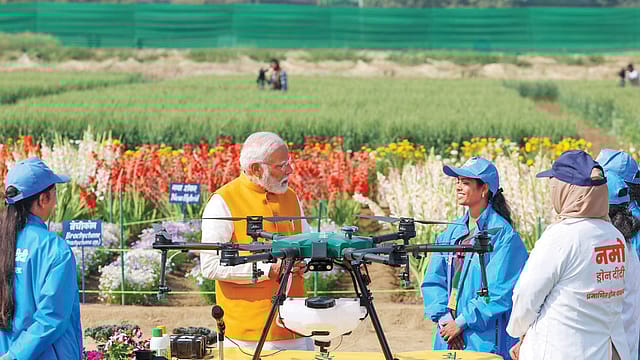
THE MISSION statement of AI and Robotics Technology Park (ARTPARK) in Bengaluru, mentored by the Indian Institute of Science mission, outlines the development of incubator and accelerator programmes for deep tech and includes a training module for aspiring entrepreneurs, funds technopreneurs and partnerships intended to network academia, industry and government. An important area of work involves developing early warning systems for adverse and sudden climate change, a phenomenon increasingly evident during the monsoon but also impacting the intensity and duration of cold and hot weather. The models seek to integrate climate forecasting with health data to work on a risk classification for heat-health linkages.
The robotics developed by ARTPARK includes ‘rehab robots’ made by startup Charukesi that will help therapists plan treatment for muscular and neural problems. At CIPRA.ai researchers work on managing chronic conditions by creating a “digital twin” of an individual. “By leveraging your data, we create a digital twin that holistically understands your lifestyle, context, and preferences, along with their impact on your condition… your digital twin predicts how factors like nutrition and lifestyle affect your health, delivering precise insights and personalised recommendations so you can focus on what truly matters,” the startup says. By mapping the impact and mitigation of climate-related health risks, India’s AI mission is working on problems that have a significant economic bearing on individuals, society, and governments.

War on Iran: The War That No One Won
10 Apr 2026 - Vol 04 | Issue 66
And the price of surviving it
INDIA’S AI HAS a distinct swadeshi flavour not confined to developing homegrown technology. Answering a question in Lok Sabha in July this year, Electronics and IT minister Ashwini Vaishnaw said that India will seek to develop indigenous large and small language models trained to ensure a better understanding of local contexts, dialects and cultural nuances. The importance of developing indigenous models is immediately apparent in the context of partial and often selective accounts of Indian politics, history and culture available on platforms such as Wikipedia. The advent of AI-driven models like Grok has added information and perspective, but the end result is still an improvement, not a resolution of problematic depictions of India. The remote control of data and algorithms makes it more urgent—as the government statement suggests—to develop platforms that tap into and rely on Indian data banks. The nature of AI technology limits censoring of information and in any case a doctored platform would lose all credibility. AI models faithful to native contexts and fidelity can provide more nuanced answers to questions about India’s society and culture.
The LLMs Sarvam AI, Soket AI, Gnani AI and Gan.aI selected to develop India’s foundational models will harness information generated in official and private domains and will be open to be accessed by startups building a range of applications, particularly India-specific ones. The target areas of healthcare, education, agriculture, climate and governance focus attention and resources on key problems but are not unrelated to improving and encouraging a better understanding of indigenous conditions. The decision to make the foundational models open borrows from the success of the United Payments Interface (UPI) in providing access to the private sector, something that ensured a fast and even spread of digital infrastructure. The policy allowed the National Payments Corporation of India (NPCI) digital backbone to make robust and safe services available to the banking system’s physical and electronic payment and settlement protocols. A similar principle animates the vision to make AI easy to access so that it can power innovation.
The close to 35,000 GPUs (graphics processing units) that accelerate simulation, machine learning and data processing and are provisioned through the IndiaAI compute portal benefit academia, medium, small and micro enterprises (MSMEs), startups and government agencies. There is pricing support by way of a discounted rate of 40 per cent and the average price on the portal is less than $1 per GPU-hour or around a third of the global average. Meshing datasets and stepping up computing power are integral to AIKosh that contains more than 1,000 India-specific datasets and 200-plus AI models. The initiative to provide non-personal data was launched by Vaishnaw in March 2025 and AIKosh data provides access to queries from Kisan call centres, statewise geological data, clinical and imaging information used for AI-based diagnosis. Smaller models deliver important services like text-to-speech facilities for Indian languages.
The government announced in May 2025 that 10 startups have been selected for an AI accelerator programme in collaboration with French institutions Station F—advertised as the world’s biggest startup campus—and HEC, Paris, a top-ranked business school. The initiatives fructified soon after Prime Minister Narendra Modi’s participation in the AI Action Summit in February this year where he held detailed discussions on sharing and developing technology that will help Indian companies achieve global standards and access markets such as the European Union (EU). The startups include conversational platforms to deliver contextual and human-like interaction, audio-video analytics for surveillance, security and governance, a full-stack earth observation system combining satellite imagery with AI, applications to transform product URLs and brand context into creative and automated video content, drone-based inspections, edtech platforms with immersive and adaptive learning, proactive security management, deep tech image editing and intelligent voice agents across industries.

THE FOUR FOUNDATIONAL models earmarked for leading AI development aim to enhance governance through Citizen Connect and AI4Pragati programmes, develop open source access to increase linguistic diversity, and enhance real-time speech processing and superior text-to-speech capabilities. The governance and climate forecast applications are looking at problems caused by rapid flood inundation that is now a regular feature—Assam suffered repeated incidences this year— through the use of mapping tools using satellite-based SAR (synthetic aperture radars) and deep learning models. With the rising costs of healthcare and higher occurrence of lifestyle diseases becoming a worrying trend, end-to-end cloud platforms are being developed by Endimension Technology, founded by IIT alums, leading the way in early diagnosis. Other teams are examining utility of AI-enhanced X-rays and integrated lung screening. Early detection and leads on a disease can dramatically alter mortality and costs associated with ‘expensive’ illnesses. A hand-held detector being developed by SIAMAF Healthcare provides radiation-free, non-invasive and cost-effective solutions to evaluate metastases in lymph nodes assisted by AI-based algorithms. BrainSightAI is working on computational neuroscience and 3D visualisation to provide clinicians insights into brain structure and function. Another common ailment diabetes is being treated through early eye screening through retinal scanners. Many of these technologies are at the prototype stage, according to MeitY documents. Secunderabad-based Startoon Labs has a ‘Team Pheezee’ dedicated to developing AI-powered wearable technology to detect causes of joint pain.
Climate variations and sudden fluctuations in international supplies due to events like the Ukraine war have meant predictability in commodities is intertwined with national security. Agriculture-related applications are a pillar of India’s AI strategies. Applications for conversational, personalised assistance to farmers, rapid and chemical-free soil testing, measurement of carbon credits, advanced water and fish monitoring, traceability of maize quality from farm to processing units and data on food quality have all reached the solution stage. The nature of call centres could change with machine translation and multilingual voice recognition improving communication and access while similar processes can deliver automatic transcription of court proceedings. Applications like Jiveesha and ScreenPlay—at conceptual and solution stages respectively—are useful in diagnosing learning difficulties and identifying Autism Spectrum Disorder at early stages. A web-based application ‘Readabled’ has been designed to assist dyslexic children in improving phonetic awareness while VoiceFusion is a cloning platform for speech-impaired people.
The development of an AI structure and implementation of a policy for safe and reliable AI requires strong and well-considered initiatives at school and university level and the National Education Policy (NEP 2020) has given due importance to the introduction of contemporary subjects. The All India Council for Technical Education (AICTE) has devised curricula for IT programmes in various streams. AI is accompanied by significant risks related to automatic decision-making, misinformation and deepfakes and the legal framework to regulate and punish wrongdoers is spread across the IT Act, 2000, provisions of the Bharatiya Nyaya Sanhita, 2023, and Digital Personal Data Protection Act, 2023. Of particular note are limitations on the “safe harbour” status of social media intermediaries who need to be accountable and responsive for removal of deepfakes and patently false information. Interconnected programmes to integrate datasets, innovation, development, future skills, finance and safe AI aim to create a strong AI ecosystem that will ensure India does not miss out on the next stage of the digital revolution, one that promises to be the most consequential.