National Guard: The home ministry unveils a forward-looking strategy against terrorism and insurgency
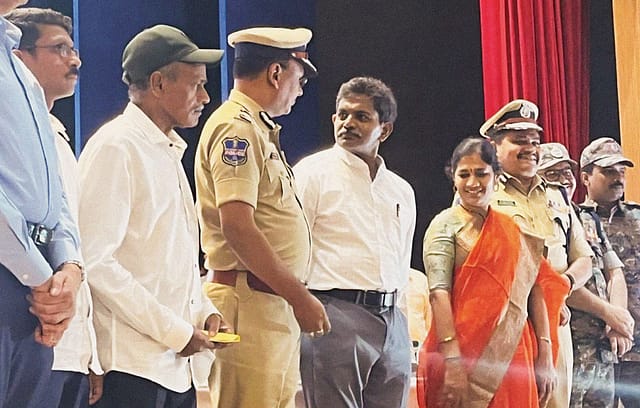
JUST AT THE time when Thippiri Tirupathi (Devji), one of the last surviving senior leaders of the Communist Party of India (Maoist), was surrendering to Telangana Police this week, the Union Ministry of Home Affairs (MHA) headed by Home Minister Amit Shah released a document outlining the National Counter-Terrorism Policy and Strategy. The timing of the release is interesting as India is ending some of its long-running insurgencies and notching up much-needed internal security successes.
The strategy document shows the Narendra Modi government is not one to rest contented and now wants to ensure that crises—terrorist violence, insurgencies and separatism—are not allowed to emerge in the first place. This is in marked contrast to the approach to such matters until the last decade. The planners and managers of the Indian state never devoted attention to prevent such crises from emerging; they simply ‘managed’ them as they arose. From Nagaland to Jammu & Kashmir (J&K) and from Punjab to the forests of East Central India, precious resources— manpower, blood and treasure—were thrown at problems after they emerged. The cost to India has yet to be reckoned with.
Thematically, the policy and strategy are delineated along seven axes. The first pole of the strategy is prevention of terrorist attacks; the second one is based on response; the third on aggregating capacities of government agencies against such threats while the fourth one deals with human rights and the legal infrastructure geared to managing the problem. The fifth part of the strategy, perhaps its most important one, is based on attenuating the conditions that are conducive to terrorism. The sixth and seventh parts of the strategy deal with aligning and shaping of international efforts and recovery and resilience through a whole-of-society approach. Together, these elements have been strung together into an acronym, “PRAHAAR”.

The Abandoned Kejriwal
01 May 2026 - Vol 04 | Issue 69
Brain drain from AAP leaves Arvind Kejriwal politically isolated
All parts of the policy and strategy are vital and all present their own set of challenges. It is, of course, historically true that no society, barring some exceptional city-states and very small jurisdictional units, have been able to keep insurgency, separatism and terrorism at bay. It is the nature of political life across history that such challenges will emerge at one time or the other. The challenge is to ensure that the likelihood of such eventualities is reduced.

In India, the political spectrum across which such challenges exist is large. In many cases, the external element of terrorism merges with the internal security challenges. Terrorism and separatist insurgency in J&K is one example. The challenge posed by separatist insurgencies in the Northeast gaining support and shelter from China and Bangladesh is another example. Then there are largely homegrown insurgencies like the Maoist one. This is apart from the ever-present threat posed by religious and political (left) radicalisation in the country. Urban unrest is another threat.
Perhaps the most important part of the strategy, attenuating these threats, notes this problem clearly: “Terrorist groups are continuously making efforts to recruit Indian youth and to thwart these efforts, Indian intelligence and law enforcement agencies have been continuously disrupting the designs of terrorist groups.” And then again, “Issues of poverty and unemployment among vulnerable communities are addressed through various government schemes and initiatives to prevent inimical elements from misusing these conditions to their advantage. Access to quality education, affordable housing and stable jobs is promoted among such communities.” Together, these elements can go some distance in reducing the scale and scope of threats posed by terrorism and insurgency.
WHY SHOULD THE new policy and strategy matter? Especially when India has overcome some of the most serious internal security challenges seen over the past quarter century?
For one, in a country like India, the risk of insurgency and separatism will not disappear overnight even if active insurgencies are in the process of being dismantled. In regions like Punjab, J&K and parts of the Northeast, a long period of probation is necessary. For another, the intellectual life of India, especially in its universities, is infected with radicalism of various hues. Undoing this is not just a political problem and requires active measures to reduce this risk. The second “A” in the document’s acronym—PRAHAAR— signifies this approach. For the first time, India has a coherent set of ideas on handling the problem of insurgency and terrorism.
India has a long history of battling internal security challenges after Independence. The first—and the longest running—insurgency broke out in what was once called the Naga Hills district of Assam. Since then, not one decade has passed before some insurgency or separatist trend did not emerge in different parts of the country.
Even after vast experience in handling insurgencies, institutional memory and experience have not resulted in a coherent system of understanding the phenomenon across different domains, from political to strategic levels and from tactical to sociological realms. Security forces have the tactical experience of countering insurgency in different regions; civil officers have a different perspective and academics, activists and retired officers—very often, far-removed from the site of action, both in time and space—end up doing most of the ‘analysis’. This itself is a réchauffé of what academics and activists have said over time. What passes off for ‘analysis’ is nothing more than a set of clichés.
The result is a curious, disjointed and often downright misguided understanding of how insurgencies begin and what it takes to end them. The debates and the commentary around these events end up being misguided to the point of being comical. The prescriptions that continue to flow from such stilted analyses are worthless at best and, in fact, positively harmful for national security. Two examples are apt. J&K witnessed a separatist insurgency from 1989 to 2019. The start and end dates often generate controversy and some analysts claim separatism is far from over. But the two dates are like a closed set of time in which most of the separatist politics and violence was observed. The ‘consensus’ among analysts is that a pervasive sense of alienation among the people of J&K due to erosion of the erstwhile state’s autonomy and their ‘political disempowerment’ from repeated spells of President’s Rule were, among other factors, contributors to the spread of separatism. One constant demand, even at the height of separatist insurgency, has been for “political activity” in J&K. Other demands have varied: at one time, “full autonomy” used to be a popular demand with analysts and activists; now, this has been reduced to “full statehood”.
The facts on the ground are at odds with these prescriptions. After August 5, 2019, when Article 370 of the Constitution became inoperative and J&K was no longer a state, let alone one with a “special status.” From June 2018, when the Mehbooba Mufti ministry ceased to exist until October 2024, when Omar Abdullah became the chief minister of J&K (Union Territory), political activity was at a standstill, barring some local elections.
Yet, this has been one of the most peaceful periods ever since insurgency began in 1989. If the claim of public alienation due to erosion of autonomy of the state and political disempowerment leading to separatism is true, there should have been more turmoil in J&K, not less. Even now, there is insurgent violence in J&K—to deny that would be an error—but terrorists are now largely located in the thickly forested areas of the Jammu division that offer a suitable terrain and geographic conditions. The terrorists who operate in the Pir Panjal area are of Pakistani origin. The areas of South Kashmir and the capital, Srinagar, that were considered hotbeds of secessionism, are more or less quiescent. The flag-bearer of separatism, the All Parties Hurriyat Conference, is now moribund.
If one were to follow the prescription of restoring full statehood, there is a very strong likelihood that the political patronage of separatism will return, along with an active and armed separatism. If anything, separatists made full use of the democratic space in J&K even as elected governments made use of separatism to keep the Centre on a back foot in a symbiotic relationship. While this reality is obvious to the framers of the PRAHAAR strategy, it eludes all analysts of separatism and insurgency down to the last man and woman. Is there any surprise that insurgency lasted for so long in J&K?
The second example is from the rapidly extinguishing Maoist insurgency in the Bastar region of Chhattisgarh. Like the one in J&K, insurgency in Bastar has been the subject of sustained misinterpretation at the hand of analysts and activists, a trend that has continued right until now. It has been claimed that Maoism in India was the product of deprivation, poverty and lack of development. Over time, alienation of Adivasis as their water, forests and land—jal, jangal aur jameen in activist parlance—were taken away from them, was grafted on the original “explanation” proffered for the origin of Maoism. That the two claims contradicted each other and the fact that Maoism has spread over its various phases in very different social and physical settings never bothered those who sought to explain the insurgency.
The reality was very different. For one, the Maoist insurgency could never spread beyond the densely forested regions of East Central India. It took root there because the government and its apparatus had no, or very thin, presence there from the time of Independence. That thinness itself was a product of a misguided Nehruvian prescription: that the Adivasi areas should be left ‘undisturbed.’ Decades later, the Maoists—who were waging a ‘revolutionary war’ in Andhra Pradesh—moved into Bastar. This had nothing to do with “poverty and deprivation” in Bastar but everything to do with its thickly forested terrain and its remote location.
There is no doubt that compared to the developed parts of India, Bastar lacked even the most basic infrastructure. But then, Maoists themselves ensured that no development took place: from the year 2000 to until very recently, the area was out of bounds for all government agencies and even something as basic as PDS rations could not be provided to the Adivasis. Then came the question: how could development take place if it could not take over land and forests for development purposes, such as extracting natural resources through mining and forestry? The story of how and why the Maoist insurgency took off and sustained itself for so long, tied analysts and activists into knots as they put forward these mutually exclusive claims.
This fashion has not stopped. In recent weeks, two celebrated and superannuated police officers have warned that as the Maoist insurgency comes to an end, it is important to ensure that ‘corporates’ do not ‘take over’ Adivasi lands for mining projects and that gram sabhas be held in an ‘honest manner’ in villages in the region if such land is necessary. If such a policy is adopted, there will be no development worth its name in Bastar. There is now a stratum of local Adivasi politicians who have a vested interest in not letting any development take place in the name of preserving jal, jangal and jameen. Structurally, this sort of politics serves the same purpose as it once did in J&K: ensuring that the writ of the government does not run in these turbulent regions. It is a travesty that police officers with vast experience in dealing with insurgencies should swallow such arguments.
THE POLICY AND strategy document lists everything that India is doing to minimise threats posed by terrorism, from international coordination to domestic responses and from immediate steps in the wake of crises and forward-looking steps that are necessary to reduce these threats. It is perhaps for the first time that different elements of India’s response have been outlined in a coherent, publicly declared, strategy and policy. In an uncertain world, internal security is perhaps one of the most important parts of running a country. India badly needed a coherent strategy instead of prescriptions based on talking points of vested interests.