Narendra Modi: The Power of One
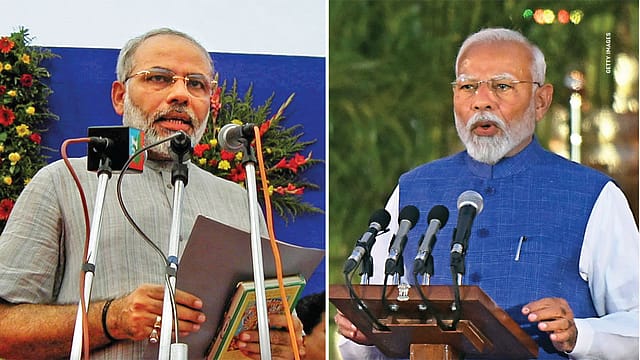
AFTER HE became Gujarat chief minister on October 7, 2001, Narendra Modi immersed himself in fulfilling a destiny that beckoned him for long. Tumult within the Gujarat BJP following the “Hajuria- Khajuria” divide in 1995 saw Modi move out of the state for several years as central leaders tried to put a lid on internal power struggles. His absence however failed to restore order and as the Keshubhai government struggled to deal with the aftermath of the January 26, 2001 Bhuj earthquake, the BJP brass turned to Modi.
Modi began by leading a massive rehabilitation of Kutch that saw the construction of modern infrastructure and reconstruction of thousands of homes. Seeing an opportunity in the adverse situation, he decided the region could be transformed into a hub of modern agriculture while modern ports opened windows to the world. Many years later, inaugurating development projects on May 26, 2025, Modi said mangoes, dates, pomegranates, cumin and dragon fruit from Kutch are reaching global markets marking the metamorphosis of a region where forced migration was once common.
The torching of coach S6 of Sabarmati Express and death of 59 passengers, including women and children on February 27, 2001, at Godhra and the subsequent communal riots tested Modi in every way. Years of litigation followed before a special investigation team (SIT) appointed by the Supreme Court concluded in 2010 that there was no evidence that Modi failed to discharge his constitutional duties. The Supreme Court accepted the SIT’s final report submitted on February 8, 2012. BJP’s political rivals, activists and ideological opponents responded by criticising the SIT but by now Modi’s stock was rapidly rising on the national scene as a strong and decisive leader.
The “Gujarat model” gripped the national imagination ahead of the 2014 Lok Sabha election after BJP declared Modi as its prime ministerial candidate on September 13, 2013. The decision faced some resistance within BJP but the rank and file overwhelmingly favoured Modi and the Rashtriya Swayamsewak Sangh concurred. Yet, Modi’s reputation for effective governance and clean image were the result of years of relentless effort where he led by personal example. Courageous decisions, such as organising the first Vibrant Gujarat global summit in 2003 in an adverse political climate, delivering Narmada waters to arid parts of Kutch and Saurashtra, three-phase electric supply to all villages through the jyotirgram scheme were signal achievements. Modi’s modernising approach attracted business.
The 360-degree approach to governance and tenacity in the face of political challenges can explain Modi’s successful completion of 8,931 days as head of a government on March 22, first as Gujarat chief minister and then as prime minister. The landmark eclipsed the record of Sikkim leader Pawan Chamling who was chief minister between 1994 and 2019. Of course, the feat of being sworn-in as prime minister for three consecutive terms places Modi on a different pedestal altogether. Despite entrenched oppositionofthe‘liberal’opinion and continued attempts of the Manmohan Singh government to enmesh Modi in cases— even getting Central agencies to overturn their own affidavits in terror investigations— BJP won a majority on its own winning 282 seats in the 2014 Lok Sabha election, the first any party did after 1984.
Though there was plenty of evidence that Modi had fired the imagination of voters, many luminaries in India and abroad were unprepared for the development. Foreign-based academics of Indian origins wrote letters claiming to be filled with dread about India’s future.
Homegrown Modi baiters, some who had said they would leave the country if he won, found themselves in a difficult situation too. Modi is more than willing to engage in an ideological joust but while he understood the importance of the BJP-RSS cultural agenda, he focused on key governance-welfare schemes such as PM Jan Dhan bank accounts for the poor and a speedy rollout of Aadhaar-based identities. The need to reform the banking sector and legislating the Insolvency and Bankruptcy Code and formation of the National Company Law Tribunal held his attention. He also pressed on with the implementation of the “one nation, one tax” Goods and Services Tax (GST) which was finally passed by Parliament in August 2016, after being stalled in the Rajya Sabha, principally by Congress and the Left parties for close to two years.
Modi’s first term witnessed a trial by fire as Pakistan-based terrorist outfits targeted India and he responded by ordering military operations, such as the 2016 surgical strike on terror launch pads in Pakistan-occupied Kashmir and the bombardment of a Jaish training camp in Balakot in February 2019. At the same time, he significantly expanded India’s diplomatic footprint with the Gulf states and pursued close ties with the US while retaining traditional contacts with Russia. Modi’s flair for diplomacy and his ability to establish personal equations surprised Delhi’s polite crowd, which felt a ‘provincial’ leader like Modi would be out of his depth. The surprise soon turned to resentment as Modi showed no inclination to court the approval of the Lutyens’ set.
After the Modi government returned to office in 2019 with an enhanced majority, a new set of domestic and international crises erupted. The Covid global pandemic posed a potentially catastrophic threat to India’s large population and despite the ravages of the deadly second Delta wave in mid-2021, India manufactured and developed vaccines at scale and created a digital platform CoWin that successfully facilitated the administration of over 2 billion doses in 18 months. In fact, under “Vaccine Maitri”, India delivered over 300 million vaccine doses to close to 100 countries. In contrast, China with a comparable population, struggled as its reliance on prolonged lockdowns prevented immunity from developing in the general population. Even as Covid was raging, China’s aggression on the Line of Actual Control in Ladakh led to a four-year military face-off. Barely was the world emerging from the shadow of Covid, wars in Ukraine and Gaza posed new threats to the global economy and supply chains.
BJP’s failure to retain a single-party majority in the 2024 Lok Sabha election was a setback but Modi put it behind him by single-mindedly focusing on recovering lost ground in state elections. And just as BJP looked to be doing well, the segregated killings of male non-Muslim tourists in front of their families in Pahalgam on April 2015 saw Modi order India’s biggest military action against Pakistan since the 1971 war. The fierce May 7-10 exchange ended in emphatic victory for Indian arms after the successful bombing of Pakistan airfields and hits on radar stations. US President Donald Trump’s unanticipated claims to have brokered a ceasefire and Modi’s categorical rejection rocked India-US ties in a completely unexpected manner. Barely had India and US resolved their differences and a trade deal with the European Union sealed, the US and Israeli attacks on Iran disrupted all calculations.
At 75, Modi’s average work day is much more demanding than the schedule of someone half his age. His energy on the campaign trail is undiminished and it is evident that Modi has set himself several goals that indicate Chamling’s record will be surpassed by some distance.