Nandan Nilekani: Man for All Reasons
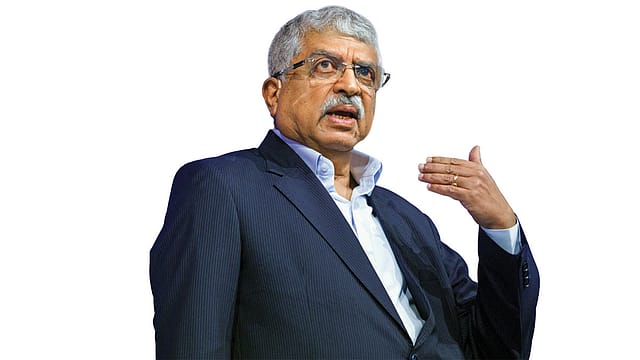
SEVENTEEN YEARS AGO, NANDAN NILEKANI almost became education minister. Rahul Gandhi offered him the job in 2009 but the offer was withdrawn. Then Manmohan Singh asked him if there was something else he might do, and Nilekani proposed taking on the identity project, an idea he had already set out in Imagining India. He joined the government in July. The first Aadhaar number was issued 14 months later.
What eluded him as office has now returned to him as a task. On July 25, then Union Education Minister Dharmendra Pradhan resigned after weeks of youth protests over examination paper leaks, organised under the banner of the Cockroach Janta Party (CJP). The next day Prime Minister Narendra Modi announced a high-powered task force on examination reforms under Nilekani’s leadership. The day after, the government introduced the Public Examinations (Prevention of Unfair Means) Amendment Bill in Lok Sabha, raising penalties for those involved in leaks.
Infosys was Nilekani’s first lesson in working with scale. He joined Patni Computer Systems in Mumbai in the 1970s, where he was interviewed by NR Narayana Murthy. He left with Murthy and five others to found Infosys in 1981. Nilekani emerged as the outward-facing strategist, the salesman, and eventually of an idea of India as a dependable home for global technology. As chief executive from 2002 to 2007, he presided over rapid global expansion, with annual revenues rising from around half a billion dollars to some three billion.
UIDAI had been notified in January 2009 under the Planning Commission and came with a formidable mandate but no machinery. When Nilekani was brought in, he recruited technologists from outside, paired them with career administrators and persuaded states, banks and private agencies to participate in the enrolment of a country. The team designed Aadhaar as a foundational identity system. UIDAI would screen each enrolment against its biometric records, issue a number to anyone who did not already have one, and authenticate the holder thereafter, leaving government departments and other authorised providers to decide which services would use it. Critics argued that once Aadhaar became a gateway to essential services, it could facilitate surveillance or exclude people whose authentication failed. Nilekani nevertheless pushed enrolment quickly, knowing that political support might not last. By the time he left in March 2014, about 600 million people had Aadhaar numbers and government programmes had begun relying on them.
He joined Congress in March 2014, contested Bangalore South and lost to Ananth Kumar by 2,28,575 votes. Six weeks later he met Modi and Arun Jaitley and argued that Aadhaar should survive the change of government. A project BJP had attacked from the campaign stage was soon embraced.
At 71, Nilekani occupies a position almost without precedent in Indian public life. He is neither a serving bureaucrat nor an elected politician. Nor is he simply a consultant. He enters public systems for bounded missions, builds institutions and assembles people, and leaves without building a bureaucratic or electoral career. This makes him unusually portable across governments.
In Nilekani’s career, acceptability has been an instrument of power. When he returned to a divided Infosys in 2017, he explained his selection with characteristic understatement: he was “acceptable to all the parties”. What he offers is less a body of technical knowledge, which the government can buy anywhere, than the capacity to be trusted simultaneously by parties that do not trust each other.
The task force includes former ISRO chairman S Somanath, former Intelligence Bureau director Tapan Deka, IIT Madras Director V Kamakoti, former Education Secretary and CBSE chairperson Anita Karwal, and Amrit Lal Meena, the retired Bihar cadre officer who served as Union coal secretary and then as the state’s chief secretary. Nilekani’s presumed role is that of the integrator.
The panel is not the first of its kind. In June 2024, after UGC-NET was cancelled on suspicion of a breach and amid allegations of irregularities in NEET-UG, the education ministry constituted a high-level committee under former ISRO chief K Radhakrishnan. It submitted its report later that year with 101 recommendations covering the entire “Testing Life Cycle”, drawn in part from more than 37,000 responses from students and parents, and proposed a high-powered steering committee to drive implementation in mission mode. While the government says many recommendations were implemented or remained in progress, key proposals, including greater use of computer-based testing and multi-session examinations, were not fully rolled out.
“Given Nandan’s stature, it will be difficult to sidestep this task force’s recommendations,” says political scientist Sandeep Shastri, who is vice president, NITTE Education Trust. “Appointing Nandan sends an important message because he represents what it means to have a system with integrity. All his life he has worked on restoring trust in systems,” he says, adding that Nilekani has been committed to the education sector for much of his life. He co-founded EkStep with Rohini Nilekani and Shankar Maruwada to address gaps in foundational literacy and numeracy. Sunbird, the modular open-source platform developed by EkStep, became the technological foundation for DIKSHA, the government’s national platform for school education.
V Ravichandar, a civic evangelist who worked alongside Nilekani on the Bangalore Agenda Task Force and has known him for decades, says Nilekani’s style is “less advisorial and report-writing than showing a proof of concept and suggesting a scaling roadmap”. He adds, “Whatever [Nilekani] does, it will be controversial. When you are making choices for the greater good, it’s not possible to please everyone.”