MT Sarv Shakti Breaks Through: 46,000 Tonnes of LPG on the Way as Indian Tanker Clears Hormuz
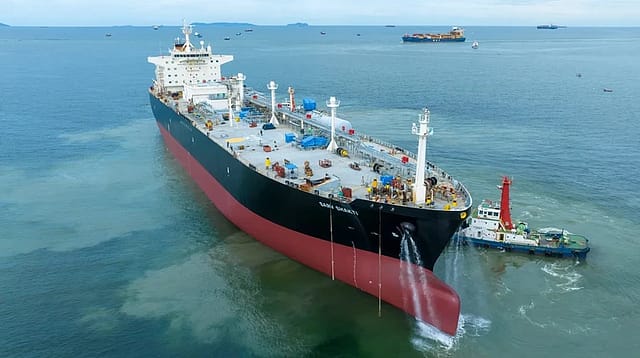
The Marshall Islands-flagged LPG carrier MT Sarv Shakti cleared the strategic Strait of Hormuz on May 2, carrying 46,313 tonnes of liquefied petroleum gas bound for India, an official statement said on Sunday, as reported by PTI.
The vessel is the first India-linked tanker to pass through the region since the recent US-led blockade targeting vessels linked to Iran.
Ship-tracking data showed the very large gas carrier's position in the Oman Gulf on Sunday evening.
Chartered by state-owned Indian Oil Corporation (IOC), it has previously made runs between the Persian Gulf and Indian ports, and is expected to reach Visakhapatnam on May 13. The vessel carries a crew of 20, including 18 Indian nationals.
The cargo, officials said, is enough to meet half a day's requirement of the country, and will partly tide over supply constraints being faced since the start of the West Asia conflict more than two months back.
Is India's LPG Supply Keeping Pace With Demand?
The Ministry of Ports, Shipping and Waterways is working closely with the Ministry of External Affairs, Indian missions and maritime stakeholders to ensure crew welfare and uninterrupted operations. No incidents involving Indian-flagged ships have been reported in the past 24 hours.

I.N.D.I.A. Falling
12 Jun 2026 - Vol 04 | Issue 75
The Unravelling of an Alliance
On the home front, the government struck a tone of vigilant reassurance.
On May 2, around 47 lakh domestic LPG cylinders were delivered against bookings of around 47.4 lakh, indicating that supplies are largely keeping pace with demand.
The Ministry of Petroleum and Natural Gas also said that "100% supply is being made to Domestic LPG, Domestic PNG and CNG (Transport)," with supply to priority segments described as uninterrupted.
Yet the strain is visible in the enforcement numbers. More than 1,900 raids were conducted across the country in a single day as the government intensified monitoring to curb hoarding and black marketing.
Penalties were imposed on 349 LPG distributorships, and 74 LPG distributorships have been suspended.
Even as these measures were announced, the ministry acknowledged that "supply of LPG to domestic households has been prioritised," a phrasing that implicitly admits pressure on other segments.
Together, the images tell a story that no single official statement does in full: a country navigating a narrow passage, not unlike the one its tanker just cleared.
Relief is slow, partial, and hard-won. MT Sarv Shakti's passage is less a triumph than a reminder of how fragile the arteries of energy trade can be.
(With inputs from ANI)