Misir Besra: The Last Politburo Man
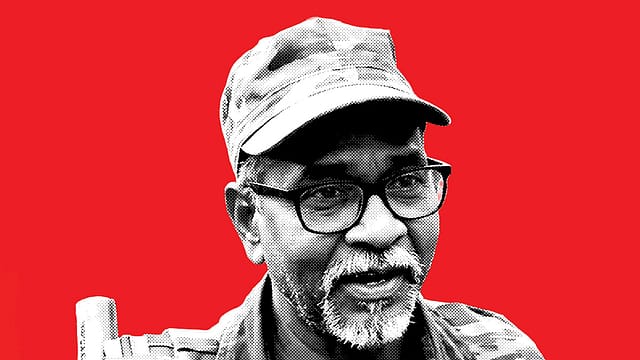
FOR NEARLY four decades, Misir Besra remained the most prominent Adivasi face of the Maoist movement.
Known by a collection of aliases—Sunirmal, Bhaskar, Pradhanji, Sagar—Besra had survived governments, massive counter-insurgency offensives, organisational splits and the deaths of almost every major leader who once defined India’s leftwing insurgency.
This week, that remarkable run came to an end.
Security forces arrested the 65-year-old Politburo member in Jharkhand’s Dhanbad district, ending one of the country’s longest manhunts. Carrying a reward of ₹1 crore and facing more than 150 criminal cases, Besra was widely regarded by security agencies as the last operational heavyweight of CPI (Maoist). His capture is not merely another arrest; it symbolises, in more ways than one, the closing chapter of a conflict that, atits height, stretchedacross what was once called the “Red Corridor”—a belt of forests and tribal districts extending from AndhraPradeshtoNepal’sborder.
Besra’s story began far from the jungles that would define his life. Born in 1960 in Madadih village in Jharkhand’s Giridih district, he grew up in an ordinary rural household. After completing his schooling, he moved to Dhanbad to study political science and, according to some accounts, Hindi litera-ture. It was a period of profound political ferment. The Jharkhand movement was gathering momentum, demanding a separate tribal state, while radical Left organisations were expanding their influence among students and young activists.
Besra later recalled witnessing the routine humiliation of tribal communities and poor villagers. Two incidents remained etched in his memory. A trader refused to pay him for Mahua flowers and threatened him with violence. In another, influential landlords attempted to carry away a jackfruit tree from his village. Besra organised local youths and physically stopped them.
Initially attracted to Shibu Soren’s Jharkhand Mukti Morcha, he gradually became disillusioned with electoral politics. Then came the turning point. In October 1985, a revolutionary cultural troupe visited his village. When the performance ended, Besra quietly left with them. He never came home again.
His wife, Monasi Devi, eventually rebuilt her life and remarried. Their son, Siddharth, told journalists that he remembers seeing his father only a handful of times before the latter disappeared permanently into the underground.
The movement Besra joined was still small and poorly equipped. Early guerrilla squads carried little more than double-barrel guns and country-made weapons. Villagers often mistook them for ordinary criminals rather than Maoist rebels. But when the Maoist Communist Centre (MCC) merged with the People’s War Group in 2004 to create CPI (Maoist), the insurgency acquired a unified command, stronger logistics and a coherent military doctrine.
Besra flourished in this new structure. Unlike some of the movement’s intellectual leaders, he earned his reputation as an operational planner. He joined the Central Military Commission and eventually became a Politburo member, supervising the Eastern Regional Bureau across Jharkhand, Chhattisgarh, Odisha, West Bengal and parts of Assam. He also handled military intelligence, recruitment and procurement of arms.
Investigators linked him to some of the insurgency’s deadliest operations. These included the 2003 and 2004 landmine attacks in West Singhbhum that killed dozens of security personnel, the Baliba ambush, and later operations that established CPI (Maoist) as India’s most formidable insurgent organisation. His name also surfaced repeatedly in investigations into attacks on police stations, ambushes and extortion networks that financed the movement.
Nearly two decades ago, in 2007, police arrested him almost by accident. A police team intercepted the vehicle in which he was travelling. The officers had no photograph to compare him with. Short, soft-spoken and physically unimposing, he looked nothing like the fearsome guerrilla commander described in intelligence reports. Only later did cadres identify him.
Shortly afterwards, this correspondent met him inside a Jharkhand jail, in what became his first interview with any journalist. Wrapped against the cold, he declined a cigarette with an apologetic smile. “I have quit smoking,” he said.
Nothing about him suggested the stereotype of a hardened insurgent. He spoke calmly, almost academically, about organisation, discipline and the long-term strategy of revolution. He spoke about the early days, when many recruits, he said, abandoned the movement because they could not endure life in the forests. Those who stayed often did so for reasons less ideological than practical. The organisation guaranteed food, purpose and a sense of dignity unavailable in the impoverished villages they came from.
His assessment revealed an uncomfortable truth about India’s Maoist conflict: the insurgency fed not only on political conviction but also on deep social and economic deprivation.
Besra also acknowledged that the movement had failed to expand meaningfully into India’s cities.
“Without the participation of the middle class,” he observed, “there will be no revolution.”
It was an admission that the Maoists had succeeded in creating rural insurgencies but failed to build the urban networks they believed essential for a nationwide revolution.
In August 2009, heavily armed Maoists attacked the Lakhisarai court complex in Bihar while Besra was being produced before a judge. The assault killed a policeman and enabled Besra to escape.
For the next 16 years, Besra remained elusive. As one senior leader after another was killed or arrested, the organisation steadily weakened. Roads penetrated remote forests. Mobile connectivity expanded. Intelligence networks improved dramatically. Security forces increasingly relied on precise, intelligence-led operations rather than large troop movements.Meanwhile, surrender policies persuaded hundreds of cadres to abandon the insurgency. But Besra chose not to. He retreated into Jharkhand’s Saranda forests, one of the last remaining Maoist strongholds.
His arrest now carries significance beyond the fate of one individual. Operationally, CPI (Maoist) has been reduced to almost nothing. The sprawling “Red Corridor” that once challenged the Indian state’s authority across central India has largely disappeared. In that sense, the capture of the last major Politburo commander represents the symbolic conclusion of India’s longest internal armed conflict.
But it also leaves behind a warning that the Indian state should choose not to ignore.
The Maoist movement emerged from genuine grievances—land alienation, tribal displacement, exploitation by contractors, poor governance and the absence of state institutions in remote regions. Security operations have succeeded in weakening the armed organisation. Whether those underlying conditions have been addressed remains a more complicated question. Misir Besra spent nearly 40 years trying to wage a revolution that ultimately failed. He and his comrades believed that their struggle would transform India. But they ultimately failed the people they were supposed to fight for.
Whether history remembers Misir Besra as a committed revolutionary, a ruthless insurgent or simply the last survivor of a lost cause will remain contested. What is no longer in doubt is this: with his arrest, an era has ended.