MDI Gurgaon: Innovation Is Inevitable
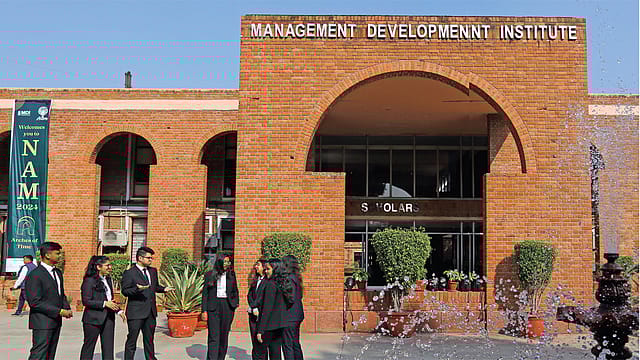
MANAGEMENT education is experiencing its greatest transformational period ever, over the next few years. The rapid development of technology, the impact of fluctuating economic conditions, the expectations of employers, and the changing roles of graduate business schools around the world have changed the way business schools are viewed by the general public. In order for institutions of learning to continue to be considered relevant today, they must not only possess rigorous academic standards but must also be able to demonstrate a commitment to innovative ideas and to prepare their students for a global business environment that is in continuous change.
MDI Gurgaon has built its foundation for leadership over five decades on excellence. The institute has long been recognised among India’s leading management schools, holding the ninth rank in the NIRF rankings, the eighth rank in India in the Financial Times ranking, and standing as the third management institution in India for custom executive education. These recognitions are not merely numbers; they reflect a sustained commitment to excellence, industry linkages, and an academic environment that encourages rigorous thinking. Our dual accreditations from AACSB and AMBA further underline this commitment and place the institute on the verge of achieving the coveted triple-crown distinction, an honour earned by fewer than 1 per cent of business schools across the world. The journey toward that distinction mirrors our focus on global standards at a time when the world of work is being reshaped at an unprecedented rate.
Over the years, the focus of management education has expanded beyond knowledge delivery, and capability building has taken centrestage. Previously, business schools were focused on theoretical frameworks and functional competency. Instead, today’s work requires a greater variety of skills: digital literacy, nimbleness, effective problem-solving, and the ability to operate effectively in uncertain circumstances.
Organisations increasingly look for professionals who can think creatively, work across domains, communicate effectively, and lead with an ethical and sustainable perspective. These evolving expectations influence how we design and refine our programmes at MDI Gurgaon. We routinely update and modify our current curriculum structure to reflect the changing needs of the industry. While the focus continues to be placed on core management areas, a greater emphasis will now be given to other courses such as Digital Business Transformation, including Artificial Intelligence Applications, Sustainable Development Strategy, Insight Behaviour, and Organisational Change.
Additionally, the experience of learning will be extremely experience-based. Case studies, real-world simulations, industry-supported projects, and capstone assignments help students apply concepts and internalise them through practice rather than memorisation. This blend of theory and experience equips them to understand real-time challenges in a corporate setting.
A strong research culture has been at the core of the institute’s mission since the founding of MDI Gurgaon. All faculty are active participants in ongoing, relevant research that contributes to current public discourse in the fields of leadership, behavioural sciences, sustainability transitions, future work, analytics and HR. Research done by faculty is not only published in academic journals but also incorporated into classroom teaching, delivered through executive programmes/ projects/consulting, and used in the various levels of activity undertaken with our partners in engaging with public policy. This approach ensures that students are exposed to insights that go beyond textbooks, grounded in the latest developments in the global economy.
INDUSTRY ENGAGEMENT IS another major pillar of our approach. What distinguishes MDI’s relationship with industry is its depth. Companies do not simply partner with us by providing students with internships. Companies partner with us to develop and design courses, create course modules, mentor student consulting groups and invite students to participate in solving real-world consulting problems. These partnerships mirror the new corporate expectation: graduates must be ready to contribute from day one.
Through continuous interaction with organisations, our students gain a realistic view of business challenges and learn how innovation, digital fluency, and strategic thinking shape organisational success.
The vibrancy of our student community contributes greatly to the learning environment. Each cohort draws students from engineering, commerce, humanities, sciences, and several other fields, making peer learning extremely rich. Such diversity exposes students to varied viewpoints, encourages open communication, and enhances cultural intelligence, qualities essential for leadership roles. Campus life extends far beyond academics. Students participate in clubs, committees, competitions, sport, and social initiatives that foster teamwork, resilience, and a sense of responsibility. These experiences help students develop a balanced and holistic personality.
THE SKILLSETS REQUIRED by modern organisations have been evolving rapidly. Digital intelligence is no longer optional; a manager must understand how AI, analytics, automation, and digital ecosystems drive organisational decisions. At the same time, innovation has become a core capability. It is anticipated that leaders will generate new ideas through experimentation and also rethink their long-held beliefs regarding how they conduct business. Flexibility across functional areas is also beginning to emerge as a standard of leaders, and businesses now look for individuals who will work collaboratively across multiple functional areas, and not just within their own area of expertise. Interpersonal and emotional intelligence also play a vital role. The ability to motivate teams, handle conflict, communicate authentically, and build trust sets apart high-potential managers from the rest. Ethics and sustainability, once considered add-ons, are now seen as essential guiding principles.
Furthermore, with globalisation making workplaces increasingly multicultural, global competence has become crucial. MDI Gurgaon’s international immersion programmes, exchange partnerships, and collaborations with universities abroad help students build this global mindset.
A brief SWOT view provides clarity on where management education stands today. Among its strengths are growing employer demand, the rising importance of analytical and digital skills, and India’s position as a developing global talent hub. These create strong openings for institutions like MDI Gurgaon that have a legacy, accreditations, and deep industry connections. The sector’s weaknesses include increasing competition from international schools, the pressure to constantly refresh curriculum, and the financial barriers some students face due to the cost of quality management education. Opportunities arisefromemergingfieldssuchasAI-driven roles, sustainability leadership, digital-first business models, and the expansion of India’s knowledge economy. At the same time, the landscape faces threats from economic fluctuations, technological disruption, changesinemployerexpectations, and the need for continuous faculty upskilling.
MDI Gurgaon’s strategy is built around responding to this changing environment. We are strengthening our research ecosystem, deepening global partnerships, enhancing digital learning tools, and expanding opportunities for experiential and project-based learning. Our initiatives in student wellbeing, community engagement and leadership development ensure that students graduate not only with competence but also with empathy and resilience. The focus on industry collaboration remains strong, with new sectoral labs, practice-led learning environments and joint academic endeavours in development.
As India’s economic status continues its upward transition to an emerging economic giant, business schools must become the backbone for training and developing our future leaders. The contributions of business schools are much broader than just their contributions to intellectual growth; they are also responsible for developing professionals who can quickly adapt, behave in a manner that is ethical and act as global thinkers. The main purpose of MDI Gurgaon is to fulfil this mission; to this end, we are dedicated to achieving these goals through providing students with a quality education that is skill-oriented and relevant throughout the world, as well as developing individuals into leaders who will take an active and positive role in society.
The future will belong to institutions that blend intellectual depth with practical insight, global perspective with local understanding, and technological capability with human-centred values. MDI Gurgaon stands prepared for this future, steadily progressing, continuously improving, and dedicated to empowering the next generation of management leaders.